PuniCodex

Extended Lore

하나님 Hwanin

Etymology · Orthography · Cult · Iconography · Reception · Sources

Tier 2 Hwanin
Hwanin — Supreme God, Heaven
01

Quick Facts

Essential information about Hwanin, Supreme God, Heaven

Original Script하나님
Unicode RestorationHwanin
Reconstructed Pronunciation/hwa.nin/
PantheonKorean
DomainSupreme God, Heaven
MeaningLord of Heaven
ClassificationTier 2
Primary DomainHwanin
Sacred SymbolsThe heavens, The sandalwood tree, The heavenly seal, Sun and moon, Mugwort and garlic
02

Etymology & Word Family

From original script to Unicode restoration

Original Script 하나님 Hwanin — "Lord of Heaven"
Unicode Restoration Hwanin Canonical scholarly spelling — ASCII-identical
Modern ASCII hananim Plain-ASCII fallback

The name Hwanin reaches the modern world through scholarly transliteration of the korean tradition. Because the conventional spelling uses only Latin letters, its Unicode and ASCII forms coincide — the tradition it carries is in the name itself, not in diacritics.

03

Unicode Character Breakdown

Character-by-character philological analysis

CharacterUnicodeNameBlockPhonetic Role
HU+0048Latin Capital Letter HBasic LatinSame, capitalized
wU+0077Latin Small Letter WBasic LatinSpecial character
aU+0061Latin Small Letter ABasic LatinSpecial character
nU+006ELatin Small Letter NBasic LatinSpecial character
iU+0069Latin Small Letter IBasic LatinSpecial character
nU+006ELatin Small Letter NBasic LatinSpecial character
—N/ADropped characterKorean orthographyDropped

The Tier 2 classification here reflects fidelity to the attested tradition, not recovered diacritics: every character of Hwanin already survives in ASCII. What the restoration preserves is the canonical spelling itself — the form scholarship standardised.

04

Cult & Worship

How the sacred was kept — rites, sanctuaries, remains

The Cult

No ancient cult of Hwanin is attested. As the celestial father in the Dangun foundation myth, he belongs to a mythological genealogy—Hwanin, Hwanung, Dangun—rather than to an excavated temple or priesthood. Later Korean religious history mapped the name onto the high god of heaven: the term Hananim was adopted by nineteenth-century Korean Christians as a vernacular name for the biblical God, while Ch'oe Che-u's Donghak movement spoke of Haneullim. The cult is therefore a retrospective and adaptive one, reshaped by each era that needed a Korean name for supreme heaven.

In the Earth

Because Hwanin belongs to a late-written myth rather than an excavated cult, his 'archaeology' is the archaeology of the myth's own survival and projection. The Samguk Yusa survives in early manuscripts of 1390 and 1512; the Dangun narrative it records was projected backward into art by the Goguryeo tomb murals of the fourth–sixth centuries CE, where celestial courts, sun-and-moon deities, and sacred-tree imagery painted on the ceilings of the Ji'an-area tombs give visual form to the same heavenly order that sends a son down to earth. In modern times the association of the myth's 'sacred sandalwood' with the slopes of Baekdusan — inferred, not stated, from the Samguk Yusa's Taebaeksan — has fixed Hwanin's descent-point on the peninsula's most symbolically charged mountain, and Dangun's traditional tomb is maintained as a shrine near Pyongyang, visited by Koreans from both North and South.

05

Iconography

How Hwanin was imaged across the ages

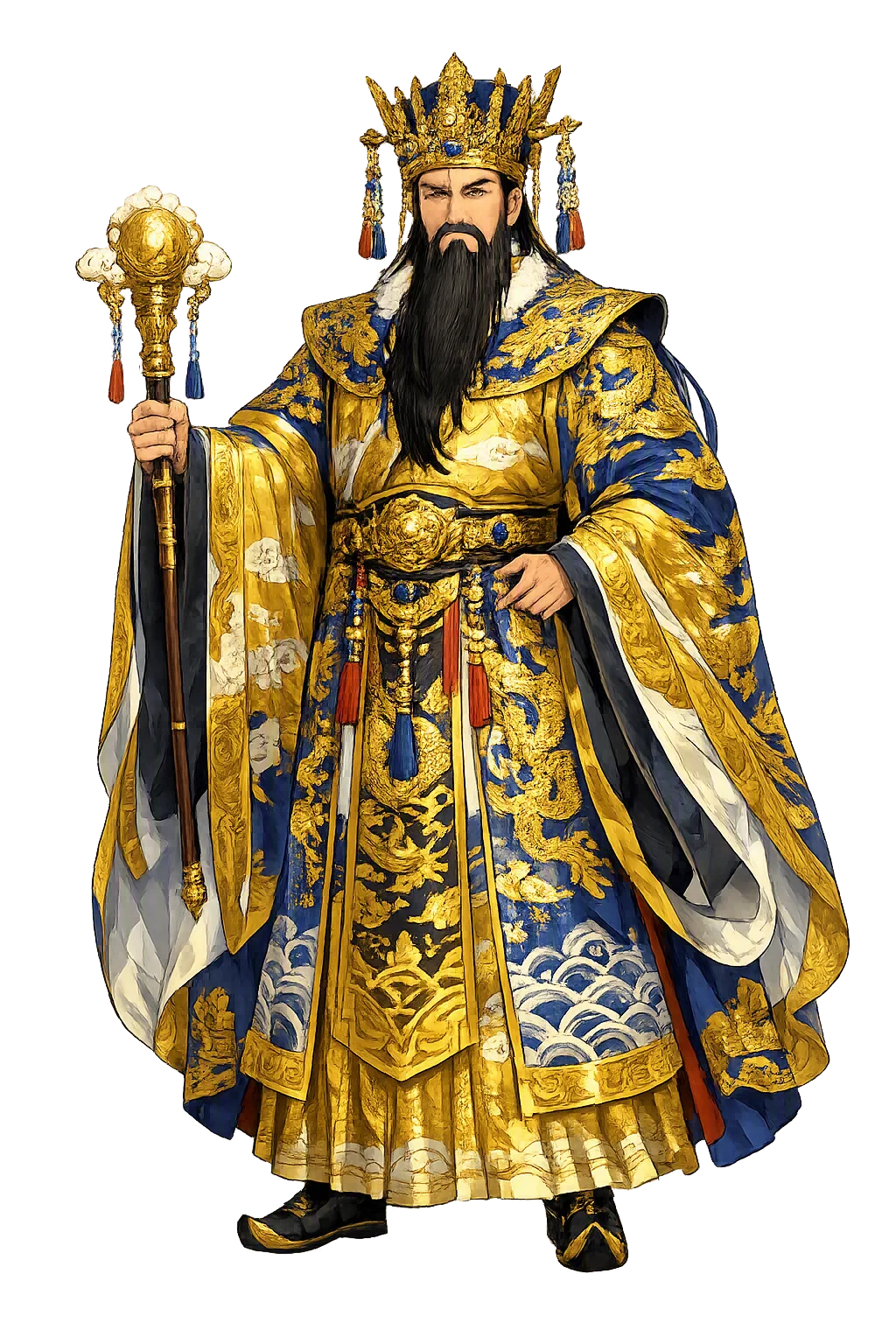
The Image

Hwanin has no pre-modern visual tradition. The Goguryeo tomb murals of the fourth to sixth centuries CE show celestial courts, sun-and-moon deities, and mountain gods that the later Dangun myth claimed as its setting, but they do not name or portray Hwanin. Iconography is modern and didactic: textbook diagrams of the heavenly descent, Christian Sunday-school images of Hananim, and nationalist art illustrating the three generations of the Korean foundation myth. The figure remains a name and a cosmology more than a visual type.

06

Reception & Transformation

The name after its own age — transmission, translation, survival

Afterlives

Hwanin reaches the historical record only in Iryeon's 1281 Samguk Yusa, which preserves a much older oral narrative of heavenly descent. The name's later career is one of translation: Joseon Neo-Confucians read the myth as moral allegory; nineteenth-century Korean Catholics and Protestants seized Hananim as the indigenous word for God, a move still debated by theologians; the Donghak religion reinterpreted the high heaven as an immanent divine presence within humanity. Modern nationalist historiography has treated the Dangun genealogy as a charter of Korean antiquity, while critical scholarship reads Hwanin as a medieval projection of a sky-god figure common to Altaic and East Asian cosmologies. The name has also been adopted by new religious movements seeking a native Korean high god. His afterlife is thus largely philological, theological, and nationalist.

Identifications Across Traditions

Hwanin entered Korean religion on two tracks at once. The Samguk Yusa itself glosses Hwanin as Indra — the Buddhist Śakra, lord of heaven — folding the Korean celestial father into the Sanskrit cosmology that Buddhism carried east. In the twentieth century the vernacular title Hananim became the standard Korean Christian name for God, so that Protestant congregations prayed to a word that had once named the father of Hwanung. In shamanic and nationalist discourse Hwanin remains the mythic ancestor of the Korean people; the Daejonggyo movement, founded in 1909, worshipped Dangun and, through him, the heaven that sent him. Confucian interpreters read the celestial hierarchy as an ethical model of good government. All these traditions keep one constant: Korea's legitimacy descends from heaven, whatever costume the Lord of Heaven wears.

Modern Legacy

Hwanin survives in Korean public life chiefly through the Dangun myth, which is taught in schools, celebrated on National Foundation Day (Gaecheonjeol, 3 October), and invoked in discussions of Korean identity on both sides of the peninsula. The name Hananim remains one of the most common words for God in Korean Christianity — it is the word Korean Bibles print for the biblical God — while Hwanin continues to appear in scholarly reconstructions of early Korean religion, in museum exhibitions on Gojoseon, and in cultural diplomacy that presents Korea as a nation with ancient, heaven-blessed foundations.

07

The Meditation

What Hwanin means — beyond the dictionary

Hwanin is a god known almost entirely through his absence from the story he frames. He never descends; he appoints, seals, and sends. The active divine work of the Korean foundation myth is done by his son and grandson — Hwanung who rules beneath the sandalwood tree, Dangun who founds the state — while Hwanin remains above, the unmoved source of a moved world. That structure is the myth's theology in miniature: heaven does not administer the earth directly but delegates, authorizes, and watches, and legitimacy on the peninsula is real only insofar as it can trace that delegation back upward to its source.

The restoration of the name matters in the same register. 'Hananim' in ASCII flattens a title — the Lord of Heaven, 환인, 桓因 — into a string a registrar can process; Hwanin restores the capital, the characters, and the centuries-old claim that a Korean word can carry the highest meaning in the language: the Christian God, the shamanic ancestor, and the bureaucratic father of kings all live inside it at once.

08

Frequently Asked Questions

Common questions about Hwanin, Supreme God, Heaven, and Unicode restoration

01How do you pronounce Hwanin?

In reconstructed pronunciation, Hwanin is /hwa.nin/ — approximately 'HWAH-neen' — in the Korean reading the first syllable is pronounced with rounded lips and the second is short and level. The scholarly form Hwanin preserves the capital that marks a proper name; the ASCII form hananim is an older romanisation still used in domain names.

02What does Hwanin mean?

Hwanin means Lord of Heaven in the korean tradition.

03What are the symbols of Hwanin?

Hwanin is associated with The heavens (The celestial realm from which Hwanin dispenses authority and blessing.), The sandalwood tree (The axis linking heaven and earth in the Dangun myth; the place where Hwanung alighted on Taebaeksan.), The heavenly seal (The token of delegated authority that Hwanin gives to Hwanung — the warrant without which the descent is illegitimate.), Sun and moon (Celestial emblems of the luminous, ordering presence of heaven.), Mugwort and garlic (The hundred-day food of the bear-woman — the austere diet that turns a beast into the ancestress of the Korean people.).

04Why restore Hwanin in Unicode?

Hwanin is written entirely in ASCII letters, so its restoration is about canonical fidelity rather than recovered diacritics: the temple fixes the name in its scholarly standard spelling, attested in the source tradition, instead of leaving it to drift.

05What is the most important myth about Hwanin?

“The Lord of Heaven Sends His Son” — the Samguk Yusa story that anchors the mythology of Hwanin, told in full on the lore page.

09

Scholarly Sources

The philological foundations of this restoration

Every claim on this page is grounded in established scholarship. The orthographic restorations follow disciplinary convention. The etymological chain follows the best available reference works. This is not invention — it is resurrection through scholarship.

◈

Lexicography & Philology

  • Samguk Yusa
  • Korean folklore
◎

Primary Texts

  • Primary sources in the korean tradition for Hwanin.
◉

Archaeology & Art History

  • Material evidence — iconography, inscriptions, and temple archaeology — for Hwanin and related cults.
✦

Religious Studies

  • Iryeon, Samguk Yusa (Memorabilia of the Three Kingdoms), 1281; English trans. Ha Tae-Hung and Grafton K. Mintz (1972).
  • Lee, Peter H., ed., Sourcebook of Korean Civilization, vol. 1 (Columbia University Press, 1993).
  • Grayson, James H., Korea: A Religious History (Clarendon Press, 1989).
  • Kim Won-yong, The Arts of Korea (Kodansha International, 1979) — Goguryeo tomb murals and the visual culture of heavenly cosmology.
Return

The Surface Awaits

You have traced the name from its earliest attestation to its Unicode restoration. Now return to the myth. The story is where the name lives.

Back to Lore
Hwanin mascot