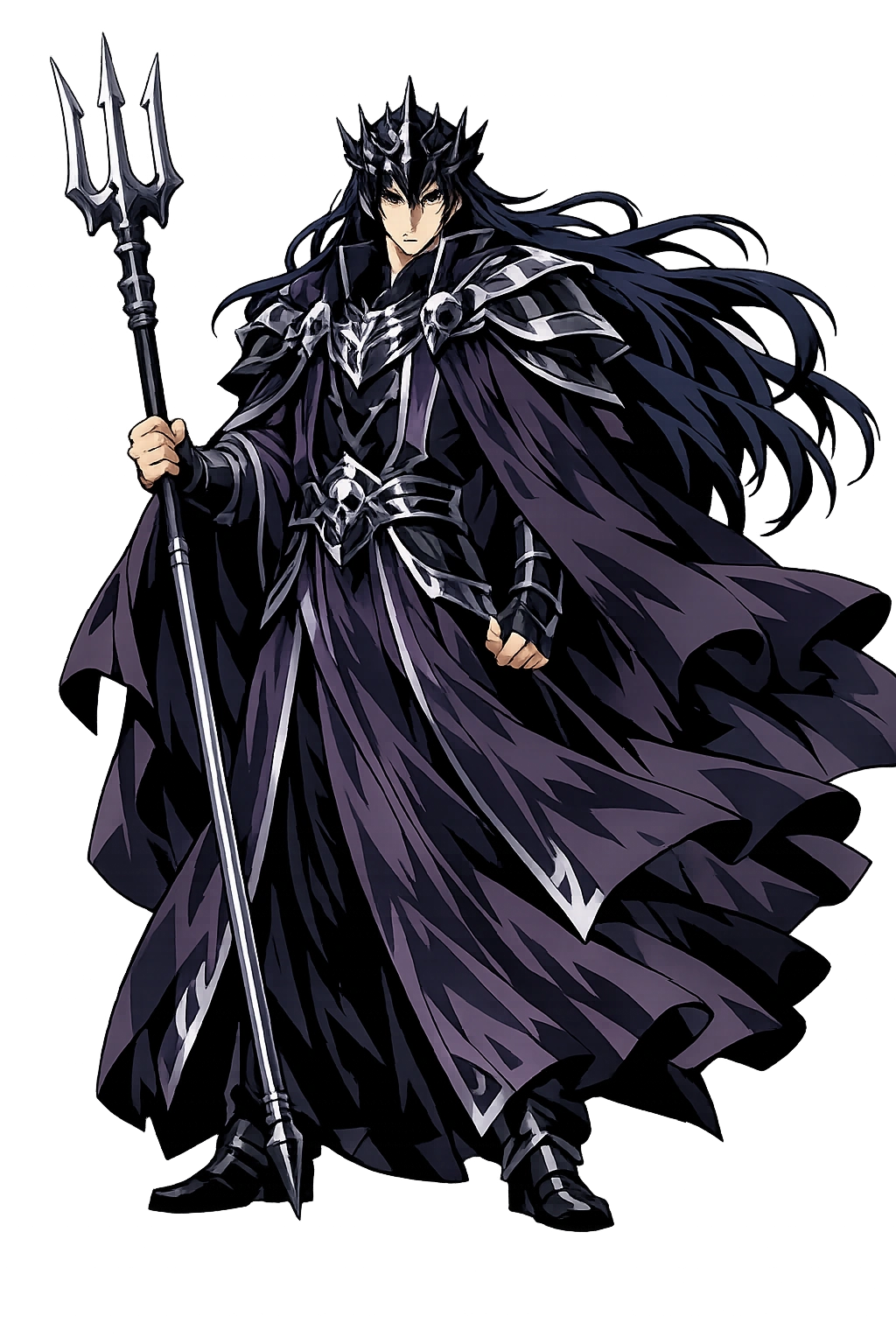
Stories of Hádēs
Hádēs appears rarely in Greek myth because his realm is separate from the world of the living — and the Greeks preferred it that way. His stories all concern the boundary: how Persephonē crossed it, how Orpheus almost crossed back, and why the door only opens inward.
The Homeric Hymn to Demeter gives the underworld its founding story. Persephonē, daughter of Demeter, was gathering flowers — roses, crocus, violets, and 'the wondrous narcissus, a trap planted by Zeus to please Hades' (5–15) — when the earth gaped and Hádēs burst up in his golden chariot 'with the consent of Zeus' and carried her down, 'weeping and crying aloud' (30–32). No one heard her — no god, no mortal; only Hekátē, from her cave, and the Sun, whose testimony later convicts the sky (24–32, 62–90). Demeter's grief stopped the seasons: seed lay hidden, famine stalked the fields, and humanity faced extinction. The settlement brokered by Zeus splits the year — two-thirds above with her mother, one-third below — 'and while she is with the strong king below, the fields are barren' (399–413, 441–470). The myth is read variously: abduction, arranged marriage, seasonal allegory. What it never forgets is that the arrangement had to be negotiated with the daughter's consent — and that the dead, like the seed, must be buried before anything grows.
What happens after the ferryman? The developed tradition — later than Homer, who knows only the dreary meadow of Asphodel — gives the dead three judges: Minos, whom Homer already sees 'holding a golden scepter, dealing judgments among the dead' (Odyssey 11.568–571); Rhadamanthys, who in the Odyssey rules in the Elysian plain (4.564); and Aiakos, keeper of the keys. Plato's Socrates (Gorgias 523e–524a) rationalizes the office with his usual irony: the judges must be naked souls judging naked souls, stripped of the wealth and fine clothes that corrupt verdicts above. The good go to the Isles of the Blessed, the curable to purification, the incurable to Tartarus. Hádēs himself is barely in these scenes — and that is the point: the underworld runs on procedure, not passion. In no other god's realm is law so absolute; the king who owns everything interferes with almost nothing.
The musician Orpheus descended to bring back Eurydikē, bitten by a snake on her wedding day. Vergil (Georgics 4.453–527) gives the canonical scene: Orpheus charms Kérberos to stillness and moves the very halls of Dis, until 'the bloodless shades... wept' — and Hádēs and Persephonē grant the condition: lead her up, but do not look back. At the threshold, love and doubt collide; Orpheus turns, and 'she cried out farewell... as down she fled'. Ovid (Metamorphoses 10.1–63) adds the detail that Hades wept — the god who receives everyone unmoved was moved by song. The versions differ on who set the condition and whether Eurydikē was ever really following; the meaning holds in all of them. The law of the dead is not cruelty but the last law that cannot bend — even for the man who made the stones weep and the king of shadows shed a tear.
Among the Cyclopes' three gifts to the sons of Krónos was a helmet for Hádēs that makes its wearer unseen — and the god, who is himself 'the Unseen', occasionally lends out his own nature. In the Iliad (5.844–845), Athēnâ 'placed on her head the cap of Hades' to confront Árēs without being seen; Apollodorus (2.4.2) sends Perseus down to fetch the same helmet for his assault on the Gorgons, along with the winged sandals and the kibisis. The object literalizes the god's theology: his power is the power of not being perceived. Greek religion kept Hádēs almost entirely out of temples and cult — no Olympian share of the cosmos, no throne on Olympus, almost no prayer addressed to him — because to see him was already to have crossed his line. His helmet lets the living borrow, briefly, the dead's defining condition: present, and unperceived.
The boldest attempt on the underworld was a marriage plot. Theseus and Peirithoös, having sworn to wed daughters of Zeus, descended to Hádēs' halls to claim Persephonē herself — for Peirithoös, the proudest match in the cosmos. The god received them with the hospitality of the damned: seats were offered, and the seats took hold of them; the 'chair of forgetfulness' bound them fast (Apollodorus, Epitome 1.23–24; Diodorus 4.63). Hēraklēs, come on his own mission to fetch Kérberos, tore Theseus free — leaving pieces of the chair, and by some accounts pieces of Theseus, behind; Peirithoös, who had planned the abduction, stayed forever. The story is a parody of courtship that ends as a parable: the underworld's hospitality is irreversible. Hádēs does not pursue sinners and punishes almost no one himself; he simply never lets go. The intruders' crime was not wickedness but scale — they tried to steal from the one god whose property is everything and whose door only opens inward.
The Dead, Wealth, and the Underworld
Hádēs is the necessary god — the one everyone meets and no one chooses. Not evil and not a devil, he is the impartial king of the dead, the lord beneath the earth from whose realm nothing returns unchanged. His myths concern the boundary between life and death: who may cross it, at what price, and why the boundary must hold.
Not a place of torment but the common destination of all mortals, ruled with strict impartiality.
As Plouton he owns gold, silver, and the fertility that rises from below — riches and graves in one vault.
A place of shadow, gates, and the three-headed Kérberos, who allows entry but not exit.
Unlike other gods, Hádēs almost never intervenes in human affairs; his realm runs on procedure, not passion.
From the original script to the living URL
Ἅιδης
The name in its original Greek form. Hádēs (Ἅιδης) is attested in the source tradition — “The Unseen One (from ἀ- + εἶδον)”. Its long vowels and acute accents carry the full phonetic and orthographic weight of the source tradition.
hades
Reduced to plain hades, the name loses everything that made it specific: long vowels and acute accents. What remains is an ASCII string that machines can parse but that no longer speaks with its original voice.
Hádēs
The Unicode restoration recovers what ASCII flattened. Hádēs restores long vowels and acute accents, returning the name to its original written dignity. The domain encodes to Punycode, but the browser displays the truth.
Hádēs.com → xn--hds-ela5w.com
The non-ASCII characters in Hádēs are encoded while the ASCII remains visible. To the DNS, it is Punycode. To humanity, it is Hádēs.
Owned, ideal, and ASCII forms of Hádēs
Hádēs
Restores Ἅιδης. The live temple domain — hádēs.com.
hades
Flattens Ἅιδης. The plain ASCII fallback — what DNS and legacy systems see.
How Hádēs was spoken
How Hádēs travels from ancient script to the modern URL
Greek Ἅιδης; from ἀ- “un-" + εἶδον “to see", hence “the unseen one".
Underworld, Wealth
The Unicode restoration Hádēs preserves Greek stress and length; the ASCII form hades loses these features.
The lore you have read is the living myth. Extended Lore opens the scholarly vault beneath it: the cult and its material remains, a history of the image, the name after antiquity, a meditation on what the name still means, and the full scholarly apparatus — etymology, orthography, sources.
Enter Extended Lore