PuniCodex

Extended Lore

八幡 Hachiman

Etymology · Orthography · Cult · Iconography · Reception · Sources

Tier 2 Hachiman
Hachiman — War, Archery, Protection
01

Quick Facts

Essential information about Hachiman, War, Archery, Protection

Original Script八幡
Unicode RestorationHachiman
Reconstructed Pronunciation/ha.tɕi.ma.ɴ/
PantheonJapanese
DomainWar, Archery, Protection
MeaningEight banners
ClassificationTier 2
Primary DomainHachiman
Sacred SymbolsEight banners, Bow and arrow, White dove, Helmet and armor
02

Etymology & Word Family

From original script to Unicode restoration

Original Script 八幡 Hachiman — "Eight banners"
Unicode Restoration Hachiman Canonical scholarly spelling — ASCII-identical
Modern ASCII hachiman Plain-ASCII fallback

The name Hachiman reaches the modern world through scholarly transliteration of the japanese tradition. Because the conventional spelling uses only Latin letters, its Unicode and ASCII forms coincide — the tradition it carries is in the name itself, not in diacritics.

03

Unicode Character Breakdown

Character-by-character philological analysis

CharacterUnicodeNameBlockPhonetic Role
HU+0048Latin Capital Letter HBasic LatinSame
aU+0061Latin Small Letter ABasic LatinSame
cU+0063Latin Small Letter CBasic LatinSame
hU+0068Latin Small Letter HBasic LatinSame
iU+0069Latin Small Letter IBasic LatinSame
mU+006DLatin Small Letter MBasic LatinSame
aU+0061Latin Small Letter ABasic LatinSame
nU+006ELatin Small Letter NBasic LatinSame

The Tier 2 classification here reflects fidelity to the attested tradition, not recovered diacritics: every character of Hachiman already survives in ASCII. What the restoration preserves is the canonical spelling itself — the form scholarship standardised.

04

Cult & Worship

How the sacred was kept — rites, sanctuaries, remains

The Cult

Hachiman's cult was a state affair from the start. His head shrine at Usa in Kyūshū — three sanctuaries in the distinctive Hachiman-zukuri style — anchored a grand festival and, more consequentially, an oracle: for centuries the court consulted Usa on succession, rebellion, and the casting of the Great Buddha, and the answers moved armies. Iwashimizu, founded south of the capital in 859–60 after an oracle chose the site, was tended as a shrine-temple complex by Buddhist clergy — the medieval jingūji pattern — and its network carried his name along the Inland Sea. Below the great houses, branch shrines multiplied by kanjō invitation until Hachiman altars stood in nearly every province. Peasants prayed to him for harvest and protection; archers for aim; the state for victory.

In the Earth

Usa Jingū in Ōita is Hachiman's head shrine, with a documented history running from the eighth century in shrine records and excavation. Iwashimizu Hachimangū near Kyōto was founded in 860 as the capital's guardian shrine, and its mountain site preserves the medieval pilgrimage routes. Tōdai-ji's Hachiman shrine preserves the Buddhist-Shinto synthesis of the Nara period in situ, and Tsurugaoka Hachimangū at Kamakura — established 1063, relocated 1191 — is the great medieval monument of his cult, its long approach lined to this day with the banners of his name.

05

Iconography

How Hachiman was imaged across the ages

The Image

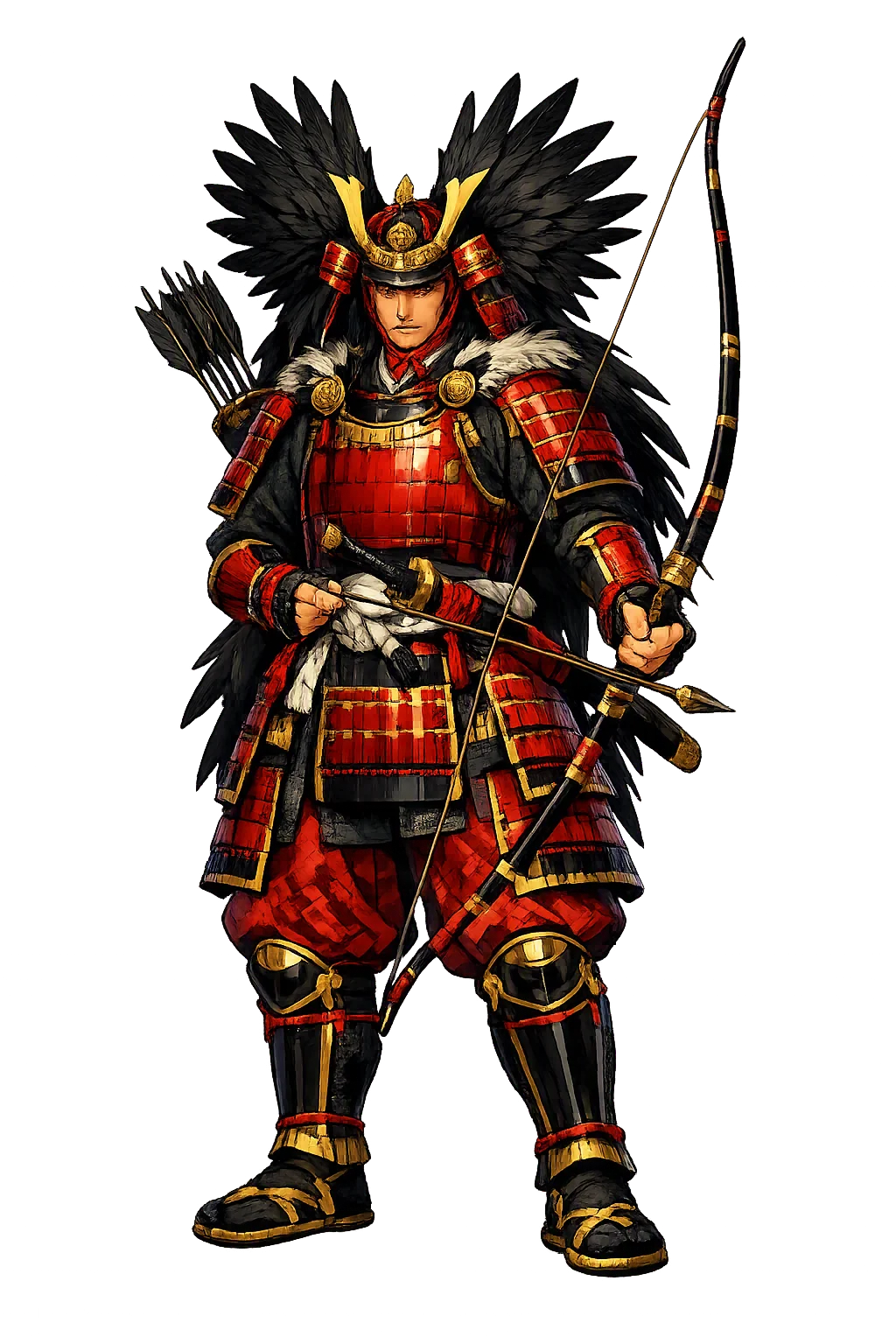
Hachiman's images wear two bodies. In his most characteristic early form he is a Buddhist monk — sōgyō Hachiman, 'Hachiman in monk's guise' — the Nara-period statues showing the war god in priestly robes, preaching rather than fighting; the celebrated eighth-century example is preserved at Tōdaiji. In his other body he is the armed bowman, helmeted, the eight banners behind him — the face of the medieval samurai cult, fixed in painting and on the ema plaques warriors left at his shrines. Helmets and armor offered by grateful Minamoto generals still fill Iwashimizu's treasure house, gratitude made metal. And around every image stands the architecture itself: the Hachiman-zukuri gable is unique to his cult and marks one of his shrines from a mile off.

06

Reception & Transformation

The name after its own age — transmission, translation, survival

Afterlives

Hachiman's afterlife is entangled with Japan's own. The medieval period made him a national institution — medieval shrine rankings placed Iwashimizu at the head of the twenty-two great shrines — and his cult rode the warrior age into the shogunate's founding city. Edo-period nativist scholars reopened the question of who he really was: the kokugaku critics argued the bodhisattva trappings were accretion and the deified emperor the truth, and historians still debate whether the kami took his name from the Usa country or the country from him. Postwar scholarship has been reversing the flattening: Kuroda Toshio's kenmitsu taisei theory of medieval religion made the Hachiman cult at Iwashimizu one of its load-bearing examples, and the shrine archives of Usa and Kamakura are now read as windows into the whole combinatory age. The god who protects a nation has kept every costume he ever wore.

Identifications Across Traditions

Hachiman is the archetype of shinbutsu shūgō, the medieval blending of kami and Buddhist cult. As Emperor Ōjin he is human, ancestral and imperial; as Hachiman Daibosatsu he is a bodhisattva — the first kami the national chronicles style a bosatsu — compassionate, universal and warlike at once. This double identity made him indispensable to the samurai state: the Minamoto claimed him as clan ancestor (ujigami) and patron, and the great medieval temples housed his shrines as their guardian chapels. The Meiji separation of Shinto and Buddhism in 1868 forcibly divided what had been one ritual body for a millennium — the bodhisattva title shelved, the shrines reclassified — yet the union survives in popular practice, where a visit to Tsurugaoka Hachimangū is at once a shrine rite and a memory of the Daibosatsu.

Modern Legacy

Hachiman shrines are found throughout Japan, from the head shrine Usa Jingū in Ōita and Iwashimizu Hachimangū south of Kyōto to the great Tsurugaoka Hachimangū at Kamakura — founded by Minamoto no Yoriyoshi in 1063 and moved to its present site by Yoritomo in 1191 as the shrine of the shogunate's own city. He remains the tutelary kami of the Minamoto line and of countless warrior houses, and his September festival at Kamakura is among the grandest shrine rites in the country. Archers invoke him, sumo honors him, and his dove still serves as his messenger on shrine crests, festival floats and military insignia. In the twentieth century his name was borrowed for battleships and war bonds; in the twenty-first he has quietly resumed his older role — the god who protects a nation rather than a war.

07

The Meditation

What Hachiman means — beyond the dictionary

Hachiman asks what it means to fight with divine sanction. He is not a god of aggression but of protection — the warrior who defends the realm. His eight banners remind us that war, when it comes, should be ordered, ritualized, and directed toward preservation rather than conquest.

08

Frequently Asked Questions

Common questions about Hachiman, War, Archery, Protection, and Unicode restoration

01How do you pronounce Hachiman?

In reconstructed pronunciation, Hachiman is /ha.tɕi.ma.ɴ/ — approximately 'HAH-chee-mahn' — the 'ch' is crisp, and the final 'n' is a soft closed nasal.

02What does Hachiman mean?

Hachiman means Eight banners in the japanese tradition.

03What are the symbols of Hachiman?

Hachiman is associated with Eight banners (The ritual standards from which his name derives — the eight flags of the divine birth), Bow and arrow (Attributes of his role as patron of archery and of the disciplined warrior), White dove (His messenger, said to descend where his protection rests; the dove still marks his shrine emblems), Helmet and armor (The martial regalia of the deified emperor — a god who fights as a soldier, not a force of nature).

04Why restore Hachiman in Unicode?

Hachiman is written entirely in ASCII letters, so its restoration is about canonical fidelity rather than recovered diacritics: the temple fixes the name in its scholarly standard spelling, attested in the source tradition, instead of leaving it to drift.

05What is the most important myth about Hachiman?

“The Divine Child of the Campaign” — the The Deified Emperor story that anchors the mythology of Hachiman, told in full on the lore page.

09

Scholarly Sources

The philological foundations of this restoration

Every claim on this page is grounded in established scholarship. The orthographic restorations follow disciplinary convention. The etymological chain follows the best available reference works. This is not invention — it is resurrection through scholarship.

◈

Lexicography & Philology

  • Hepburn
◎

Primary Texts

◉

Archaeology & Art History

  • Material evidence — iconography, inscriptions, and temple archaeology — for Hachiman and related cults.
✦

Religious Studies

  • Shoku Nihongi — entries for 749 (casting of the Great Buddha) and 764 (Fujiwara no Nakamaro revolt)
  • Azuma Kagami — Kōan era, the Mongol invasions of 1274 and 1281
  • Grapard, The Protocol of the Gods: A Study of the Kasuga Cult in Japanese History (1988)
  • Teeuwen and Bock, eds., Shinto in History: Ways of the Kami (2010)
Return

The Surface Awaits

You have traced the name from its earliest attestation to its Unicode restoration. Now return to the myth. The story is where the name lives.

Back to Lore
Hachiman mascot