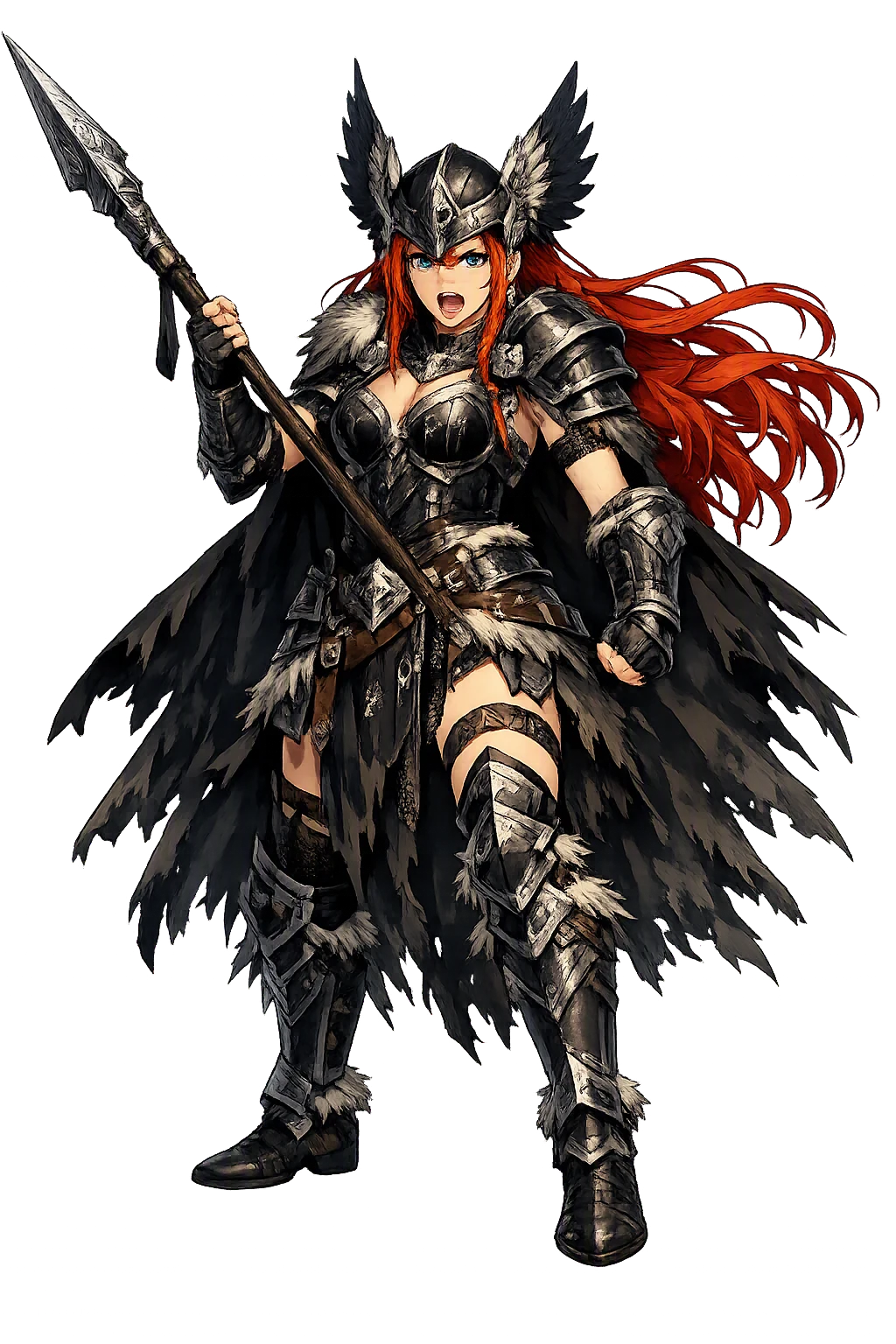
Stories of Gunnr
Gunnr has no adventure of her own; her mythology is her office, told in lists that are anything but dry. Four witnesses fix her in the corpus: the Völuspá seeress sees her ride, Snorri states her function in a single sentence, the þulur keep her name in the valkyrie roll, and the skaldic poems describe the choosing she personifies — the tradition's way of saying that battle, in the North, had a chooser, and the chooser had a name.
Deep in the völva's prophecy, between the world's making and its burning, the seeress turns her eyes to a road in the sky: 'She saw valkyries come from far and wide, ready to ride to the gods' people; Skuld held a shield, and Skögul was with her; Gunnr, Hildr, Göndul and Geirskögul — now are counted Herjan's ladies, the valkyries ready to ride over the earth' (Völuspá 30, trans. Larrington). Herjan, 'lord of hosts', is Óðinn, and the company is his household cavalry, mustered with shield and spear like a war-band rather than a flock of omens. The detail that fixes Gunnr here is sequence: she is named fourth in the most famous roll-call of the Poetic Edda, riding behind a norn carrying a shield, among spear-women ranked and armed. The seeress tells no story about her because the tradition needs none — battle with a chooser is as fixed a feature of the Norse cosmos as the norms and the doom they enforce. In this poem her whole biography is one line of a list, and the list is the point: war has personnel.
Snorri, explaining Óðinn's household to his skeptical king, gives the valkyries their job-description and Gunnr her one great sentence: Óðinn sends the valkyries to every battle, 'to allot death to men and to award victory'. Then the roll-call: 'Gunnr and Rota and the youngest norn, who is called Skuld, always ride to choose the slain and to decide the fighting' (Gylfaginning 36, trans. Faulkes). The grouping is precise and chilling — two choosers of the slain and one weaver of fate riding together, because in Norse thought the choice of the fallen and the doom of the fallen are one act seen from two sides. The same chapter fills Valhǫll with valkyries waiting, drinking-horns in hand, and Grímnismál's catalogue (st. 36) arms the mead-bearers with names like Hrist and Mist — 'shaker' and 'mist'. Snorri's Gunnr needs no adventure, because her function is the adventure of everyone else: she is what war looks like when a warrior culture refuses to call its harvest random.
The þulur — the metrical name-lists a skald learned as working vocabulary — file Gunnr among the heiti of the valkyries, and the same tradition hands her name back to the battlefield as a common noun: gunnr, 'war, battle', a word a poet could set inside a kenning. Cleasby–Vigfusson's dictionary gives both entries side by side, the woman and the war, without apology, because Old Norse poetry refuses to separate them. When a skald sang that 'Gunnr's snow' drifted on the field, his hearers were meant to catch the double exposure — snowfall and battle, the white thing that covers the slain. De Vries registers the same double filing in his etymological dictionary, and the þulur's matter-of-factness is itself the evidence: no gloss was needed, because everyone knew. The lists are usually called dry; here they are a theology in shorthand. To put battle in the feminine, give it a horse, and enter it in the god's roster of women is to personify without allegory — the word itself walks, armed, and the name it walks under is Gunnr.
No Eddic poem gives Gunnr a scene of her own, so the corpus describes her office instead — and the office is among the best-attested in Norse verse, though the honest record must say that none of these poems names her. Hákonarmál (Eyvindr skáldaspillir) sends Göndul and Skögul to weigh two kings in the balance and choose which falls; Geirskögul 'shook her spear' over Hákon's host, and the chosen king is greeted on the field by valkyries with wine. The anonymous Eiríksmál wakes the dead heroes Sigmundr and Sinfjötli because a king is coming whom the valkyries must receive in Valhǫll. Grímnismál's mead-bearers and the dying warrior's welcome — a horn from a woman's hand — are the consolation carved and cast across the Viking world, from the gilt-silver valkyrie of Hårby on Funen to the picture stones of Gotland. All of it is the meaning of gunnr when the word rides: war's harvest gathered by named women, and the fallen comforted at the moment of election. The tradition's reticence about Gunnr herself is the meaning — battle's chooser needs no biography, only a name.
Battle Made Divine — the Rider Who Chooses the Slain
Gunnr is the valkyrie whose name is the whole battlefield: Old Norse gunnr is simply the word for war, and the þulur and the Völuspá seeress set her riding among Óðinn's choosers of the slain. Snorri gives her the purest job-description in the corpus: Gunnr and Rota and the youngest norn, Skuld, always ride to choose the slain and decide battles.
The einherjar — the warriors she marks on the field and carries to Valhǫll, the harvest a valkyrie exists to gather.
Völuspá's image: Skuld held a shield and Skögul rode with her, and Gunnr, Hildr, Göndul and Geirskögul rode behind — the armed company of the god-folk.
The valkyrie's weapon and the battle's own emblem: Snorri says Gunnr, Rota and Skuld ride to every fight to award the victory.
The act her office names: val-kjósa, to choose the slain — the divine prerogative of saying who falls and who is taken.
From the original script to the living URL
ᚴᚢᚾᚾᚱ
The name in its original Norse form. Gunnr (ᚴᚢᚾᚾᚱ) is attested in the source tradition — “War”. Its original diacritics and script distinctions carry the full phonetic and orthographic weight of the source tradition.
gunnr
The plain gunnr form is identical to the Unicode restoration. Because this name is already written in Latin letters, no diacritics, stress, or script information were lost — only capitalization differs.
Gunnr
The Unicode restoration does not need to recover lost marks for Gunnr. Its value is canonical spelling and consistent cataloguing, not the reconstruction of erased orthography. The domain is readable as-is to both DNS and humanity.
Gunnr.com
This restoration is written entirely in ASCII letters — no Punycode encoding stands between Gunnr and the DNS. The domain reads identically to machines and to human eyes.
Owned, ideal, and ASCII forms of Gunnr
Gunnr
Restores ᚴᚢᚾᚾᚱ. The full Unicode restoration. gunnr.com is not in the PuniCodex collection — it is watched for release; if it drops, this temple upgrades to an owned flagship.
How Gunnr was spoken
How Gunnr travels from ancient script to the modern URL
The lore you have read is the living myth. Extended Lore opens the scholarly vault beneath it: the cult and its material remains, a history of the image, the name after antiquity, a meditation on what the name still means, and the full scholarly apparatus — etymology, orthography, sources.
Enter Extended Lore