PuniCodex

Extended Lore

Gunnr — The Deeper Record

Etymology · Orthography · Cult · Iconography · Reception · Sources

ASCII-equivalent form Gunnr
Gunnr — Valkyrie of War
01

At a Glance

Gunnr — every fact links to its home

PantheonNorse
DomainValkyrie of War
Original Scriptᚴᚢᚾᚾᛦ →
Primary Sources5 cited →
02

Etymology & Word Family

From original script to canonical restoration — the full etymology page →

Original Script ᚴᚢᚾᚾᛦ Gunnr — "War"
Canonical Restoration Gunnr Canonical scholarly spelling — ASCII-identical
Modern ASCII gunnr Plain-ASCII fallback

The name Gunnr reaches the modern world through scholarly transliteration of the norse tradition. Because the conventional spelling uses only Latin letters, its canonical and ASCII forms coincide — the tradition it carries is in the name itself, not in diacritics.

03

Character breakdown

Character-by-character philological analysis

CharacterUnicodeNameBlockPhonetic Role
GU+0047Latin Capital Letter GBasic LatinSame, capitalized
uU+0075Latin Small Letter UBasic LatinSame
nU+006ELatin Small Letter NBasic LatinSame
rU+0072Latin Small Letter RBasic LatinSame

This restoration reflects fidelity to the attested tradition, not recovered diacritics: every character of Gunnr already survives in ASCII. What the restoration preserves is the canonical spelling itself — the form scholarship standardised.

04

Cult & Worship

How the sacred was kept — rites, sanctuaries, remains

The Cult

There was no cult of Gunnr and could hardly have been one: she is a function of Óðinn's household, one of the choosers of the slain, and the corpus gives her no sanctuary, festival, priest, or votive — a silence she shares with nearly every valkyrie. What the material record does show is the office without the name: the mounted woman bearing a drinking horn who receives the warrior on the Gotland picture stones, and small armed female figures such as the gilt-silver valkyrie from Hårby on Funen, prove the chooser was imagined, and perhaps propitiated, in the Viking Age. Her name itself was carved, but inside personal names — the gunnr battle-element runs through runestone anthroponymy in names like Gunnarr and Gunnhildr — the war-noun living in the naming-pool rather than on any altar.

In the Earth

Gunnr is a wholly textual figure: no runestone invokes her, no votive deposit names her, and no cult site is hers — she shares this silence with nearly all the valkyries, who were functions of Óðinn's household rather than objects of cult. The material record knows the office if not the name. Gotlandic picture stones repeatedly show a mounted warrior received by a female figure bearing a drinking horn — the so-called valkyrie-welcome motif — and small female armed figurines, above all the gilt-silver valkyrie with sword and shield found at Hårby on Funen (Denmark), prove the image's currency in the Viking Age. The textual witnesses are the Codex Regius (GKS 2365 4to, c. 1270) for Völuspá and the principal manuscripts of the Prose Edda for Gylfaginning and the þulur; the noun gunnr itself is carved on runestones within personal names, where the battle-element lives on in the anthroponymy.

05

Iconography

How Gunnr was imaged across the ages

The Image

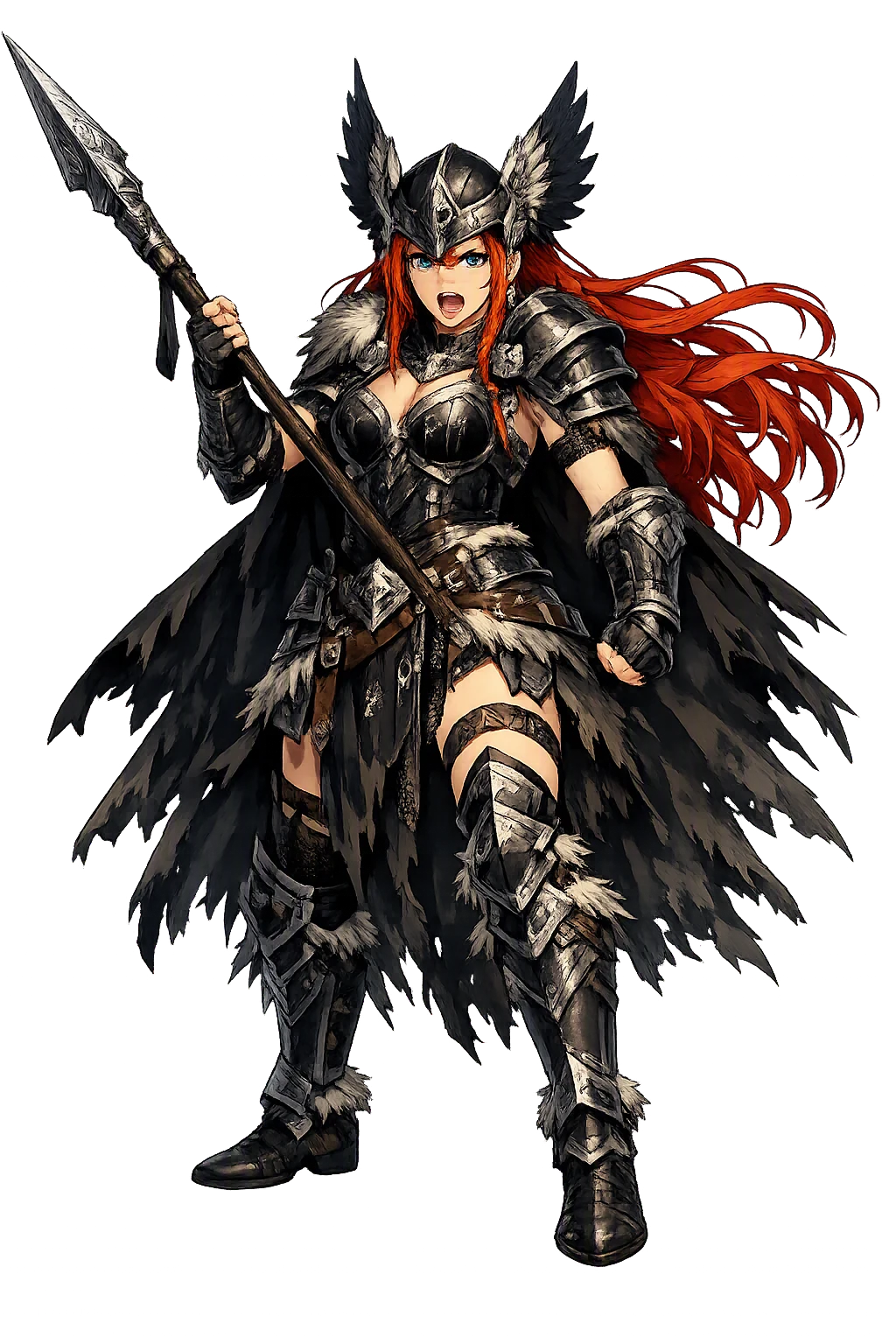
No image names Gunnr, but the type she belongs to is among the best-imaged figures of the Viking Age. Recognize her office by its kit: spear and shield, sometimes a helmet, often a horse, and above all the drinking horn with which the chosen warrior is greeted. The key surviving works are anonymous — the gilt-silver valkyrie from Hårby on Funen (c. 800, National Museum of Denmark), small enough to pin at the shoulder, sword drawn and shield braced; and the Gotland picture stones, where a rider is received by a horn-bearing woman before a hall. The Hårby figure, found in 2012, gave scholarship its first unambiguous three-dimensional valkyrie. Whether any carver meant Gunnr specifically is unknowable: her iconography is the valkyries' common uniform, and her name rides it the way it rides the battle — invisibly, and everywhere.

06

Reception & Transformation

The name after its own age — transmission, translation, survival

Afterlives

Gunnr's transmission runs through the word before it runs through the image. The Codex Regius (c. 1270) keeps Völuspá 30 and its roll-call — Skuld's shield, then Gunnr fourth among Herjan's ladies; Snorri's Gylfaginning gives her the one great sentence about choosing the slain; and the þulur kept her name in the working vocabulary every skald learned. Because her name is the common noun gunnr, war, the reception is linguistic as much as literary: the word runs through skaldic kennings as a plain noun, and the battle-element passed down the Germanic naming tradition — Old English gūþ in Beowulf, Old High German gund- in names like Hildegund, and the unbroken Scandinavian women's name Gunnur, still given in Iceland. Nineteenth-century mythography made the valkyrie a Romantic figure and Gunnr the standing example of the Norse personified abstraction — war itself, named and riding — a framing the modern handbooks of Simek, Orchard, and Lindow still teach. Her fame has always been anonymous: the face on the Hårby figurine is every valkyrie's, and the name in Völuspá's list is the one the tradition chose to keep.

Identifications Across Traditions

Gunnr's nearest kin are not borrowings but reflections. Within the Norse corpus she belongs to the tight triad Snorri names — herself, Rota, and the norn Skuld — where the valkyrie's battlefield choice and the norn's weaving of fate are one operation; Skuld carries the same office into the world of time itself. Across the sea, the Old English cognate gūþ never grew a person: Beowulf sings of gūþ as plain war, and the personification stayed Norse. Scholars comparing traditions point to the Irish Morrígan and Badb — battle-goddesses who also decide fights and choose their dead — as the closest functional parallel in the neighbouring mythology, though no historical link is provable and none need be claimed. Gunnr needs no foreign template: she is what happens when a warrior culture declines its own word for war in the feminine and gives it a horse.

Modern Legacy

Gunnr's afterlife flows through two channels. The first is the word itself: gunnr lived on as the battle-element of Scandinavian naming — Gunnarr ('warrior of battle'), Gunnhildr ('battle-fight'), and the living Icelandic and Faroese women's name Gunnur — so that the valkyrie's name is still spoken daily in the North, worn by ordinary people. The second is the image she helped fix: the armed maiden riding to the field to choose the dead, the seed from which the whole later figure of the valkyrie grew — the Valkyries of Wagner's Walküre, the shieldmaidens of modern fiction and games, and the revived valkyrie devotion of contemporary Heathenry. In scholarship she stands as the standing example of the Norse habit of personifying abstractions: not an allegory imposed on war, but war itself, named and riding.

07

The Original Script Note

What the written record preserves — and what it does not

Original Script

The normalized Old Norse form is Gunnr — already plain ASCII, with no diacritic or distinctive letter for the restoration to recover; in the Younger Futhark the name would have been carved ᚴᚢᚾᛦ (k-u-n-R, the k-rune writing g and ᛦ the final nominative -r, the doubled n written with a single rune by runic convention). Because the name is pure ASCII, its domain was registered in the ordinary way long ago: the plain-ASCII gunnr.com is held by a third party outside the PuniCodex collection and is watched for release — no form of the name is currently owned, and this temple claims none.

08

The Meditation

What Gunnr means — beyond the dictionary

Gunnr is the most honest figure in the valkyrie roll because she pretends to be nothing but what she is. Other choosers of the slain carry names of tumult, of rulership, of the spear; hers is the field itself. To say that Gunnr chooses the slain is to say that battle chooses its own — that once the spears cross, the outcome belongs to something no combatant commands. The Norse did not soften that thought; they dignified it. They gave the blind lottery of combat a rider, a rank among Óðinn's women, and a place in the seeress's vision, as if to say: what you cannot control, you can at least name. Every soldier who ever marched out knowing the choice was not his own has stood, without knowing it, in Gunnr's shadow.

09

Frequently Asked Questions

Deep-dives into the cult, attestation, reception, and sources of Gunnr

01How do we know how Gunnr was worshipped?

Gunnr is a wholly textual figure: no runestone invokes her, no votive deposit names her, and no cult site is hers — she shares this silence with nearly all the valkyries, who were functions of Óðinn's household rather than objects of cult. The full cult record →

02Where do the earliest attestations of Gunnr come from?

The record rests on Poetic Edda: Völuspá 30 (the valkyrie ride: Skuld, Skögul, Gunnr, Hildr, Göndul, Geirskögul), trans. Carolyne Larrington, Snorri Sturluson, Prose Edda: Gylfaginning 36 (Gunnr, Rota and Skuld ride to choose the slain and decide battles), trans. Anthony Faulkes, Snorri Sturluson, Prose Edda: Skáldskaparmál, þulur of valkyrie names, trans. Anthony Faulkes, among 6 cited works. The full source apparatus →

03How did later traditions reinterpret Gunnr?

Gunnr's transmission runs through the word before it runs through the image. Reception & transformation →

04What do the surviving images of Gunnr actually show?

No image names Gunnr, but the type she belongs to is among the best-imaged figures of the Viking Age. The iconography →

05What does the written record of Gunnr actually preserve?

The normalized Old Norse form is Gunnr — already plain ASCII, with no diacritic or distinctive letter for the restoration to recover; in the Younger Futhark the name would have been carved ᚴᚢᚾᛦ (k-u-n-R, the k-rune writing g and ᛦ the final nominative -r, the doubled n written with a single rune by runic convention). The Original Script note →

10

Scholarly Sources

The philological foundations of the record

Every claim on this page is grounded in established scholarship. The orthographic restorations follow disciplinary convention. The etymological chain follows the best available reference works. This is not invention — it is resurrection through scholarship.

◈

Lexicography & Philology

  • Cleasby-Vigfusson
◎

Primary Texts

  • Poetic Edda
  • Poetic Edda: Völuspá 30 (the valkyrie ride: Skuld, Skögul, Gunnr, Hildr, Göndul, Geirskögul), trans. Carolyne Larrington
  • Snorri Sturluson, Prose Edda: Gylfaginning 36 (Gunnr, Rota and Skuld ride to choose the slain and decide battles), trans. Anthony Faulkes
  • Snorri Sturluson, Prose Edda: Skáldskaparmál, þulur of valkyrie names, trans. Anthony Faulkes
  • Poetic Edda: Hákonarmál (Eyvindr skáldaspillir) and Eiríksmál (anonymous), on the choosing and the welcome of the slain; Grímnismál 36 (the mead-bearers)
◉

Archaeology & Art History

  • Foote, P., & Wilson, D. M. The Viking Achievement; Graham-Campbell, J. Viking Art.
✦

Religious Studies

  • Cleasby–Vigfusson, An Icelandic-English Dictionary, and Zoëga, A Concise Dictionary of Old Icelandic, s.v. gunnr ('war, battle'; a valkyrie)
  • de Vries, Altnordisches etymologisches Wörterbuch, s.v. gunnr; Simek, Dictionary of Northern Mythology, s.v. Gunnr, valkyries
Return

The Surface Awaits

You have traced the name from its earliest attestation to its canonical restoration. Now return to the myth. The story is where the name lives.

Back to Lore
Gunnr mascot