PuniCodex

Extended Lore

ᚴᚢᚾᚾᚱ Gunnr

Etymology · Orthography · Cult · Iconography · Reception · Sources

Tier 2 Gunnr
Gunnr — Valkyrie of War
01

Quick Facts

Essential information about Gunnr, Valkyrie of War

Original Scriptᚴᚢᚾᚾᚱ
Unicode RestorationGunnr
Reconstructed Pronunciation/ˈɡunːr̩/
PantheonNorse
DomainValkyrie of War
MeaningWar
ClassificationTier 2
Primary DomainGunnr
Sacred SymbolsThe spear, The shield of the company, The choice of the slain (valr), The name that is a noun
02

Etymology & Word Family

From original script to Unicode restoration

Original Script ᚴᚢᚾᚾᚱ Gunnr — "War"
Unicode Restoration Gunnr Canonical scholarly spelling — ASCII-identical
Modern ASCII gunnr Plain-ASCII fallback

The name Gunnr reaches the modern world through scholarly transliteration of the norse tradition. Because the conventional spelling uses only Latin letters, its Unicode and ASCII forms coincide — the tradition it carries is in the name itself, not in diacritics.

03

Unicode Character Breakdown

Character-by-character philological analysis

CharacterUnicodeNameBlockPhonetic Role
GU+0047Latin Capital Letter GBasic LatinSame, capitalized
uU+0075Latin Small Letter UBasic LatinSame
nU+006ELatin Small Letter NBasic LatinSame
rU+0072Latin Small Letter RBasic LatinSame

The Tier 2 classification here reflects fidelity to the attested tradition, not recovered diacritics: every character of Gunnr already survives in ASCII. What the restoration preserves is the canonical spelling itself — the form scholarship standardised.

04

Cult & Worship

How the sacred was kept — rites, sanctuaries, remains

The Cult

There was no cult of Gunnr and could hardly have been one: she is a function of Óðinn's household, one of the choosers of the slain, and the corpus gives her no sanctuary, festival, priest, or votive — a silence she shares with nearly every valkyrie. What the material record does show is the office without the name: the mounted woman bearing a drinking horn who receives the warrior on the Gotland picture stones, and small armed female figures such as the gilt-silver valkyrie from Hårby on Funen, prove the chooser was imagined, and perhaps propitiated, in the Viking Age. Her name itself was carved, but inside personal names — the gunnr battle-element runs through runestone anthroponymy in names like Gunnarr and Gunnhildr — the war-noun living in the naming-pool rather than on any altar.

In the Earth

Gunnr is a wholly textual figure: no runestone invokes her, no votive deposit names her, and no cult site is hers — she shares this silence with nearly all the valkyries, who were functions of Óðinn's household rather than objects of cult. The material record knows the office if not the name. Gotlandic picture stones repeatedly show a mounted warrior received by a female figure bearing a drinking horn — the so-called valkyrie-welcome motif — and small female armed figurines, above all the gilt-silver valkyrie with sword and shield found at Hårby on Funen (Denmark), prove the image's currency in the Viking Age. The textual witnesses are the Codex Regius (GKS 2365 4to, c. 1270) for Völuspá and the principal manuscripts of the Prose Edda for Gylfaginning and the þulur; the noun gunnr itself is carved on runestones within personal names, where the battle-element lives on in the anthroponymy.

05

Iconography

How Gunnr was imaged across the ages

The Image

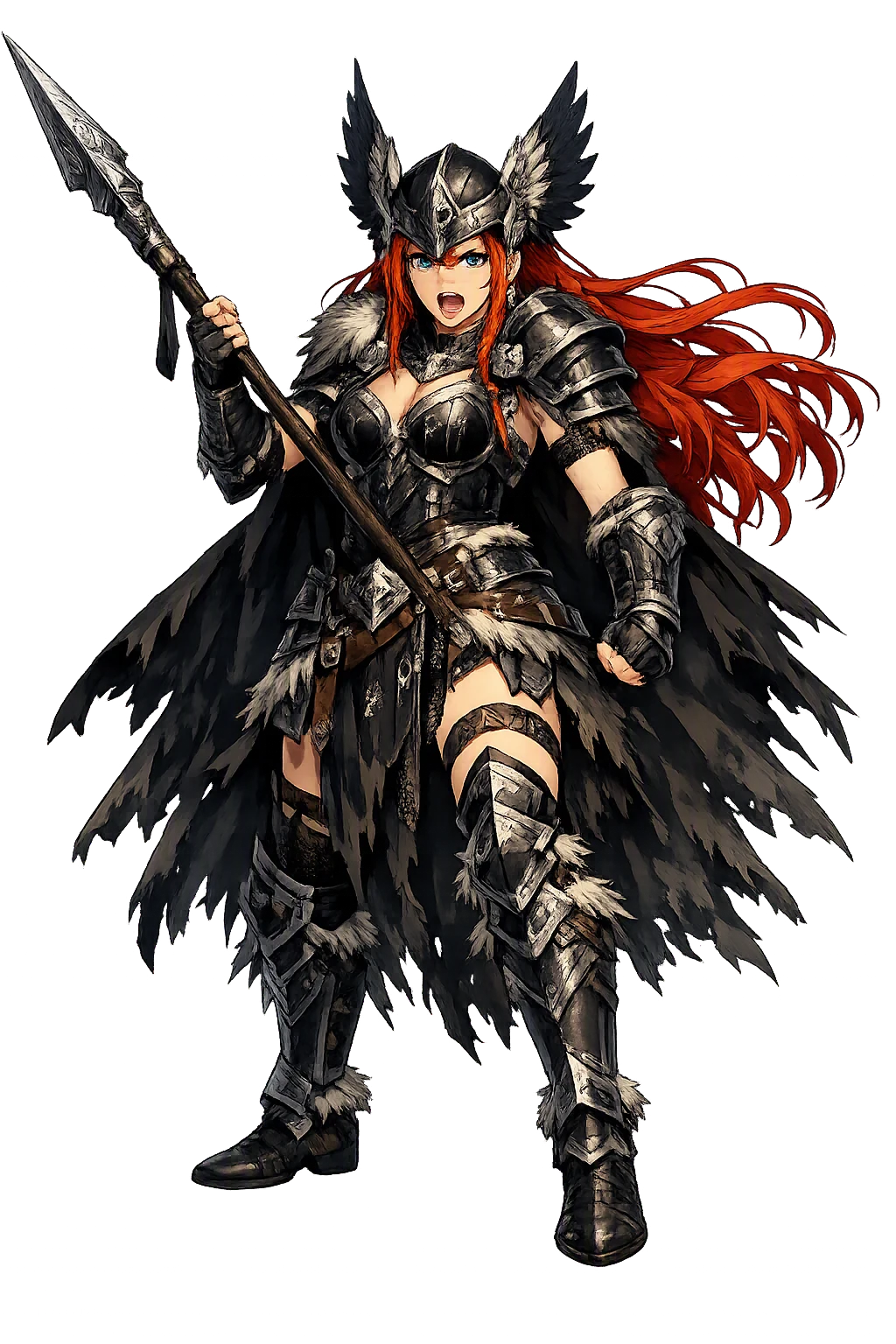
No image names Gunnr, but the type she belongs to is among the best-imaged figures of the Viking Age. Recognize her office by its kit: spear and shield, sometimes a helmet, often a horse, and above all the drinking horn with which the chosen warrior is greeted. The key surviving works are anonymous — the gilt-silver valkyrie from Hårby on Funen (c. 800, National Museum of Denmark), small enough to pin at the shoulder, sword drawn and shield braced; and the Gotland picture stones, where a rider is received by a horn-bearing woman before a hall. The Hårby figure, found in 2012, gave scholarship its first unambiguous three-dimensional valkyrie. Whether any carver meant Gunnr specifically is unknowable: her iconography is the valkyries' common uniform, and her name rides it the way it rides the battle — invisibly, and everywhere.

06

Reception & Transformation

The name after its own age — transmission, translation, survival

Afterlives

Gunnr's transmission runs through the word before it runs through the image. The Codex Regius (c. 1270) keeps Völuspá 30 and its roll-call — Skuld's shield, then Gunnr fourth among Herjan's ladies; Snorri's Gylfaginning gives her the one great sentence about choosing the slain; and the þulur kept her name in the working vocabulary every skald learned. Because her name is the common noun gunnr, war, the reception is linguistic as much as literary: the word runs through skaldic kennings as a plain noun, and the battle-element passed down the Germanic naming tradition — Old English gūþ in Beowulf, Old High German gund- in names like Hildegund, and the unbroken Scandinavian women's name Gunnur, still given in Iceland. Nineteenth-century mythography made the valkyrie a Romantic figure and Gunnr the standing example of the Norse personified abstraction — war itself, named and riding — a framing the modern handbooks of Simek, Orchard, and Lindow still teach. Her fame has always been anonymous: the face on the Hårby figurine is every valkyrie's, and the name in Völuspá's list is the one the tradition chose to keep.

Identifications Across Traditions

Gunnr's nearest kin are not borrowings but reflections. Within the Norse corpus she belongs to the tight triad Snorri names — herself, Rota, and the norn Skuld — where the valkyrie's battlefield choice and the norn's weaving of fate are one operation; Skuld carries the same office into the world of time itself. Across the sea, the Old English cognate gūþ never grew a person: Beowulf sings of gūþ as plain war, and the personification stayed Norse. Scholars comparing traditions point to the Irish Morrígan and Badb — battle-goddesses who also decide fights and choose their dead — as the closest functional parallel in the neighbouring mythology, though no historical link is provable and none need be claimed. Gunnr needs no foreign template: she is what happens when a warrior culture declines its own word for war in the feminine and gives it a horse.

Modern Legacy

Gunnr's afterlife flows through two channels. The first is the word itself: gunnr lived on as the battle-element of Scandinavian naming — Gunnarr ('warrior of battle'), Gunnhildr ('battle-fight'), and the living Icelandic and Faroese women's name Gunnur — so that the valkyrie's name is still spoken daily in the North, worn by ordinary people. The second is the image she helped fix: the armed maiden riding to the field to choose the dead, the seed from which the whole later figure of the valkyrie grew — the Valkyries of Wagner's Walküre, the shieldmaidens of modern fiction and games, and the revived valkyrie devotion of contemporary Heathenry. In scholarship she stands as the standing example of the Norse habit of personifying abstractions: not an allegory imposed on war, but war itself, named and riding.

07

The Meditation

What Gunnr means — beyond the dictionary

Gunnr is the most honest figure in the valkyrie roll because she pretends to be nothing but what she is. Other choosers of the slain carry names of tumult, of rulership, of the spear; hers is the field itself. To say that Gunnr chooses the slain is to say that battle chooses its own — that once the spears cross, the outcome belongs to something no combatant commands. The Norse did not soften that thought; they dignified it. They gave the blind lottery of combat a rider, a rank among Óðinn's women, and a place in the seeress's vision, as if to say: what you cannot control, you can at least name. Every soldier who ever marched out knowing the choice was not his own has stood, without knowing it, in Gunnr's shadow.

08

Frequently Asked Questions

Common questions about Gunnr, Valkyrie of War, and Unicode restoration

01How do you pronounce Gunnr?

In reconstructed pronunciation, Gunnr is /ˈɡunːr̩/ — approximately 'GOON-ur' — a hard g as in 'go', a short full 'u' as in 'put', the n held long and doubled, and the final r sounded as a light syllabic trill, as in modern Icelandic Gunnur.

02What does Gunnr mean?

Gunnr means War in the norse tradition.

03What are the symbols of Gunnr?

Gunnr is associated with The spear (The weapon of the chooser — the stroke that both kills and elects), The shield of the company (Völuspá's riding detail: the valkyries go armed and ranked, not as omens but as soldiers), The choice of the slain (valr) (The office itself — war's harvest selected by name, the power the name gunnr carries into personhood), The name that is a noun (Gunnr the valkyrie and gunnr the battle are one word — war personified walking its own field).

04Why restore Gunnr in Unicode?

Gunnr is written entirely in ASCII letters, so its restoration is about canonical fidelity rather than recovered diacritics: the temple fixes the name in its scholarly standard spelling, attested in the source tradition, instead of leaving it to drift.

05What is the most important myth about Gunnr?

“The Riders the Seeress Saw” — the Völuspá 30 story that anchors the mythology of Gunnr, told in full on the lore page.

09

Scholarly Sources

The philological foundations of this restoration

Every claim on this page is grounded in established scholarship. The orthographic restorations follow disciplinary convention. The etymological chain follows the best available reference works. This is not invention — it is resurrection through scholarship.

◈

Lexicography & Philology

  • Cleasby-Vigfusson
◎

Primary Texts

  • Poetic Edda
  • Poetic Edda: Völuspá 30 (the valkyrie ride: Skuld, Skögul, Gunnr, Hildr, Göndul, Geirskögul), trans. Carolyne Larrington
  • Snorri Sturluson, Prose Edda: Gylfaginning 36 (Gunnr, Rota and Skuld ride to choose the slain and decide battles), trans. Anthony Faulkes
  • Snorri Sturluson, Prose Edda: Skáldskaparmál, þulur of valkyrie names, trans. Anthony Faulkes
  • Poetic Edda: Hákonarmál (Eyvindr skáldaspillir) and Eiríksmál (anonymous), on the choosing and the welcome of the slain; Grímnismál 36 (the mead-bearers)
◉

Archaeology & Art History

  • Material evidence — iconography, inscriptions, and temple archaeology — for Gunnr and related cults.
✦

Religious Studies

  • Cleasby–Vigfusson, An Icelandic-English Dictionary, and Zoëga, A Concise Dictionary of Old Icelandic, s.v. gunnr ('war, battle'; a valkyrie)
  • de Vries, Altnordisches etymologisches Wörterbuch, s.v. gunnr; Simek, Dictionary of Northern Mythology, s.v. Gunnr, valkyries
Return

The Surface Awaits

You have traced the name from its earliest attestation to its Unicode restoration. Now return to the myth. The story is where the name lives.

Back to Lore
Gunnr mascot