
From Cuneiform to Unicode: the journey of Gula
Long before it was a domain name, Gula traveled through three millennia of writing. She begins in Sumerian cuneiform as the great healing goddess of Mesopotamia, passes through Akkadian and Babylonian invocation, survives in Assyrian votive inscriptions and scholarly handbooks, and now arrives — fully restored — inside the punycode machinery of the global DNS. The name is small, only four letters, yet it carries one of the ancient world's most sustained meditations on sickness, recovery, and the mercy of the divine physician. This post follows that journey stage by stage: the original script, the reconstructed pronunciation, the mythological and medical record, the material and artistic evidence, and finally the Unicode form that carries all of it into the address bar. Think of it as a biography of a goddess told through her spelling.
At a Glance
- Restored name: Gula
- ASCII form: gula
- Meaning: "The great one"
- Domain of influence: Healing, Medicine
- Pantheon: Mesopotamian
- Classification: Tier 2
- Original script: 𒀭𒄖𒆷 (Cuneiform)
Overview
Gula (gula) — Healing, Medicine · "The great one" — belongs to the Mesopotamian tradition, where she is catalogued under the domain of healing and medicine. Her name is a Sumerian epithet that became a personal name: gu-la, literally "great," elevated into a divine title. She is not a marginal figure. In the Babylonian and Assyrian periods she ranks among the most widely invoked goddesses, the patroness of physicians, the comforter of the sick, and the divine judge who both sends illness and grants recovery. Kings, exorcists, and ordinary petitioners alike address her in hymns, incantations, and votive dedications.
PuniCodex restores the name as Gula and serves its temple at its temple. The restoration needs no distinctive letters or diacritics that its ASCII form would lose, which places the name in Tier 2. The plain ASCII form gula survives as a modern convenience imposed by the early domain-name system; the restoration, not the fallback, is the form the project defends as philologically complete. Even when the Latin letters look identical, the decision to treat the restored spelling as canonical matters: it preserves the link to the cuneiform original and announces that the name refers to a specific divine person rather than a generic word.
Etymology and Meaning
The name Gula is written in cuneiform as 𒀭𒄖𒆷. The initial sign 𒀭 (dingir) is the divine determinative, the small wedge-shaped flag that tells the reader: this is a deity. The following signs 𒄖𒆷 spell GU.LA, a Sumerian word meaning "great." The whole is read dGU.LA or simply Gula, "the great one" — not great in the sense of size, but in the sense of magnitude, authority, and overwhelming protective power.
The etymology is transparent within Sumerian: gu-la is the regular adjective "great," the same root that appears in royal titles, temple names, and hymns of praise. Applied to a goddess, it becomes an honorific that singles her out as the pre-eminent healer, the one whose knowledge and compassion exceed all others. The Akkadian scribes who inherited the Sumerian canon recognized this meaning and rendered her name accordingly: Gula, Gaulta, or, in fuller epithets, "Gula, the great physician" (asûtu rabītu). The name therefore carries its theology openly. To call upon Gula is to call upon "greatness" understood as healing efficacy.
The transparency of the name also explains why it overlaps with other divine titles. In some contexts Gula is identified with Nintinugga ("Lady who revives the dead"), Ninkarrak (a healing goddess of the west), Meme, or Bau. These are not simple duplicates but regional and functional faces of a single medical tradition. Gula is the great name under which the healing arts are gathered; the other names emphasize particular aspects — rescue from death, care of the body, protection of a city, or tender mercy. The PuniCodex entry keeps the form Gula as the canonical restoration because it is the most widely attested spelling across Sumerian, Babylonian, and Assyrian sources.
The Original Script
The cuneiform writing of Gula's name is itself a small lesson in how Mesopotamian scribes managed sacred language. Cuneiform is a mixed system: some signs represent whole words (logograms), some represent syllables (phonograms), and some carry semantic hints (determinatives). In 𒀭𒄖𒆷, the determinative 𒀭 marks divinity, while 𒄖 (gu) and 𒆷 (la) form a logographic compound read as the Sumerian word for "great." The scribe does not need to spell out g-u-l-a sound by sound; the two signs carry the whole concept, and the reader supplies the divine reading.
This economy is important for understanding the Unicode restoration. The Latin alphabet cannot reproduce the wedge-shaped signs, but it can preserve the scholarly convention that distinguishes a divine name from a common adjective. Writing Gula with an initial capital performs a function analogous to the determinative 𒀭: it signals that the word names a goddess. The ASCII form gula strips away even that modest convention, leaving only the raw letters. The restoration therefore does more than recover aesthetics; it recovers a layer of meaning that the original script encoded visually.
Pronunciation
The reconstructed pronunciation of the name is /ˈɡuːla/ — a two-syllable Sumerian form with a long first vowel and stress on the first syllable. The initial g is a plain voiced velar stop, as in English "good." The u is long, held roughly twice the length of a short vowel, a distinction that Sumerian and Akkadian both preserved. The l is clear, and the final a is open. For a modern speaker, the closest approximation is: say "GOO-lah," but make the first syllable long and level rather than gliding.
Because the goddess's name is a common Sumerian word, there is no mystery about the vowel qualities. The long u is inferred from Sumerian lexical lists and from the Akkadian transcription Gūla. In later Babylonian, the name could also be pronounced with a short first vowel or with secondary stress, but the scholarly convention Gula preserves the older, fuller form. The ASCII form "gula" is a DNS compromise; the restoration "Gula" preserves the name's scholarly dignity and its link to the long-vowel Sumerian original.
Mythology and Domain
The mythology of Gula is not a single linear story but a dense network of healing narratives, medical hymns, and cultic roles. Her domain is medicine in the broadest ancient sense: the treatment of wounds, the curing of fever, the lifting of curses, the soothing of childbirth, and the restoration of harmony between patient and cosmos. She is the divine patroness of the asû (physician) and the āšipu (incantation priest), the two professions that together addressed physical and spiritual illness in Mesopotamia.
The Great Physician
In the so-called Gula Hymn of Bulluṭsa-rabi, a long Babylonian prayer addressed to the goddess, the speaker — a court official or physician — praises Gula as the source of all medical knowledge. She is said to know herbs, bandages, poultices, and incantations. She binds what is broken, cools what burns, and drives out the demons of disease. The hymn is not merely literary flattery; it is a theological statement about the origin of medicine. Every effective remedy, the text implies, is a gift from Gula, and every successful healer acts in her name.
The goddess's medical authority extends beyond the human world. In some traditions she is the daughter or consort of Ninurta, the warrior god who defeats chaotic forces. This pairing makes mythological sense: Ninurta wins the battle against disorder, and Gula heals the wounds that disorder leaves behind.
The Lady of the Dog
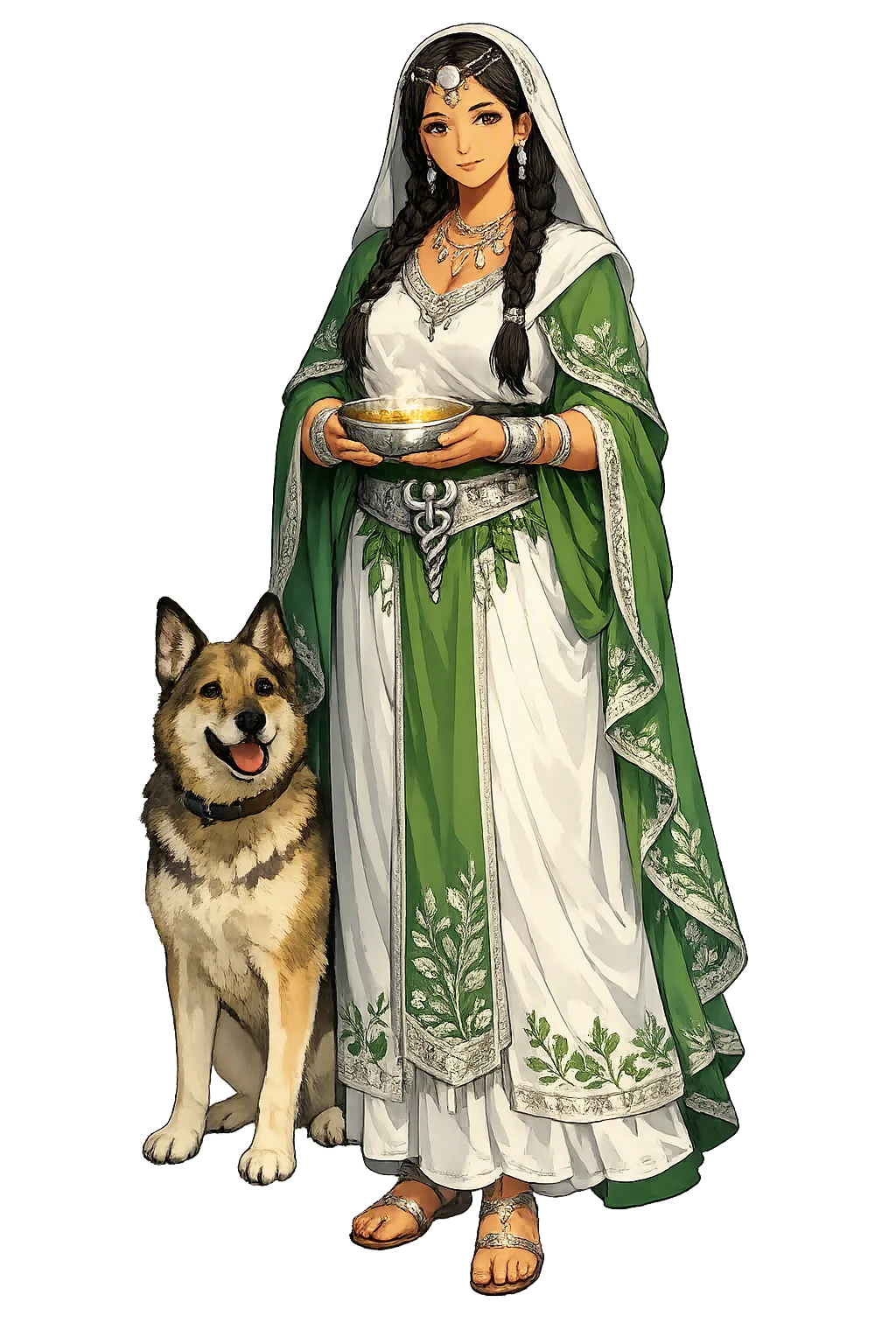
Gula's most distinctive iconographic attribute is the dog. She is frequently depicted seated on a throne with a dog at her feet or standing with a dog beside her. The dog is not a pet in the modern sense; it is a symbol of her diagnostic and protective power. Dogs were associated with licking wounds, with watchfulness, and with the threshold between sickness and health. A votive dog figurine placed in a temple or buried at a healing shrine was a petition or a thank-offering: "Gula saw my suffering; Gula sent her dog to heal me."
Hundreds of terracotta dog figurines have been found at sites such as Isin, Nippur, and Nineveh. Many carry inscriptions naming Gula. These objects give the abstract concept of healing a tangible presence. The dog is the goddess's envoy, the creature that stays by the sufferer until recovery comes.
Worship and Memory
Gula's cult was centered at Isin, a city in southern Mesopotamia that became a major religious center under the dynasty of Larsa and later Babylonian kings. The temple of Gula at Isin, the E-gal-mah or "Exalted Palace," was one of the city's most important monuments. Kings such as Nebuchadnezzar II and Nabonidus boasted of restoring or embellishing it.
But Gula was not only a royal goddess. Incantation tablets from Assyrian households show ordinary people calling on her for fever, headache, broken bones, difficult births, and haunted sleep. The same name appears in the grandest temple hymns and in the most private spells. Wherever Mesopotamian medicine was practiced, Gula was present.
Symbols and Iconography
The iconography associated with Gula concentrates in a small but powerful set of recurring attributes:
- Dog — Her primary animal emblem, signifying watchful care, diagnostic licking, and the passage from sickness to health.
- Rod or staff — A symbol of medical authority and of the goddess's power to strike or bind disease demons.
- Scalpel or knife — The surgeon's tool, marking her patronage of physical medicine as well as incantation.
- Votive figurine — Small images of dogs, healing hands, or the seated goddess offered in thanks for recovery.
- Name — The restored form Gula, carrying scholarly and cultural weight.
- Domain — Healing, Medicine, the great art of restoring life.
Archaeology and Evidence
The material record for Gula is unusually rich for a Mesopotamian deity. It includes inscribed votive dog figurines, temple foundations at Isin, cylinder seals showing the goddess with her canine companion, and hundreds of cuneiform tablets containing hymns, incantations, and medical recipes that invoke her name. Each category of evidence tells a different part of her story.
The dog figurines are the most evocative. Often made of baked clay and painted in black and white, they bear short dedicatory inscriptions such as "For Gula, for the life of so-and-so" or simply "Gula." Their distribution across Mesopotamia and Assyria shows that devotion to the healing goddess extended well beyond her official cult center. A sick person who could not travel to Isin could still place a small dog before a local image of Gula and ask for her help.
Temple excavations at Isin have revealed architectural remains of the sacred precinct, including courtyards, offering rooms, and deposits of votive material. Royal building inscriptions confirm that kings from several dynasties invested in the site, treating the maintenance of Gula's temple as a pious duty and a political statement. The goddess who healed the body also healed the body politic, and her sanctuary was a place where royal legitimacy could be displayed and renewed.
The textual evidence is equally important. Medical tablets from the libraries of Nineveh and Babylon list recipes "proven by Gula," incantations that open with invocations to her, and diagnostic omens that interpret disease as a message from the divine realm. These texts show that Gula was not merely a figure of popular devotion; she was embedded in the intellectual and professional structure of Mesopotamian medicine. To study the healing arts was, in part, to study the will of Gula.
Cultural Legacy
Gula remains a touchstone for understanding Mesopotamian religion, art, and identity. Her cult demonstrates that ancient medicine was never purely technical; it was always also theological. The physician, the exorcist, and the patient operated within a shared cosmos in which sickness could be a punishment, a test, a demonic attack, or simply a bodily disorder. Gula presided over the entire field, offering a single divine address for every kind of suffering.
In later reception, Gula's imagery influenced the iconography of healing goddesses across the ancient Near East. The seated goddess with a dog became a visual formula adapted to local deities and needs. Even after the cuneiform tradition ended, the association of dogs with healing survived in folklore. The name Gula itself, though no longer invoked in prayer, continues to appear in scholarly works, museum labels, and now — through the PuniCodex restoration — in the domain name system.
The modern study of Gula also matters for the history of women and medicine. As a female patron of a high-status technical profession, Gula complicates easy assumptions about gender in the ancient world. Her hymns give her voice, knowledge, and agency; she is not a passive helper but an active sovereign over disease and health.
The Scholarly Record
The account of Gula given in this edition rests on the witnesses and reference works listed below. Lexica and etymological dictionaries secure the form and meaning of the name; the literary and religious texts supply the narrative evidence.
Key scholarly sources include the Assyrian Dictionary of the Oriental Institute of the University of Chicago (CAD), which documents the Akkadian spelling and usage of Gula across many centuries; Jeremy Black, Graham Cunningham, and Eleanor Robson's The Literature of Ancient Sumer; Benjamin R. Foster's From the Days of the Sumerians; Thorkild Jacobsen's The Treasures of Darkness; and Andrew R. George's The Babylonian Gilgamesh Epic. The Electronic Text Corpus of Sumerian Literature (ETCSL) preserves Sumerian hymns and temple songs, while the cuneiform medical corpus — including the Gula Hymn of Bulluṭsa-rabi — has been edited in modern Assyriological publications. For the iconography and archaeology, the excavations at Isin and the corpus of Mesopotamian votive figurines provide essential material context.
Why This Restoration Matters
Every stage of the journey from Cuneiform to Unicode was an act of care: the scribe who first pressed the wedge-shaped signs into clay, the lexicographer who glossed the name as "the great one," the Assyriologist who edited the hymns, and the engineer who taught the DNS to carry non-ASCII characters. The PuniCodex restoration is the latest stage, not the last word — the Scholarly Edition is revised as the evidence improves. What does not change is the principle: a name deserves to be written the way its own tradition wrote it. Gula in the address bar is that principle, made routable.
The restoration is particularly meaningful because Gula's name is so short. Four letters do not give much room for nuance. Yet those four letters connect a modern user to three thousand years of healing practice, theology, and art. When someone types Gula into a browser, they are not merely reaching a website; they are reaching a named point in the historical record. The punycode translation happens silently in the background, so the infrastructure remains compatible while the visible name keeps its scholarly form.
The Unicode Restoration
Gula is classified as Tier 2 because the restoration needs no distinctive letters or diacritics that its ASCII form would lose. The Latin letters in Gula and gula are the same; the restoration is a matter of capitalization and canonical convention. But that does not make the restoration trivial. The capital G performs the work of the cuneiform determinative 𒀭, marking the word as a divine name. The stable spelling prevents the drift that happens when a name is romanized differently in every article, map, and database. And the public, routable form turns a scholarly convention into a working address on the live web.
The ASCII fallback gula still resolves everywhere, but it is the restored form that carries the name's full information. That is the whole thesis of this temple: the marks are the message. Even when the marks are modest — a single capital letter — they record a decision about what the name means and whom it names. A visitor who disagrees with the classification can at least see exactly which evidence produced it, because every step is recorded in the Scholarly Edition. That transparency is the difference between a restoration project and a branding exercise. The name is being put back, not invented.
Character by Character
The journey from gula to Gula, one character at a time:
- g → G — Same, capitalized, carrying the convention of a proper divine name.
- u → u — Same, preserving the long Sumerian vowel in the scholarly reading.
- l → l — Same.
- a → a — Same.
What looks like "no change" is, in fact, a deliberate choice to keep the name stable, searchable, and addressable. The breakdown lists each character so visitors can see exactly what is being carried forward and what is not.
Sister Temples
Other temples in the Mesopotamian pantheon include Ninlil, Ninurta, and Enlīl — each with its own restoration story, its own scholarly record, and its own place in the lexicon. Cross-tradition kindred figures in the PuniCodex index include Asklēpiós, Bhaiṣajyaguru, Brigid, Eir, Hygíeia, and Sukunahikona, each linked through the shared domain of healing and medicine.
Explore Further
This post is one doorway into the temple. The home page carries the full character breakdown and the ambient canvas; the lore page tells the myths in long form; the Scholarly Edition preserves the sources, variant forms, and revision history; and the patron wall supports the restoration directly. For the wider map, browse the Lexicon, explore the Pantheon, or return to the PuniCodex blog. To type the restoration yourself, use the PuniCodex Type Tool, which converts gula into Gula as you type, or install the browser extension for the same conversion in any text field.
Gula in the address bar is a small thing — four letters, one capital, a world of healing behind it. That smallness is the point. The restoration does not need to be loud to be faithful.
Related Names
- Anšar — Sky, Circle of Heaven
- Anû — Phonological Reconstruction, Sky, Heaven, Kingship
- Apsû — Phonological Reconstruction, Fresh Water, Abyss
- Aššur — War, Kingship, Assyrian Patron
- Ēa — Phonological Reconstruction, Water, Wisdom
Sources
- Benjamin R. Foster (trans.), From Distant Days: Myths, Tales, and Poetry of Ancient Mesopotamia (1995).
- Thorkild Jacobsen, The Treasures of Darkness: A History of Mesopotamian Religion (1976).
- Jeremy Black & Anthony Green, Gods, Demons and Symbols of Ancient Mesopotamia (1992).