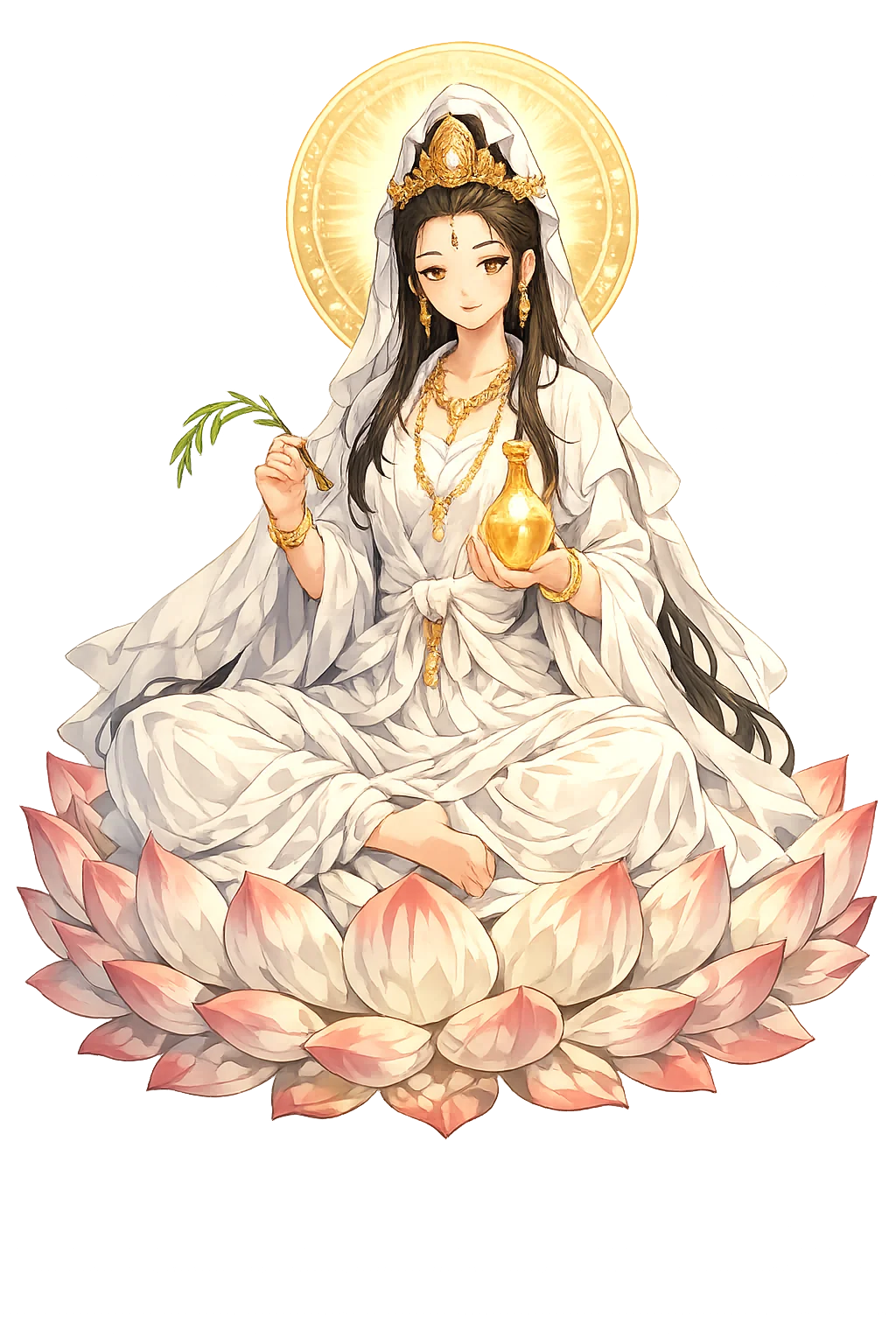
Stories of Guānyīn
Guānyīn's "myths" are vows and legends of response: the sūtra promises that whoever calls her name in danger will be heard, Chinese legend supplies the daughter who keeps the promise, and the great novels make her the patron of every journey. What is worshipped is attention itself — the answer that never comes too late.
Chapter 25 of the Lotus Sūtra — Kumārajīva's Chinese translation of 406 CE, so widely copied on its own that it became the independent Guānyīn Jīng — makes the vow explicit: if beings caught in fire, flood, storm, demon-lands, or the executioner's blade "call in one voice upon the name of Guānshìyīn, the bodhisattva will immediately perceive the sound and free them." The chapter names the perils one by one and then multiplies the rescue: Guānyīn appears in thirty-three forms — monk, king, celestial, even demon-queller — going wherever beings are. It became the most recited chapter in East Asian Buddhism, chanted at funerals and deathbed vigils, and the Great Compassion Dhāraṇī that grew around her cult turned the vow into a chant anyone could carry. The chapter’s insight is structural: compassion is not an emotion but an infrastructure — a cosmic emergency line with no closing hour, answering every call.
The legend that made her a daughter is preserved in the Xiangshan Baojuan, a precious scroll of the twelfth–thirteenth centuries: Princess Miàoshàn refuses marriage to pursue awakening, and her enraged father commits her to a convent and then burns it down around her. Executed at last, she descends to the underworld — where her compassion turns hell into a garden of flowers, and the kings of death hasten to restore her to life. When the same father lies dying of a karmic disease curable only by the eyes and arms of one without anger, a blind, armless monk appears and gives them. The monk is his daughter. Revealed as the thousand-armed, thousand-eyed Guānyīn, she forgives him, and the king becomes her devotee. The story is pious fiction, not scripture — and it did what scripture could not: it gave East Asia's compassion a daughter's face, and made the most radical of vows imaginable as a family drama every household knew.
The Indian Avalokiteśvara — "the lord who looks down in compassion" — entered China with the first sūtra translations, and Kumārajīva's school analyzed the Sanskrit name into exactly what Chinese could carry: guān, to observe; shì, the world; yīn, its sounds. The early art keeps the Indian body: Tang paintings and Dunhuang banners show a princely, sometimes mustached figure, and Dunhuang manuscripts even depict the pilgrim Xuanzang's celestial guardian as a masculine guide. The transformation came between the late Tang and the Song: by the eleventh century the white-robed woman stands in nearly every temple. Scholars debate the causes — the Miàoshàn legend, the cult of the Queen Mother, the sheer grammar of a culture that heard mercy in a mother's voice. The result is one of the great metamorphoses of religious history: the bodhisattva crossed a continent and changed sex, and the change carried the doctrine further than any translation could.
In Journey to the West (ch. 8–9), Guānyīn volunteers for the quest that organizes the whole novel: the Buddha offers the scriptures of the Great Vehicle, and she descends to the world of the Tang to find someone worthy to fetch them. She recruits the entire pilgrimage — the monk Tripitaka, the disgraced celestial officer who will be Zhu Bajie, the exiled curtain-lifting general who will be Sha Wujing, and the dragon prince who will serve as a horse — and for Sūn Wùkōng she keeps the golden fillet and the headache spell that turn the monkey from a catastrophe into a disciple (ch. 13–14). Through eighty-one tribulations she returns whenever heaven's bureaucracy stalls, once descending with the fish-basket that gave her another popular form. The novel's theology is plain: the journey works not because the pilgrims are strong but because compassion is their case officer — mercy quietly running the operation from above, one rescue at a time.
Compassion, the Lotus Sūtra, and the Cries of the World
Guānyīn is the most beloved figure of East Asian Buddhism: the bodhisattva who vows to hear every cry of suffering in the world and answer it. Born in India as the male Avalokiteśvara, she became, in China, a mother — and compassion itself found its lasting face.
Her seat and symbol: purity flowering unsullied from the mud of the world.
The pure vase with willow branch — the dew of compassion sprinkled on the suffering.
The thousand-armed form: an eye in every palm — to see and to reach, without limit.
Her island mountain off Zhejiang: the Potalaka of the sūtras, anchored in the Chinese sea.
From the original script to the living URL
觀音
The name in its original Chinese form. Guānyīn (觀音) is attested in the source tradition — “Perceiver of sounds”. Its macron-length vowels carry the full phonetic and orthographic weight of the source tradition.
guanyin
Reduced to plain guanyin, the name loses everything that made it specific: macron-length vowels. What remains is an ASCII string that machines can parse but that no longer speaks with its original voice.
Guānyīn
The Unicode restoration recovers what ASCII flattened. Guānyīn restores macron-length vowels, returning the name to its original written dignity. The domain encodes to Punycode, but the browser displays the truth.
Guānyīn.com → xn--gunyn-gwa01a.com
The non-ASCII characters in Guānyīn are encoded while the ASCII remains visible. To the DNS, it is Punycode. To humanity, it is Guānyīn.
Owned, ideal, and ASCII forms of Guānyīn
Guānyīn
Restores 觀音. The live temple domain — guānyīn.com.
guanyin
Flattens 觀音. The plain ASCII fallback — what DNS and legacy systems see.
How Guānyīn was spoken
How Guānyīn is preserved in writing
A bespoke provenance study for Guānyīn is being prepared by the PUNICODEX scholarly team.
Contribute scholarly provenance →The lore you have read is the living myth. Extended Lore opens the scholarly vault beneath it: the cult and its material remains, a history of the image, the name after antiquity, a meditation on what the name still means, and the full scholarly apparatus — etymology, orthography, sources.
Enter Extended Lore