PuniCodex

Extended Lore

ᚴᛁᚾᚾᚢᚾᚴᛅᚴᛅᛒ Ginnungagap

Etymology · Phonology · Orthography · Cultural Legacy · Primary Sources

Tier 2 Ginnungagap
Ginnungagap — Primordial Void
01

Quick Facts

Essential information about Ginnungagap, Primordial Void

Original Scriptᚴᛁᚾᚾᚢᚾᚴᛅᚴᛅᛒ
Unicode RestorationGinnungagap
Reconstructed Pronunciation/ˈɡinː.uŋ.ɡa.ɣap/
PantheonNorse
DomainPrimordial Void
MeaningMagic-gaping-void
ClassificationTier 2
Primary DomainGinnungagap
Sacred SymbolsThe gap itself, Rime and spark, The quickening drops, The windless mildness
02

Etymology & Word Family

From original script to Unicode restoration

Original Script ᚴᛁᚾᚾᚢᚾᚴᛅᚴᛅᛒ Ginnungagap — "Magic-gaping-void"
Unicode Restoration Ginnungagap Restored stress, length, and script
Modern ASCII ginnungagap Plain-ASCII fallback

Ginnungagap is Tier 2 by the mechanical rule: the normalized Old Norse form is already plain ASCII — no diacritic, no distinctive letter for the ASCII alphabet to lose. Only the capital distinguishes the restored form from the input; the void was never hard to type, only hard to imagine.

03

Unicode Character Breakdown

Character-by-character philological analysis

CharacterUnicodeNameBlockPhonetic Role
GU+0047Latin Capital Letter GBasic LatinSame, capitalized
iU+0069Latin Small Letter IBasic LatinSame
nU+006ELatin Small Letter NBasic LatinSame
uU+0075Latin Small Letter UBasic LatinSame
nU+006ELatin Small Letter NBasic LatinSame
gU+0067Latin Small Letter GBasic LatinSame
aU+0061Latin Small Letter ABasic LatinSame
gU+0067Latin Small Letter GBasic LatinSame
aU+0061Latin Small Letter ABasic LatinSame
pU+0070Latin Small Letter PBasic LatinSame

The Tier 2 classification reflects how much of the original phonology this restoration preserves — stress and vowel length for Greek names, distinctive letters and diacritics for every other tradition.

04

Cultural Significance

From ancient cult to modern Unicode

Ancient Domain

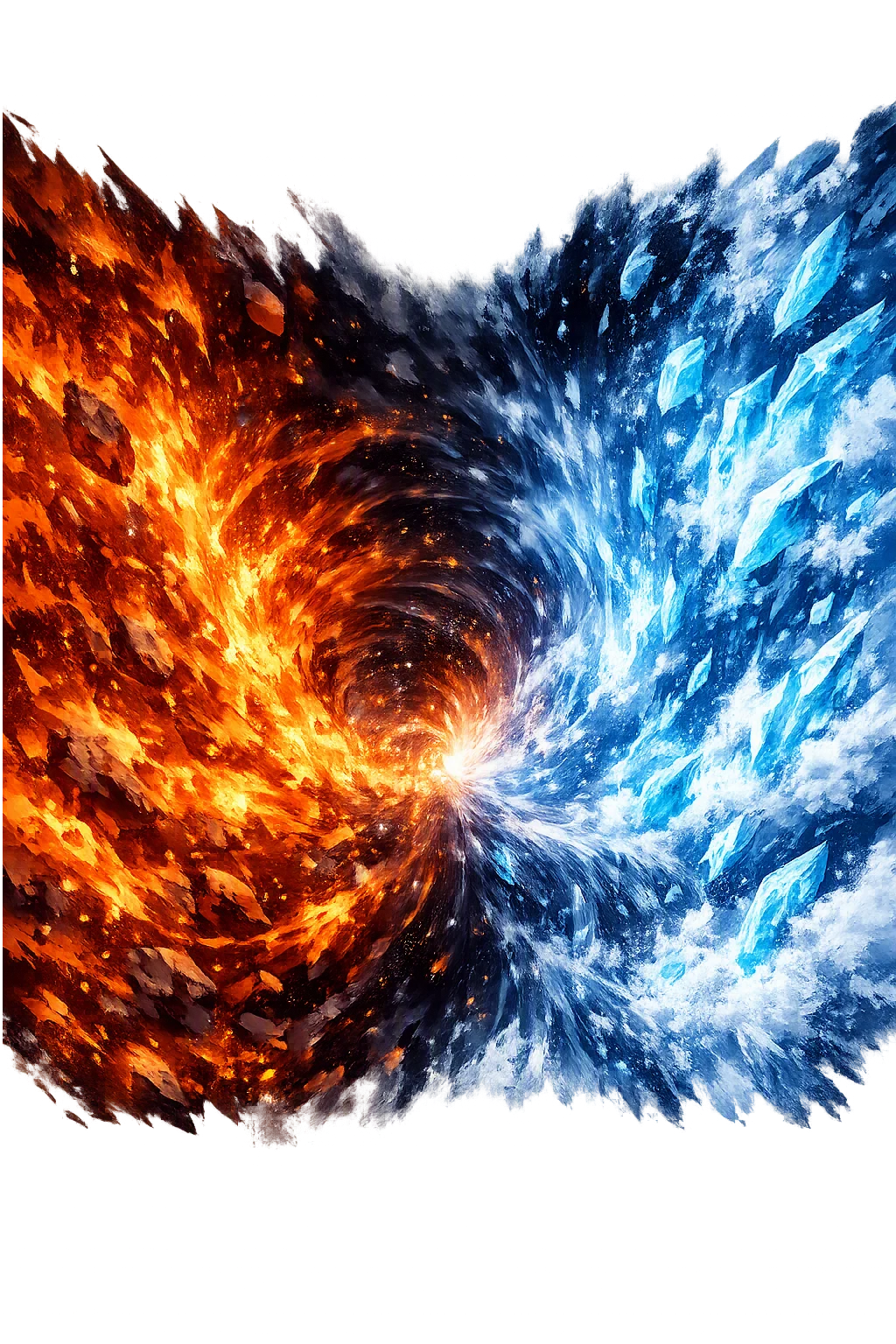
Ginnungagap is the emptiness that was there first: the vast, mild, windless chasm between Niflheimr's rime and fog in the north and Muspellsheimr's fire and sparks in the south, in whose middle the two extremes met, melted, and quickened into Ymir — the condensation from which the whole made world, and the Æsir themselves, descend.

Ginnungagap in Later Traditions

The obvious cross-border twin is Hesiod's Chaos: 'first of all came Chaos' opens the Greek theogony, and the Greek word itself derives from a root meaning 'to yawn, gape' — chaos and gap are the same image in two languages, the world beginning as an open mouth. The parallel is real but easy to overdraw: Hesiod's Chaos is a begetter, parent of Erebos and Night, while Ginnungagap begets nothing by itself — it is the neutral stage on which rime and fire do the begetting, and the North reserves the making for the gods who arrive later. Scholars such as Lindow have set the Norse account among the broader Indo-European creation patterns — the primordial being dismembered into the world has cousins from Vedic Puruṣa onward — but the void itself, cold at one end and burning at the other, is the corpus's own signature.

Modern Legacy

Ginnungagap is the rare cosmological term that never had to be revived, because it was never allowed to die: Modern Icelandic keeps ginnungagap as its word for the primordial void, and Icelandic science writing reaches for it when describing the nothing before the Big Bang. The nineteenth-century Norse revival made the scene a set-piece — the Kearys' The Heroes of Asgard (1857) opens its cosmology in 'the great gulf' between ice and fire — and every handbook since, from Simek to Orchard, has treated the word as the North's answer to chaos. Modern Heathenry honours the creation narrative as its cosmogony, and popular culture borrows the name wherever a story needs a primal abyss, from Marvel's Thor comics to fantasy games. Its deepest legacy is conceptual: the idea, natural to the North, that the precondition of creation is not a maker's word but an empty space where opposites can meet.

Unicode Restoration as Cultural Act

Restoring Ginnungagap in a domain name is more than orthographic accuracy. It is a statement that the internet should recognize the full range of human writing — not only the ASCII keyboard.

05

Frequently Asked Questions

Common questions about Ginnungagap, Primordial Void, and Unicode restoration

01How do you pronounce Ginnungagap?

In reconstructed pronunciation, Ginnungagap is /ˈɡinː.uŋ.ɡa.ɣap/ — approximately 'GIN-noong-ahp' — stress the first syllable, hold the double n long, keep the u of -ng- short as in 'put', and end with a hard g and a clipped final p..

02What does Ginnungagap mean?

Ginnungagap means Magic-gaping-void in the norse tradition.

03What are the symbols of Ginnungagap?

Ginnungagap is associated with The gap itself (Emptiness as precondition — the room in which opposites can meet and anything at all can begin), Rime and spark (The two extremes the void holds apart and joins — ice from Niflheimr, embers from Muspellsheimr), The quickening drops (Life condensing out of the meltwater where the two worlds' weather collided), The windless mildness (Snorri's strange detail that Ginnungagap was as mild as a windless sky — the void is neutral, not hostile).

04Why restore Ginnungagap in Unicode?

Plain ASCII ginnungagap strips the stress, length, and script that make the name specific. Unicode restoration returns the name to its original written dignity.

05What is the most important myth about Ginnungagap?

The seeress reaches back before memory: 'Early in time, when Ymir made his settlement — there was no sand nor sea nor cool waves; earth was found nowhere, nor the sky above; a gap of ginnungs there was, but grass nowhere.' That is the entire notice the oldest poem gives, and everything Snorri builds hangs on its two words, gap ginnunga. No god speaks, nothing acts; the poem simply registers an emptiness where the world will later be, with the first giant already housed at its edge.

06

Scholarly Sources

The philological foundations of this restoration

Every claim on this page is grounded in established scholarship. The orthographic restorations follow disciplinary convention. The etymological chain follows the best available reference works. This is not invention — it is resurrection through scholarship.

Lexicography & Philology

  • Prose Edda
  • Cleasby-Vigfusson

Primary Texts

  • Poetic Edda: Völuspá 3 (gap ginnunga, grass nowhere), Vafþrúðnismál 21 (Élivágar and the quickening of Ymir), Grímnismál 40–41 (the world made from Ymir's body)
  • Snorri Sturluson, Prose Edda: Gylfaginning 4–9 (Niflheimr and Hvergelmir, the Élivágar, Muspellsheimr and Surtr, the mildness of Ginnungagap, the quickening of Ymir and Auðhumla, the killing of Ymir, the world fashioned in the gap)
  • Hesiod, Theogony 116 (Chaos first of all) — the Greek parallel of the yawning beginning

Archaeology & Art History

  • Material evidence — iconography, inscriptions, and temple archaeology — for Ginnungagap and related cults.
  • A void can leave no votives: Ginnungagap's evidence is entirely manuscript evidence, and unusually good of its kind. Völuspá, Vafþrúðnismál, and Grímnismál survive in the Codex Regius of the Poetic Edda (GKS 2365 4to, c. 1270), the great Reykjavík codex that preserves nearly the whole mythological corpus; Snorri's Gylfaginning, with its systematic account of the gap, is transmitted in the Codex Regius of the Prose Edda (GKS 2367 4to, early 14th c.), the Codex Wormianus, and the Codex Upsaliensis, the last sometimes held to preserve an earlier redaction. No runic inscription names the compound — a silence it shares with every other item of cosmological furniture — and no picture stone can be securely read as the meeting of rime and fire, though scholars have occasionally proposed cosmic scenes among the Gotlandic imagery. The archaeology of Ginnungagap is thus the archaeology of the bookhand: a phrase in a thirteenth-century Icelandic codex, preserving the first sentence of the northern world.

Religious Studies

  • Cleasby–Vigfusson, An Icelandic-English Dictionary, s.v. ginnunga-gap, gap, ginna, ginn-regin
  • Zoëga, A Concise Dictionary of Old Icelandic, s.v. ginnungagap, gap, ginna
  • de Vries, Altnordisches etymologisches Wörterbuch, s.v. ginnunga-gap, ginna, ginnregin
  • Simek, Dictionary of Northern Mythology; Orchard, Dictionary of Norse Myth and Legend; Lindow, Norse Mythology: A Guide — s.v. Ginnungagap, Ymir, Niflheimr, Muspellsheimr (the etymological dispute and the comparative cosmogony)
Return

The Surface Awaits

You have traced the name from its earliest attestation to its Unicode restoration. Now return to the myth. The story is where the name lives.

Back to Lore
Ginnungagap mascot