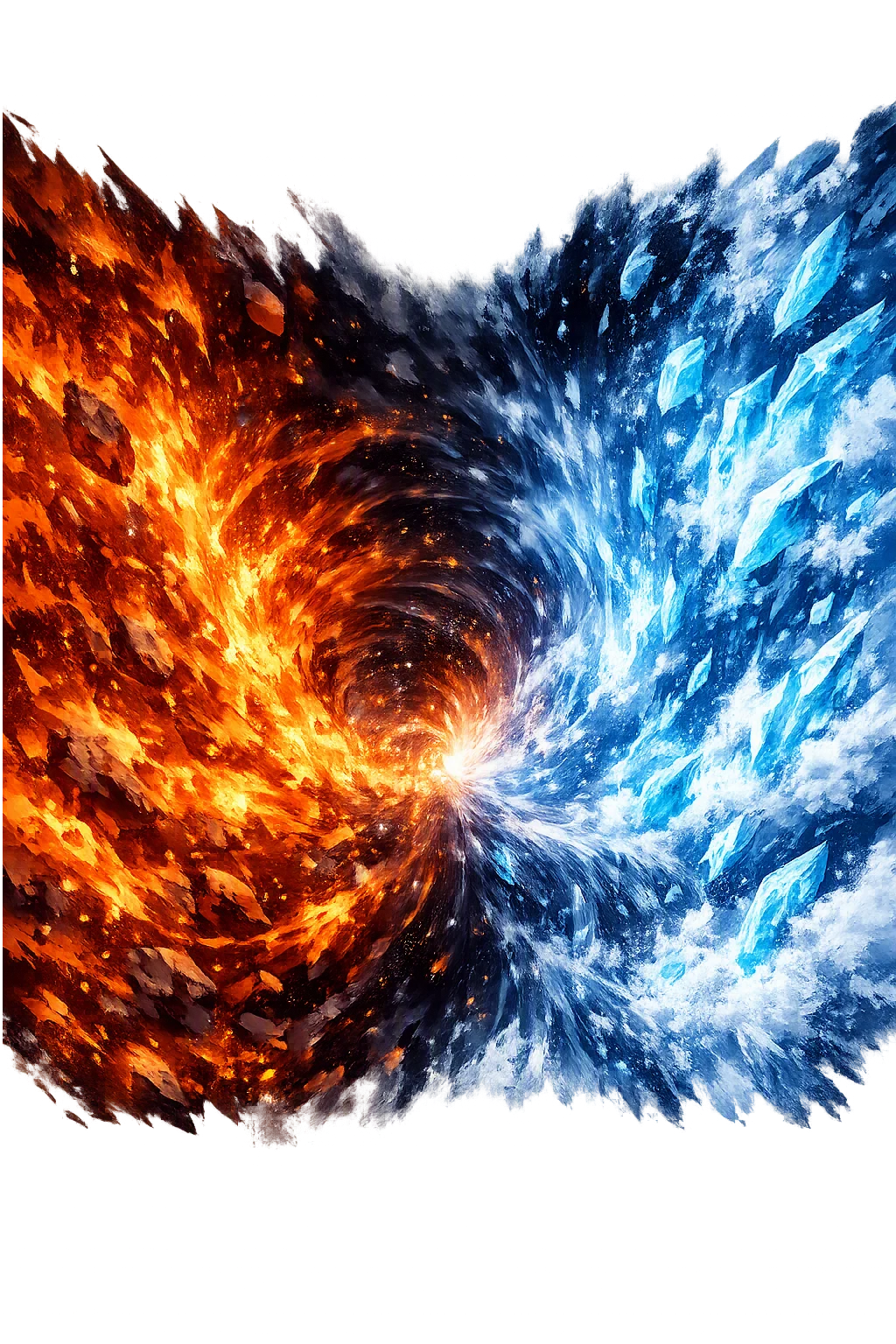
Stories of Ginnungagap
Ginnungagap has no adventures, because it is not a character but a place — or rather the condition of there being places at all. Its mythology is the first chapter of everything: the Norse creation, told in Völuspá's three terse lines and unpacked by Snorri into the finest cosmogony the Germanic world preserved.
The seeress of the Völuspá reaches back before memory, and her third stanza is the northern world’s first sentence: ‘It was at the beginning of time, when Ymir had settled — there was no sand nor sea nor cool waves; earth existed nowhere, nor sky above; a gap of ginnungs was there, but grass nowhere.’ That is the entire notice the oldest poem gives — two words, gap ginnunga, in the reversed order the later prose preferred — and everything Snorri builds hangs on them. Nothing acts in the verse; no god speaks. The poem simply registers an emptiness where the world will later be, with the first giant already housed at its edge and no grass yet anywhere. The compound itself is a puzzle the stanza declines to solve: whether ginnunga means ‘magic-charged powers’ or is kin to ginna, ‘to deceive, bewitch’, the lexica still argue. The void enters literature already wearing its oldest trick: a name no one could agree on, and a silence no one could fill.
Asked what was before the earth, Hár tells Gylfi that Niflheimr was made many ages before the world: a dark world of mist with the spring Hvergelmir at its heart, from which run the rivers called the Élivágar — Svǫl, Gunnþrá, Fjǫrm, Fimbulþul, Slíðr and Hríð, Sylgr and Ylgr, Víð, Leiptr, and Gjǫll, which flows nearest the gate of Hel. Far from that spring the rivers hardened like the slag that runs from a forge, turned to ice, and spread rime and freezing fog northward. But the southern part of Ginnungagap faced Muspellsheimr, the bright, burning world no foreigner can enter, where Surtr stands guard at the border with a flaming sword — and the sparks and glowing embers that flew out of Muspellsheimr lightened the gap from below.
Between the two, Snorri says, Ginnungagap was as mild as a windless sky. Where the warm air from the south met the rime from the north, the ice thawed and dripped — and by the power of the one who sent the heat, the running drops quickened and took the likeness of a man. He is named Ymir, though the rime-giants call him Aurgelmir, and from him their whole race descends; asked whether Ymir was a god, Hár answers flatly that he and all his kin were evil. From the same rime-drops came the cow Auðhumla, whose four rivers of milk fed the giant, and who licked the salty rime-stones until, over three days, a man emerged whole from the ice: Búri, the grandfather of the gods.
Búri's son Borr married Bestla, daughter of the giant Bǫlþorn, and their sons were Óðinn, Vili, and Vé — and the first act of the new gods in the old void was a killing. They slew Ymir, and so much blood ran from his wounds that the whole race of rime-giants drowned, save one: Bergelmir, who climbed with his wife onto his lúðr — a word that may mean a boat or a chest — and from whom the giants of the frost descend anew. The brothers dragged Ymir's body into the middle of Ginnungagap and made the world of it: the earth from his flesh, the sea and lakes from his blood, the mountains from his bones and teeth, the sky from his skull, held up at the four corners by the dwarfs Norðri, Suðri, Austri, and Vestri, and the clouds from his brains. The sparks that flew out of Muspellsheimr they set in the sky as stars. Thus the gap was not filled so much as furnished: everything that exists is a giant's body arranged inside the old emptiness.
The Poetic Edda confirms Snorri’s outline from its own witnesses. Vafþrúðnir the giant, questioned by Óðinn about the first origin of giant-kind, answers that out of the Élivágar sprang venom-drops, eitr, which grew and hardened until a giant quickened from them (Vafþrúðnismál 21). And Grímnismál gives the fashioning in verse: ‘From Ymir’s flesh the earth was shaped, the mountains from his bones, the sky from the skull of the frost-cold giant, and from his blood the sea’ — adding that the gracious powers made Miðgarðr for the sons of men from his eyebrows, and the hard-mooded clouds from his brains (Grímnismál 40–41). The poems do not name the gap as often as Snorri does, but they supply its inventory: ice-rivers, venom, melt, and a world assembled from a corpse. Between verse and prose the account is told twice from independent witnesses — a redundancy rare enough in Norse myth to count as corroboration, and the reason this cosmogony is among the best-attested in the medieval North.
The Yawning Gap Where Rime Met Flame Before the World Began
Ginnungagap is the emptiness that was there first: the vast, mild, windless chasm between Niflheimr's rime and fog in the north and Muspellsheimr's fire and sparks in the south, in whose middle the two extremes met, melted, and quickened into Ymir — the condensation from which the whole made world, and the Æsir themselves, descend.
The world of fog and rime in the north, made long before the earth — its spring Hvergelmir feeds the rivers called the Élivágar.
The burning world in the south, bright and impassable to any not native to it, where Surtr stands at the frontier with a flaming sword.
Where the sparks and embers flying from the south touched the rime drifting from the north, the gap thawed, dripped — and the drops took on life.
The first shape the void made: the frost-ogre who quickened in the meltwater, called Aurgelmir by the rime-giants who descend from him.
From the original script to the living URL
ᚴᛁᚾᚾᚢᚾᚴᛅᚴᛅᛒ
The name in its original Norse form. Ginnungagap (ᚴᛁᚾᚾᚢᚾᚴᛅᚴᛅᛒ) is attested in the source tradition — “Magic-gaping-void”. Its original diacritics and script distinctions carry the full phonetic and orthographic weight of the source tradition.
ginnungagap
The plain ginnungagap form is identical to the Unicode restoration. Because this name is already written in Latin letters, no diacritics, stress, or script information were lost — only capitalization differs.
Ginnungagap
The Unicode restoration does not need to recover lost marks for Ginnungagap. Its value is canonical spelling and consistent cataloguing, not the reconstruction of erased orthography. The domain is readable as-is to both DNS and humanity.
Ginnungagap.com
This restoration is written entirely in ASCII letters — no Punycode encoding stands between Ginnungagap and the DNS. The domain reads identically to machines and to human eyes.
Owned, ideal, and ASCII forms of Ginnungagap
Ginnungagap
Restores ᚴᛁᚾᚾᚢᚾᚴᛅᚴᛅᛒ. The full Unicode restoration. ginnungagap.com is not in the PuniCodex collection — it is watched for release; if it drops, this temple upgrades to an owned flagship.
How Ginnungagap was spoken
How Ginnungagap travels from ancient script to the modern URL
The lore you have read is the living myth. Extended Lore opens the scholarly vault beneath it: the cult and its material remains, a history of the image, the name after antiquity, a meditation on what the name still means, and the full scholarly apparatus — etymology, orthography, sources.
Enter Extended Lore