The Living Myth
Earth, Vegetation, Snakes · The Earth, its Riches and its Snakes · Earth, goose
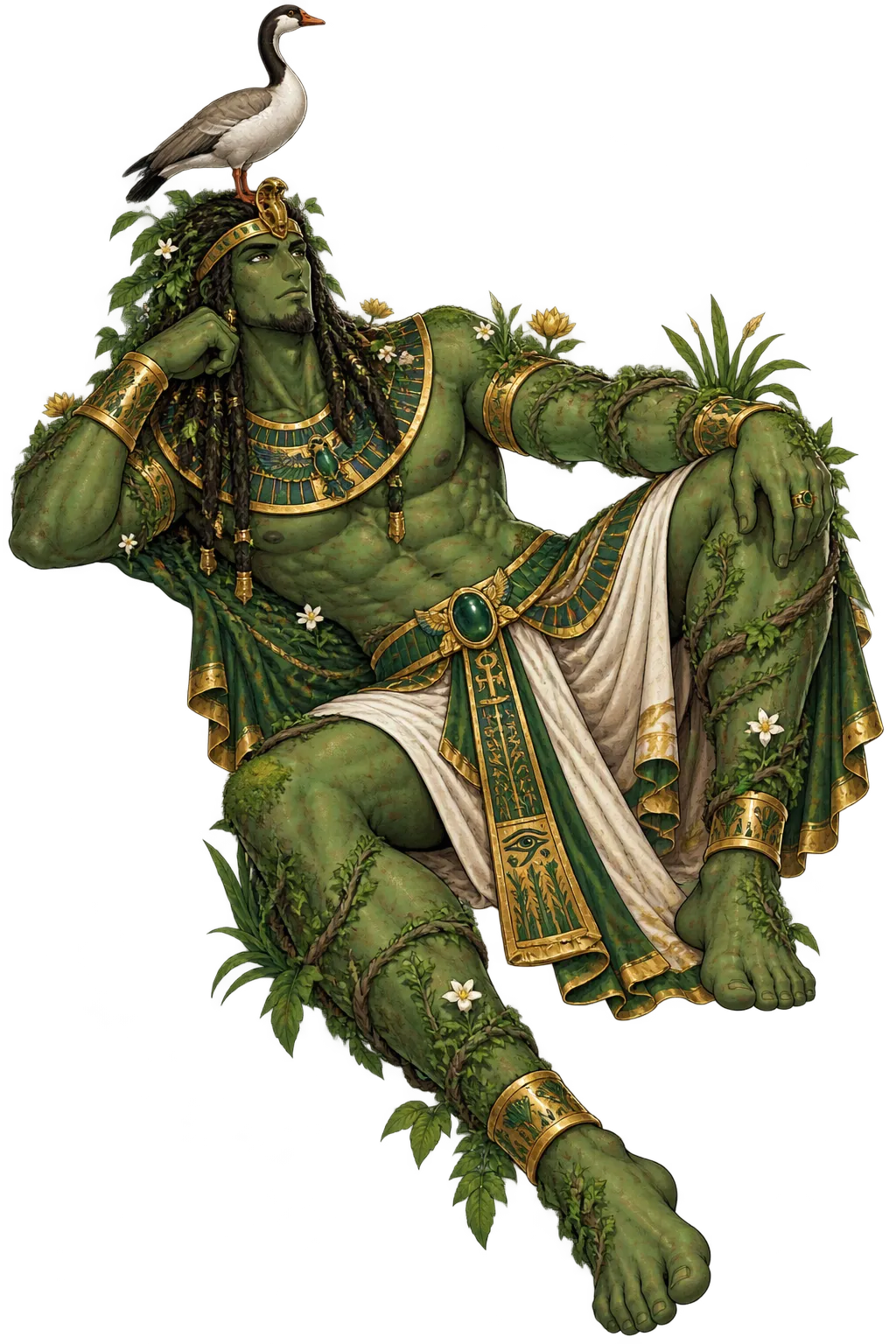
Stories of Gb
Geb’s mythology is the deep structure under the Osiris cycle: the separation of earth and sky that creates the world’s space, and the divine tribunal over which he presides when Horus and Seth dispute the succession. His jealousy of Osiris — in one strand he lies with Nut and fathers the five gods on the forbidden days — is the genealogical knot of the whole pantheon.
Born of Shu and Tefnut, Geb and Nut loved without space between them until Shu, on Ra’s command, wrenched them apart — and the world’s breathable distance dates from that separation. Geb’s green fertility and Nut’s starry vault remain arched apart for eternity, the air god’s arms the only thing between them.
Though the birth of the five gods belongs to Nut’s myth, the Pyramid Texts address Geb as their father and as the mountain of the west on which the dead king ascends. ‘You are Geb, the heir of the gods,’ the utterances tell the king — the earth is the ultimate estate of succession.
In the New Kingdom narrative of the divine lawsuit, the gods weary of the eighty-year dispute between Horus and Seth and appeal to Geb, who as earth and eldest remaining power hears the case and awards the Two Lands to Horus, assigning Seth to the desert and the thunder — the judicial myth behind the division of the living king from the dangerous margins.
Spell 125’s negative confession addresses the earth directly — ‘I have not polluted the soil’ — because the soil is Geb’s body and the dead enter it as guests. The grave itself, the shaft and chamber, is a doorway into the god; to be buried was literally to be taken into Geb.
The Laughing Earth Beneath the Sky
Gb — Geb — is the earth itself as a god: the ground that yields gold and grain, the floor of the world, and father of the third generation of the gods. He lies beneath his sister-wife Nut, parted from her by Shu, and his laughter is the tremor in the ground — the Egyptians heard earthquakes as the earth-god laughing.
The soil, the mines, the buried treasure: everything underfoot is his body and his property.
His sacred goose gives him the epithet “the Cackler”; his cry was the world’s first sound in some cosmogonies.
By Nut he fathered Osiris, Isis, Seth, Nephthys, Horus the Elder — the gods whose quarrels drive Egyptian myth.
He presides over the council of gods in the succession myth of Horus and Seth.
From the original script to the living URL
𓅬
The name in its original Egyptian form. Gb (𓅬) is attested in the source tradition — “Earth, goose (Egyptian gb)”. Its original diacritics and script distinctions carry the full phonetic and orthographic weight of the source tradition.
geb
The plain geb form is identical to the Unicode restoration. Because this name is already written in Latin letters, no diacritics, stress, or script information were lost — only capitalization differs.
Gb
The Unicode restoration does not need to recover lost marks for Gb. Its value is canonical spelling and consistent cataloguing, not the reconstruction of erased orthography. The domain is readable as-is to both DNS and humanity.
Gb.com
This restoration is written entirely in ASCII letters — no Punycode encoding stands between Gb and the DNS. The domain reads identically to machines and to human eyes.
The attested spelling family of Gb
Gb
Restores 𓅬. The full Unicode restoration. gb.com is not in the PuniCodex collection — it is watched for release; if it drops, this temple upgrades to an owned flagship. Attested by Faulkner, Wb.
How Gb was spoken
How Gb travels from ancient script to the modern URL
Egyptian gb; the original vocalisation is unknown. The name denotes the earth and is also written with the goose determinative.
The lore you have read is the living myth. Extended Lore opens the scholarly vault beneath it: the cult and its material remains, a history of the image, the name after antiquity, a meditation on what the name still means, and the full scholarly apparatus — etymology, orthography, sources.
Enter Extended Lore