
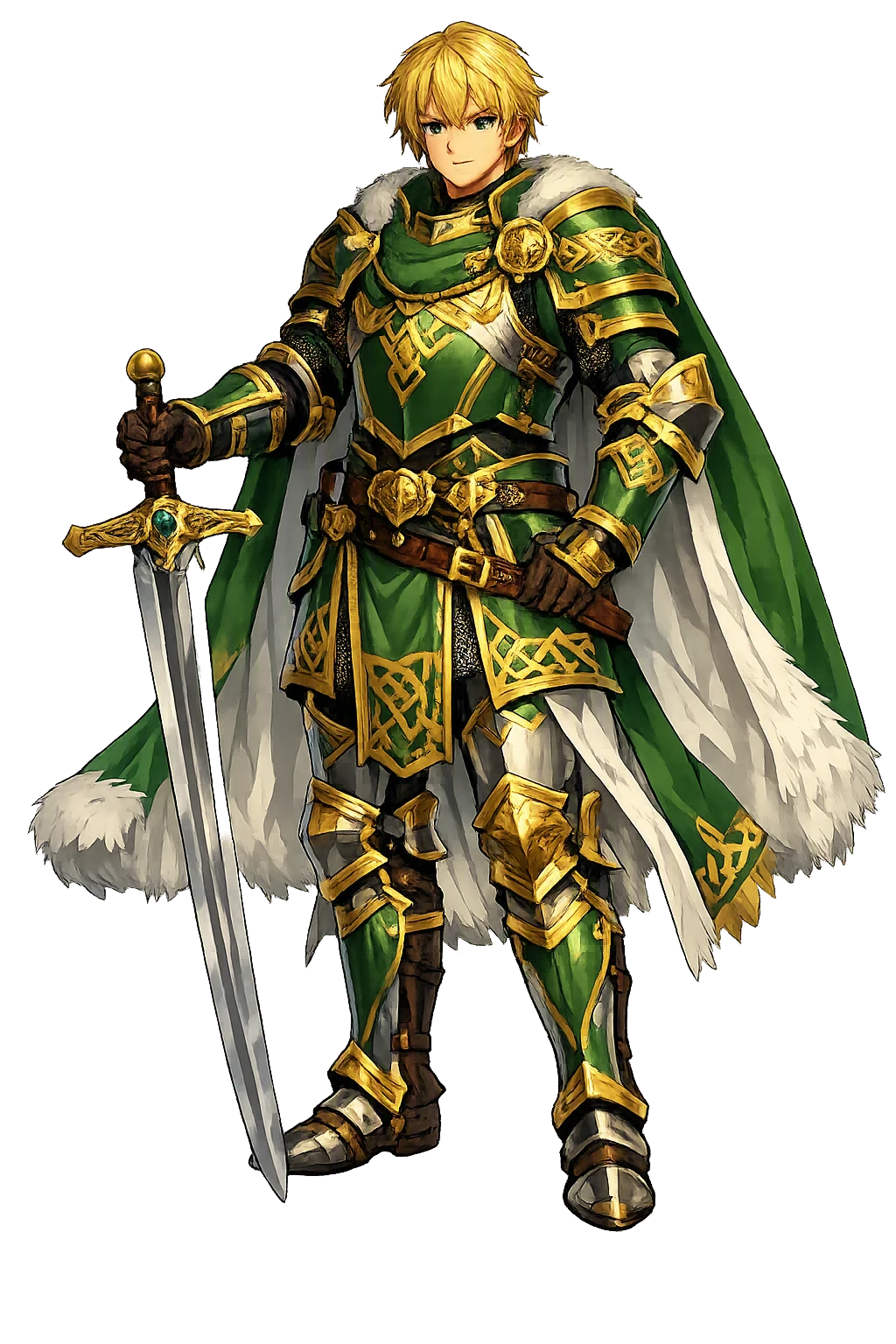
Pronouncing Gawain: a guide for the curious
Saying Gawain aloud is harder than reading it on a screen, and more rewarding. The restored spelling is a compressed pronunciation guide: every accent and macron is an instruction. This post unpacks those instructions — the reconstructed sound, the phoneme-by-phoneme record, the kindred forms in neighboring languages — and then zooms out to the full record around the name: its Celtic transcription writing, its mythology, its cult, and its modern life as a Unicode domain. Whether you arrive as a linguist, a reader of myth, or a domainer, you will leave able to say the name the way the evidence suggests it was said — and able to type it the way it was written.
At a Glance
- Restored name: Gawain
- ASCII form: gawain
- Meaning: "Little falcon"
- Domain of influence: Knight, Sun Hero
- Pantheon: Celtic
- Classification: Tier 2
Overview
Gawain (gawain) — Knight, Sun Hero · Little falcon — is Arthur's nephew and the courteous knight of the Welsh and continental cycles: Welsh Gwalchmai (also Gwalchmei), son of Gwyar, whom the oldest Arthurian tale in Welsh introduces with a single, complete characterization — 'he never returned home without achieving the quest he had gone to seek; he was the best of walkers and the best of riders.' From that Welsh beginning the figure travels farther than any other Arthurian knight: Geoffrey of Monmouth's Latin Walganus, Chrétien de Troyes' Gauvain — the fixed measure of cortoisie against whom every other knight of the Round Table is ranked — and finally the English Gawain of Sir Gawain and the Green Knight, where the Green Knight's beheading game tests him, at the turning of a year, for the one virtue the pentangle guards: truth.
The Welsh name is a transparent compound: gwalch, 'hawk', + Mai, 'May' — the 'hawk of May' of the standard philological reading; the PuniCodex lexicon keeps the traditional English gloss 'little falcon' for the same root-image. His dossier spans the Culhwch ac Olwen court-list and the Welsh Triads, Geoffrey's Historia Regum Britanniae and William of Malmesbury's report of his tomb, the romances of Chrétien and their continuations, the unique masterpiece of the Cotton Nero manuscript, and Malory's tragic Orkney feud.
PuniCodex restores the name as Gawain — identical to the ASCII input, because the canonical English form writes no diacritic. The mechanical rule therefore places it in Tier 2: nothing distinctive is lost in transit, a statement about orthography and never about the knight. No domain is claimed: the plain-ASCII gawain.com is registered to a third party outside the collection and is watched for release.
The Name
The name enters the record in Middle Welsh as Gwalchmai (variant Gwalchmei), mab Gwyar — son of Gwyar — and the standard philological analysis is a compound of gwalch, 'hawk', and Mai, 'May': the 'hawk of May'. Rachel Bromwich's edition of the Welsh Triads is the standing witness for both the form and the etymology, and the Geiriadur Prifysgol Cymru secures the first element, gwalch, as the ordinary Welsh word for a hawk or falcon; the lexicon's traditional English gloss 'little falcon' preserves the same root-image.
The continental career of the name is a chain of phonetic wear that scholarship has traced in detail: Geoffrey of Monmouth's Latin Walganus (and William of Malmesbury's Walwen) yields Old French Gauvain in Chrétien de Troyes and the cyclic romances, whence Middle English Gawayn — the spelling of the Cotton Nero manuscript — and modern English Gawain. The carved label GALVAGIN(VS) on the Modena Archivolt (c. 1120–1140) is the name's earliest attestation in art and predates Geoffrey's Historia.
The ASCII form gawain loses nothing, because the canonical English spelling is already plain Latin letters; the restoration is therefore a matter of canonical reference, not rescued diacritics, and the name is classified Tier 2 by the project's mechanical rule.
The letter-by-letter transformation runs:
- g → G — Same, capitalized
- a → a — Same
- w → w — Same
- a → a — Same
- i → i — Same
- n → n — Same
The project holds no domain for this name: gawain.com is registered to a third party outside the PuniCodex collection and is watched for release. The temple lives at its canonical lexicon address.
The Original Script
The name is preserved in medieval Welsh, Latin, French, and English manuscripts — all in the Latin alphabet. The Middle Welsh form is Gwalchmei / Gwalchmai, attested in the White Book of Rhydderch (NLW Peniarth 4–5, c. 1350) and the Red Book of Hergest (Jesus College MS 111, c. 1382–1410), the codices that carry Culhwch ac Olwen and the Welsh Triads. There is no non-Latin original script to restore: Welsh was written in Insular Latin letters from its earliest manuscripts, and the name's one epigraphic witness — GALVAGIN(VS) on the Modena Archivolt — is likewise carved in Latin capitals.
The scholarly rendering proceeds step by step:
- Middle Welsh writes the name Gwalchmei or Gwalchmai in the Latin alphabet; the spelling requires no diacritic.
- The name is a transparent compound: gwalch, 'hawk', + Mai, 'May' — the 'hawk of May' of Bromwich's Triads commentary; the lexicon's traditional gloss 'little falcon' keeps the same root-image.
- The continental chain — Latin Walganus, Old French Gauvain, Middle English Gawayn — is ordinary phonetic transmission within Latin-alphabet scribal culture; the Cotton Nero manuscript's Gawayn is the direct ancestor of the modern spelling.
- The Unicode restoration Gawain is therefore identical to the ASCII form apart from the capital; the temple form is a canonical reference, not a rescued spelling.
One caution attaches to the record: the standard etymology 'hawk of May' is the philological reading of the Welsh form, while the traditional English gloss 'little falcon' is the one this edition carries from its lexicon; both point to the same hawk, and the difference is one of analysis, not of substance.
Pronunciation
The reconstructed pronunciation of the Middle Welsh form is /ˈɡwalx.mai/ — Middle Welsh Reconstruction (Gwalchmai).
Phoneme by phoneme:
- Gw- — Labiovelar onset [ɡw], a single rounded g as in Welsh Gwyn, never two separate sounds
- -alch — Short open [a] followed by [lx]: the Welsh voiceless velar fricative ch, the rasp of Scottish loch, closing the stressed first syllable
- -mai — The word Mai, 'May', as a closing diphthong [mai], sounded like the English month
For the modern speaker, the closest approximation is: 'GWALH-my' — the gw of 'Guinevere', the ch of 'loch', and 'my' like the month of May. The later English form Gawain runs 'guh-WAYN' (/ɡəˈweɪn/), with the stress shifted to the second syllable.
Kindred and historical forms of the name:
- Middle Welsh — Gwalchmai, Gwalchmei, mab Gwyar — the form of Culhwch ac Olwen and the Triads
- Latin (Geoffrey of Monmouth) — Walganus; William of Malmesbury writes Walwen
- Old French (Chrétien de Troyes) — Gauvain, the courteous knight of the continental romances
- Middle English — Gawayn, the spelling of the Cotton Nero manuscript
- Temple form — Gawain, the canonical English form, plain ASCII
Gawain is Tier 2 because the restoration preserves nothing ASCII loses: the letters of the canonical form are the letters of the keyboard. The capital alone marks the temple form.
Mythology
Gawain's dossier runs from a Welsh triad to a fourteenth-century masterpiece; in every century someone is testing him, and the test is always the same — not whether he can fight, but whether he will keep faith.
The Knight Who Finished the Quest (Culhwch ac Olwen)
The oldest Arthurian tale in Welsh names him in its great muster at Arthur's court: Gwalchmei mab Gwyar, 'because he never returned home without achieving the quest he had gone to seek; he was the best of walkers and the best of riders; he was nephew to Arthur, the son of his sister, and his first cousin.' In a catalogue of hundreds of warriors and wonders, that is the whole of his entry — and the whole of his character: completion itself.
One of the Three Well-Endowed Men (Trioedd Ynys Prydein)
The Welsh Triads name Gwalchmai son of Gwyar among the Three Well-Endowed Men of the Island of Britain, beside Llacheu son of Arthur and Rhiwallawn Broom-Hair (Triad 4). Bromwich's edition is the standard witness for his name and its etymology: gwalch 'hawk' + Mai 'May'.
The Nephew of the King (Historia Regum Britanniae; William of Malmesbury)
Geoffrey of Monmouth (c. 1136) made him Latin: Walganus, son of Loth of Lodonesia and Arthur's sister Anna, given as a boy to the service of Pope Sulpicius, recalled and knighted, the steel edge of Arthur's Roman campaign — and one of the first to fall when Mordred's treason brings the army home, cut down at the landing on the Kentish shore. A generation earlier William of Malmesbury had written him as Walwen and reported his tomb, found in William's own day at Rhos in Pembrokeshire, fourteen feet long.
The Measure of Courtesy (Chrétien de Troyes)
In Chrétien's romances (c. 1160–1190), Gauvain is the standard against which every hero is measured: Erec et Enide ranks him first of the knights of the Round Table, and through Cligés, Lancelot, Yvain, and the Conte du Graal he moves as the court's fixed point — courteous without effort, brave without boasting. The Continuators give him a strength that doubles with the climbing sun and fails after noon, the trace later scholarship read as a solar memory.
The Bargain of the Green Chapel (Sir Gawain and the Green Knight)
At Camelot's New Year feast a giant all in green offers a Christmas game: one stroke at his neck with the great axe, against one in return a year and a day hence at the Green Chapel. Gawain takes the challenge and strikes the head clean off; the Green Knight retrieves it and names the tryst. The year turns; Gawain rides north through winter to keep his word. At Hautdesert the lord Bertilak proposes an exchange of each day's winnings, and for three days the lady of the castle tests his courtesy in his chamber: each evening he faithfully renders the kisses he has received — but on the third day he keeps back the green girdle said to preserve his life. At the Green Chapel the axe falls three times: twice withheld, and once — for the kept-back girdle — a nick in the neck. The Green Knight reveals himself as Bertilak, sent by Morgan le Fay; Gawain wears the girdle home as his 'token of untruth', and Camelot binds a green lace on every shoulder in his honor.
The Last Letter (Le Morte Darthur)
Malory's Sir Gawaine is the courteous knight grown tragic: head of the Orkney clan, whose feud with Lancelot — after Gareth and Gaheris are slain in the fire of Guenevere's rescue — drags the fellowship to ruin. Wounded at Dover, he dies of the reopened wound, writing with his own hand the letter that calls Lancelot 'flower of all noble knights'; and on the eve of Salisbury Plain he returns in Arthur's dream, warning the king not to fight Mordred on the morrow.
Symbols & Iconography
Gawain's attributes are a name, a shield, a lace, a horse, and a wound — the most precisely itemized regalia of any Arthurian knight:
- The hawk — Gwalch in his Welsh name: the raptor of the genealogies, swift sight and swift return
- The pentangle — The five-pointed star Solomon set on his shield in the Green Knight poem: five senses, five fingers, the five wounds of Christ, the five joys of Mary, and the five knightly virtues — fraunchyse, felawschyp, clannes, cortaysye, and pit — bound in one endless knot by truth
- The green girdle — The lace of silk and gold kept back from the exchange of winnings at Hautdesert: worn home as his 'token of untruth', then taken up by the whole court as a badge of honor
- The waxing strength — The continuators' gift: a power that rises with the sun to noon and fails after — the trace the scholars read as a solar hero
- The nick in the neck — The single cut of the third stroke at the Green Chapel: the wound that is also a verdict, which he refuses to let heal into forgetfulness
Archaeology & Evidence
Gawain is a textual figure with one famous epigraphic witness. The Modena Archivolt — the carved portal relief of Modena Cathedral, dated c. 1120–1140 — depicts an Arthurian rescue scene with the figures labeled in stone: Artus de Bretania, Che (Cei), and GALVAGIN(VS), Gawain himself — the earliest Arthurian image in medieval art, carved a generation before Geoffrey of Monmouth finished the Historia. William of Malmesbury (c. 1125) adds the tradition's one grave: the tomb of Walwen, he reports, was found in his own time on the seashore at Rhos in Pembrokeshire, fourteen feet long.
His manuscript witnesses are exact: Culhwch ac Olwen survives in the White Book of Rhydderch (NLW Peniarth 4–5, c. 1350) and the Red Book of Hergest (Jesus College MS 111, c. 1382–1410); Sir Gawain and the Green Knight survives uniquely in British Library MS Cotton Nero A.x (c. 1400), the small quarto it shares with Pearl, Cleanness, and Patience.
Realm & Domain
Gawain is catalogued under the domain 'Knight, Sun Hero' — two words that map the two halves of his dossier: the living knight of the romances, and the older power that twentieth-century scholarship read beneath him.
The Knight
From Culhwch ac Olwen onward he is the quest that comes home; from Chrétien onward he is the measure of cortoisie, the knight against whom Erec, Lancelot, Yvain, and Perceval are all ranked; in the Green Knight poem he is the chosen test of truth itself — courteous, brave, and, once, humanly false by the width of a green lace.
The Sun Hero
The continuators of Chrétien's Perceval give Gauvain a strength that doubles as the sun climbs to noon and fails as it declines — a motif the romances state plainly and never explain. Twentieth-century scholarship, above all Jessie Weston and Roger Sherman Loomis, read the waxing and waning strength as the trace of a faded solar hero behind the courteous knight: a theory argued at book length, never proven, and registered here as interpretation rather than fact.
The Hawk of May
The name itself carries the third image: gwalch + Mai, the spring hawk — swift sight, swift return, and the season of setting out.
Across Cultures
Gawain's deepest comparative file is Irish. The beheading game has its classic Celtic witness in Fled Bricrenn, Bricriu's Feast, where the giant Uath — 'Horror' — offers the Ulster heroes precisely the Green Knight's bargain: strike off my head today, and I strike yours tomorrow. Only Cúchulainn takes the axe twice and kneels for the return stroke; the giant brings the blade down blunt, and the champion's portion is judged his. Kittredge's Study of Gawain and the Green Knight (1916) made the Irish episode the standing source-analogue of the English poem, and the comparison has been refined, never abandoned.
The loathly-lady strand of Gawain's story — Dame Ragnelle, whose riddle is answered with sovereignty — has its own Irish kin in the sovereignty-goddess tales, where a hag becomes a queen when a king will kiss her; the comparison is standard in the scholarship of the English Gawain romances.
Within the Welsh tradition his standing companions are Cei and Bedwyr, the pair Culhwch ac Olwen sends beside him on the quest of the Olwen tasks; within the wider pantheon his nearest structural kin is Cúchulainn himself, the only other hero in Celtic story who knelt under the return stroke. The Welsh tradition never made him a god; it made him something rarer — the knight every other knight is measured against.
Cultural Legacy
Gawain is the Arthurian figure with the longest continuous critical life. Chrétien made him the definition of cortoisie; the Gawain-poet made him the test-case of truth; Malory made him the tragedy of loyalty. Tennyson split him in two, taking his courtesy for the early Idylls and his Orkney darkness for the last.
The twentieth century gave him back to the scholars: Weston and Loomis argued his solar and Celtic pedigrees at book length, and the Tolkien–Gordon edition of Sir Gawain and the Green Knight (1925) made the poem a fixed star of the English canon. Harrison Birtwistle's opera Gawain (1991) set the Green Chapel to music, and the twenty-first century has filmed the poem twice. Through it all the Welsh name never went anywhere: Gwalchmai still stands in the Triads, the hawk of May, waiting at Arthur's court for the quest to be finished.
A Meditation
Gawain is the patron of the errand that must be finished and the word that must be kept — and the Green Knight poem's genius is to show that these are not the same virtue. He finishes everything: the quest, the journey north, the appointment no one would blame him for missing. And still he fails, once, by the width of a green lace — not from cowardice, says the poem, but from love of his own life. The court's answer is the tradition's answer: the failure is not hidden but worn, and what one man wears as his shame the fellowship takes up as its badge.
The pentangle on his shield has truth at its center because truth is the one knot that cannot be slipped; everything else — courage, courtesy, purity, fellowship, pity — hangs from it. Gawain asks the question every promise asks: not whether you are brave enough to keep it, but whether you are honest enough to say what it cost.
The Unicode Restoration
Gawain is classified as Tier 2: the restoration needs no distinctive letters or diacritics its ASCII form would lose. The ASCII fallback gawain still resolves everywhere, but it is the restored form that carries the name's full information. That is the whole thesis of this temple: the marks are the message.
Why This Restoration Matters
Pronunciation turns out to be the heart of the matter. The marks in Gawain are instructions for the voice, and a web that strips them is a web that mispronounces the past at scale. The restoration hands the instructions back: say it as the evidence suggests, type it as the tradition wrote it, and let the punycode machinery do the quiet translation in between. That is all the PuniCodex project asks of the infrastructure — and everything it asks of you, the reader, is to use the whole name.
Explore Further
This post is one doorway into the temple. The home page carries the full character breakdown and the ambient canvas; the lore page tells the myths in long form; the Scholarly Edition preserves the sources, pronunciation data, and revision history; and the patron wall supports the restoration directly. For the wider map, browse the Lexicon, explore the Pantheon, or return to the PuniCodex blog.
Related Names
Sources
The full scholarly apparatus — every citation, revision, and review — lives in the Scholarly Edition. Key references for this post:
- Bromwich, Rachel, and D. Simon Evans, eds., Culhwch and Olwen: An Edition and Study of the Oldest Arthurian Tale (Cardiff: University of Wales Press, 1992).
- Tolkien, J. R. R., and E. V. Gordon, eds., Sir Gawain and the Green Knight, 2nd ed. rev. Norman Davis (Oxford: Clarendon Press, 1967).
- Koch, John T., ed., Celtic Culture: A Historical Encyclopedia, 5 vols. (Santa Barbara: ABC-CLIO, 2006), s.v. Gwalchmai.
- Bromwich, Rachel, ed. and trans., Trioedd Ynys Prydein: The Triads of the Island of Britain, 3rd ed. (Cardiff: University of Wales Press, 2006), notes to Triad 4, s.n. Gwalchmai.
- Lexicon authorities for this entry: Arthurian legend, MacKillop.