The Living Myth
Wisdom, Beginnings, Obstacle-Removal · The Lord of Beginnings
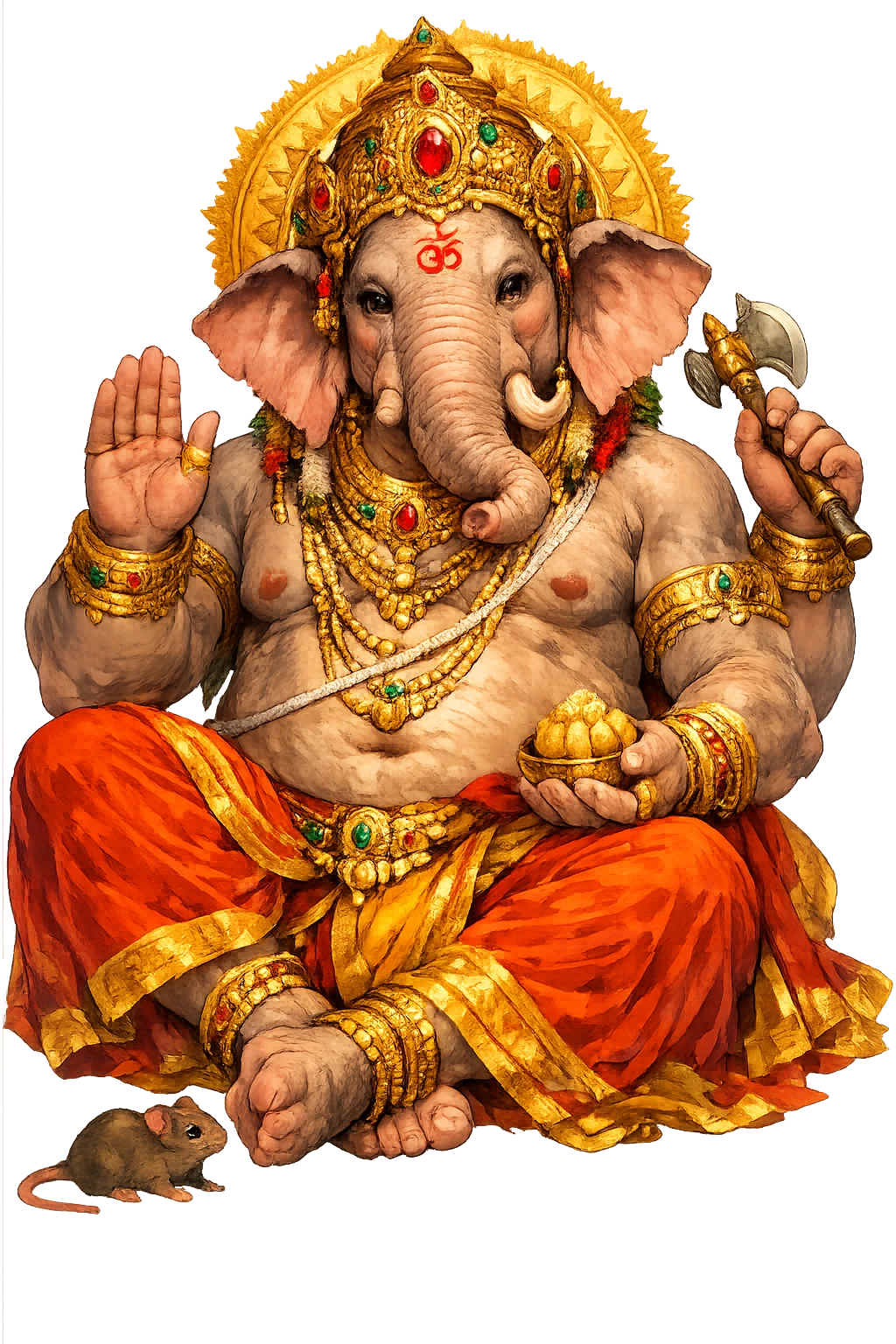
Stories of Gaṇeśa
Gaṇeśa's myths are the theology of thresholds: a boy made by his mother, beheaded by his father, and reborn with an elephant's head; a race lost by the fast and won by the devout; a mouse ridden like a lesson. Every story ends at a doorway — with wisdom, patience, or a well-placed curse standing guard.
While Pārvatī bathed, she shaped a boy from the turmeric paste and unguents rubbed from her own body and set him at her door with orders to let no one in. Śiva returned, was stopped, and an argument became a battle; Śiva's trident struck off the boy's head (Śiva Purāṇa, Rudrasaṃhitā 2.13–18; the Liṅga Purāṇa tells the same core story). Pārvatī's grief summoned armies of goddesses and nearly unmade the three worlds; to appease her, Śiva sent his gaṇas to bring the head of the first creature found facing north — they returned with an elephant's head — and restored the boy, declaring him his own son and granting him precedence at every beginning. The household myth carries a complete theology: the child made by the mother alone is legitimate, the father's violence is repaired by fatherhood, and the new head — elephantine, wise, unforgetting — makes the boy instantly recognizable across languages and regions. Gaṇeśa is born from the union of error and repair, which is to say, from family life itself.
Śiva set his two sons a contest: circle the world, and the winner takes the fruit of knowledge. Skanda — Kārttikeya, the war-god — leapt instantly onto his peacock and vanished over the horizon. Gaṇeśa, on his tiny mouse, had not the speed to compete; instead he rose, walked once slowly around his seated parents, and returned. Asked what he had done, he answered that his parents were his whole world — and Śiva awarded him the prize (the story is told in the Purāṇic tradition, notably in the Skanda Purāṇa cycle, and endlessly retold in regional literature). The nimble brother loses to the one who redefines the race: not the circumference of the earth but the circle of love is the measure of a world. The myth doubles as Gaṇeśa's charter for precedence — invoked first at beginnings — and as one of Hinduism's gentlest arguments that devotion outruns performance. It also quietly sorts the brothers' domains: Skanda, god of war and distance; Gaṇeśa, god of doorways and return.
Gaṇeśa's mount is a mouse — muṣika — and the tradition does not let the absurdity pass unexamined. In one account the mouse began as a demon, Muṣikasura, who gnawed through scriptures and granaries until Gaṇeśa subdued him and, instead of destroying him, took him as a vehicle (the tale belongs to the Gaṇeśa Purāṇa and the Mudgala Purāṇa cycles). The symbolism is deliberately homely: the mouse is desire — small, quick, endlessly gnawing, always hungry — and the vast elephant-headed god rides it to show that wisdom does not destroy appetite but seats itself upon it. India's greatest temples and its smallest grain-stores share the same theology: what you cannot exterminate, you must learn to ride. The mouse beneath Gaṇeśa is the mind beneath the meditator, and the god's comfortable seat is the tradition's image of what mastery looks like when it is no longer a struggle.
When Vyāsa needed a scribe for the Mahābhārata — the longest poem in the world — he chose Gaṇeśa, who agreed on one condition: the dictation must never pause. Vyāsa countered with his own condition: Gaṇeśa must understand every verse before writing it (Mahābhārata, Ādi Parvan 1, vulgate recension). So began the epic's great race: the sage composing at the edge of comprehension, the god writing at the edge of speed. And in the famous detail, Gaṇeśa's stylus wore down and, unwilling to break his promise, he snapped off his own tusk and wrote on with it. The broken tusk became his emblem — the god who paid a piece of himself for the text's sake — and the epic acquired a patron deity of scholarship. The myth frames all writing as a vow between two parties, each holding the other to greatness: the teacher who must never stop, the student who must never stop understanding. Every examination hall in India invokes the tusk-broken scribe for exactly this reason.
One night after a feast, Gaṇeśa rode his mouse home beneath a full moon, and when the mouse startled at a snake and threw him, the moon — Soma, proud of his beauty — laughed at the pot-bellied god sprawled in the dust. Gaṇeśa cursed him: whoever looks at you shall be falsely accused and lose his good name (the story is told in the Gaṇeśa Purāṇa's Kṛḍā-khaṇḍa). The moon's radiance was eaten away, the gods begged mercy, and Gaṇeśa relented — but kept a lesson in the sky: the dark fortnight is the curse's remainder, and moon-gazing on his own festival remains taboo. The myth explains the lunar month and the etiquette of Gaṇeśa Caturthī in a single stroke, and its moral is a god-sized version of a household truth: laughter at another's fall is the one debt the heavens always collect. Even the moon, who shines on everything, was taught what it costs to shine on someone's shame.
Wisdom, Beginnings, Obstacle-Removal
Gaṇeśa is the doorway-god of the Hindu pantheon. No ritual, wedding, venture, or text is properly begun until he has been honored, for he holds the keys to vighna — the obstacles that cluster at every threshold. Yet he is more than a divine doorman: he is the patron of learning, the scribe of epic poetry, and the sovereign of the gaṇas, the unruly hosts who serve Śiva.
Gaṇeśa is buddhi-siddhi, the lord of discernment; students invoke him before examinations and scholars before writing.
Every new undertaking — a house, a book, a marriage — begins with Gaṇapati pūjā, sealing the threshold against ill fortune.
As Vighneśvara he both places and removes obstacles; his axe cuts through the inner and outer impediments to dharma.
He commands the divine hosts, transforming chaos into ordered retinue; his sovereignty is over categories themselves.
From the original script to the living URL
गणेश
The name in its original Sanskrit form. Gaṇeśa (गणेश) is attested in the source tradition — “Lord of the gaṇas (from गणेश)”. Its nasal retroflexes and palatal/retroflex sibilants carry the full phonetic and orthographic weight of the source tradition.
ganesha
Reduced to plain ganesha, the name loses everything that made it specific: nasal retroflexes and palatal/retroflex sibilants. What remains is an ASCII string that machines can parse but that no longer speaks with its original voice.
Gaṇeśa
The Unicode restoration recovers what ASCII flattened. Gaṇeśa restores nasal retroflexes and palatal/retroflex sibilants, returning the name to its original written dignity. The domain encodes to Punycode, but the browser displays the truth.
Gaṇeśa.com → xn--gaea-n5a6355b.com
The non-ASCII characters in Gaṇeśa are encoded while the ASCII remains visible. To the DNS, it is Punycode. To humanity, it is Gaṇeśa.
Owned, ideal, and ASCII forms of Gaṇeśa
Gaṇeśa
Restores गणेश. The live temple domain — gaṇeśa.com.
ganesha
Flattens गणेश. The plain ASCII fallback — what DNS and legacy systems see.
How Gaṇeśa was spoken
How Gaṇeśa travels from ancient script to the modern URL
Sanskrit Gaṇeśa; from gaṇa “troop, host" + īśa “lord", hence “Lord of the Gaṇas".
Wisdom, Beginnings, Obstacle-Removal
The IAST form Gaṇeśa uses registrable Latin diacritics; the Devanagari form is not supported in .com.
The lore you have read is the living myth. Extended Lore opens the scholarly vault beneath it: the cult and its material remains, a history of the image, the name after antiquity, a meditation on what the name still means, and the full scholarly apparatus — etymology, orthography, sources.
Enter Extended Lore