Stories of Gaîa
Gaia's myths are cosmogonic. She is the stage on which everything happens, but she is also an actor who intervenes whenever the cosmic order threatens her children — and her interventions set generation after generation against the last. Sky, sea, giants, and prophecy all begin with her.
Hesiod's Theogony (116–133) opens the cosmos with four names: Chaos — the gaping void — then Gaia, broad-bosomed, the ever-sure foundation of all, then the deep Tartaros, then Eros, fairest among the deathless gods. Gaia acts immediately and without a mate: she bears Ouranos, starry Sky, to cover her all around; the Ourea, the Mountains; and Pontos, the barren Sea. Then, lying with Ouranos, she bears the deep-eddying Ocean with his river-children, the twelve Titans, the one-eyed Cyclopes who will forge Zeús's thunderbolt, and the three Hundred-Handers, Kottos, Briareos, and Gyges — 'unspeakable, presumptuous children' whom their father hated from the first. The structure is the poem's foundation stone: before gods, before sex, before violence, there is Earth — self-arising, self-sufficient, and already more fertile than anything that will come after her.
Ouranos hated his children and, as each was born, pushed it back into Gaia's womb, where the Titaness groaned with her crowded, straitened burden (Theogony 154–160). In pain and fury Gaia fashioned a great sickle of grey adamant and addressed her sons; only the youngest, crooked-counseled Kronos, dared the deed. That night Ouranos came down desiring to lie full-spread upon her — and Kronos, waiting in ambush, cut off his father's genitals with the sickle and threw them behind him. From the drops of blood that fell on Gaia sprang the terrible Erinyes, the great-armored Giants, and the ash-tree Meliai, nymphs of the mountains; from what fell in the sea, the white foam, was born Aphrodítē (Theogony 173–206). The act founds the whole drama of divine succession: each generation of the cosmos overthrows the last — and Gaia, generation after generation, mothers the weapon and chooses the son.
Before Apóllōn there was Gaia. Aeschylus has the Pythia open the Eumenides (1–8) by naming the succession of owners at Delphi: first among gods, Gaia; and after her Themis, her daughter, held the seat; then another Titan, Phoibe, gave it as a birthday gift to Phoibos — that is, Apóllōn. The dragon Pythôn, child of Earth, guarded the oracular spring until the young god slew it and took the tripod for his own. Pausanias (10.5.5–7), standing at Delphi in the second century CE, was told that the very oldest cult there was Earth's, and he records the omphalos — the stone navel of the world — as Gaia's marker. Delphi's famous tripod thus sits on a transferred throne: the most Olympian of all oracles began as the voice of the ground itself, and every prophet who sat on it did so with the earth's original sanction.
When the Olympians defeated the Titans, Earth answered with a harder brood. The sources disagree on the Giants' paternity, which is itself instructive: Hesiod makes them spring from Ouranos's blood on the earth (Theogony 183–187); Apollodorus (1.6.1) has Gaia bear them by Sky in anger at the loss of the Titans; Hyginus (Praefatio) names Tartaros as their father. All agree on what they were — earthborn, serpent-legged, armored — and on the war's outcome: the gods, needing a mortal's hand, prevailed with Hēraklēs' bow, and the defeated Giants were buried beneath the volcanoes, where their buried fire still betrays them. The Gigantomachy became antiquity's favorite image of order over chaos, carved across the Great Altar of Pergamon, the Siphnian Treasury, and hundreds of vases. Gaia's role is consistent: whenever the new order crushes the old, the earth defends her own — and loses, but never without producing one more brood.
Gaia's knowledge runs ahead of Zeús's power. Both Zeús and Poseidôn courted the sea-goddess Thetis until the truth reached them — Aeschylus' Prometheus Bound (755–770) and Pindar's Isthmian 8 (26–47) both preserve the prophecy — that Thetis was fated to bear a son mightier than his father. The king of the gods, who had overthrown his own father, declined to repeat the lesson; Thetis was married off to the mortal Peleus, and their son was Achilles, greatest of the Achaeans and shorter-lived than any of them. Pindar tells the story as praise of divine restraint: the goddess put off the embrace of Zeús and of Poseidôn alike, choosing a mortal marriage for which the gods paid her honor. It is Gaia's ancient prerogative that makes the plot work — the oldest goddess owns the oldest information, and even Olympus must consult the ground before it marries.
Land, Fertility, Prophecy, and the Mother of All
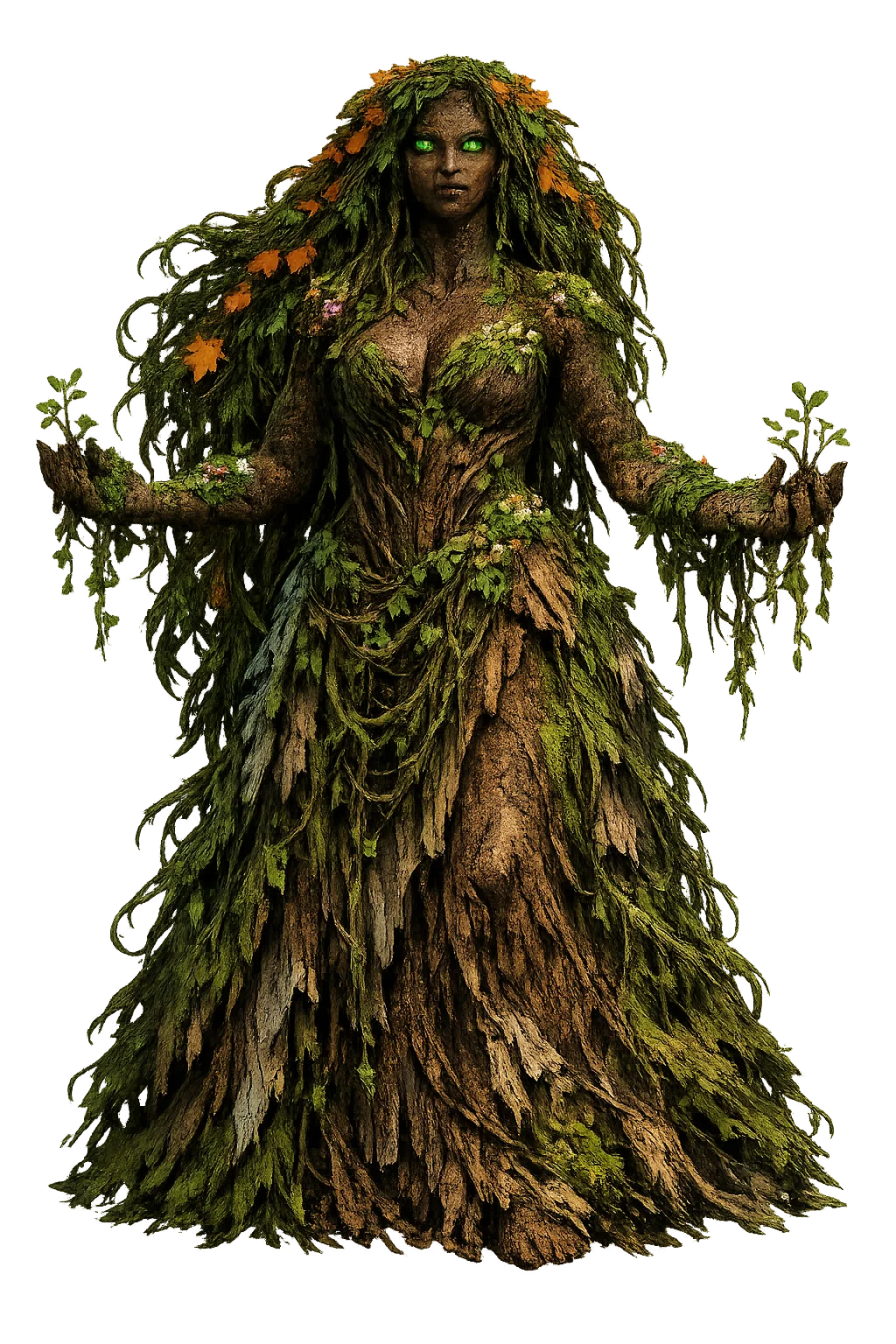
Gaia is not a goddess of the earth; she is the earth. In Hesiod's cosmogony she is the first thing to emerge from Chaos, the ever-stable foundation from which sky, sea, mountains, and gods are born. She is the original mother, the ground of being.
Mountains, plains, seas, and caves are her body; the earthquake is the earth turning in her sleep.
Without a mate she bore Ouranos, the Ourea, and Pontos; with Ouranos, the twelve Titans, the Cyclopes, and the Hundred-Handers (Theogony 126–153).
Delphi was Earth's oracle first — Gaia, then Themis, then Phoibe, before Apóllōn's arrival (Aeschylus, Eumenides 1–8).
When Ouranos buried her children back inside her, she forged the adamant sickle and armed Kronos (Theogony 154–172).
The stone 'navel' of the world at Delphi marked Gaia's primeval sanctuary; oaths and oracles radiated from the earth's center (Pausanias 10.5.5–7).
From the original script to the living URL
Γαῖα
The name in its original Greek form. Gaîa (Γαῖα) is attested in the source tradition — “Earth (from γαῖα)”. Its diphthongs and acute accents carry the full phonetic and orthographic weight of the source tradition.
gaia
Reduced to plain gaia, the name loses everything that made it specific: diphthongs and acute accents. What remains is an ASCII string that machines can parse but that no longer speaks with its original voice.
Gaîa
The Unicode restoration recovers what ASCII flattened. Gaîa restores diphthongs and acute accents, returning the name to its original written dignity. The domain encodes to Punycode, but the browser displays the truth.
Gaîa.com → xn--gaa-wma.com
The non-ASCII characters in Gaîa are encoded while the ASCII remains visible. To the DNS, it is Punycode. To humanity, it is Gaîa.
Owned, ideal, and ASCII forms of Gaîa
Gaîa
Restores Γαῖα. The live temple domain — gaîa.com.
gaia
Flattens Γαῖα. The plain ASCII fallback — what DNS and legacy systems see.
How Gaîa was spoken
How Gaîa travels from ancient script to the modern URL
Greek Γαῖα; from γῆ "earth". Gaia is the primordial Earth goddess, the first being to emerge from Chaos and the ancestral mother of all life in Hesiod's Theogony.
Earth, Mother of All
The Unicode restoration Gaîa preserves Greek stress and length; the ASCII form gaia loses these features.
The lore you have read is the living myth. Extended Lore opens the scholarly vault beneath it: the cult and its material remains, a history of the image, the name after antiquity, a meditation on what the name still means, and the full scholarly apparatus — etymology, orthography, sources.
Enter Extended Lore