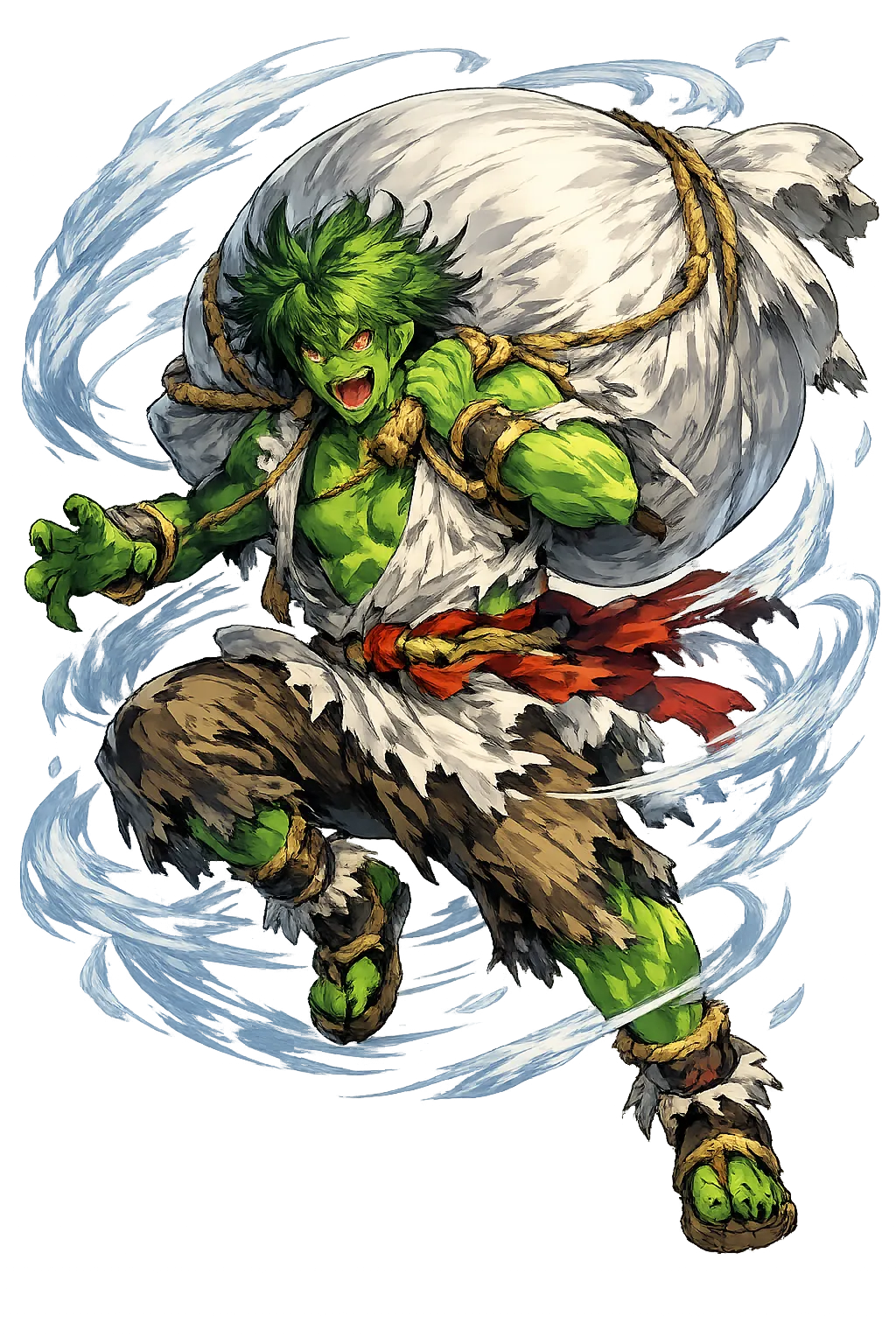
Stories of Fūjin
Fūjin's mythology is grounded in the creation narratives of the Kojiki and Nihon Shoki, in esoteric Buddhist iconography, and in the visual tradition of Japanese screen painting. He is both a primordial force and a temple guardian — and, in national memory, the wind itself that twice saved Japan.
The wind kami are older than the name Fūjin. In the Kojiki's birth-of-the-kami sequence, the wind god Shina-tsu-hiko (志那都比古) and his partner Shina-tsu-hime are born as Izanagi and Izanami take stock of the elemental kami of the new-made land; the Nihon Shoki preserves the lovelier etiology — Izanagi, looking out over the country he had made, found it wrapped in morning mist, breathed, and blew the fog away, and that first breath became the wind god. The thunder kami have a harsher nativity: when the fire god Kagutsuchi burned his mother Izanami to death, Izanagi cut him down, and from the sword's blood were born the thunder gods, among them Takemikazuchi — born, like storm's own electricity, from the catastrophe of fire itself. The demonic figure called Fūjin — leopard skin, wind-bag, streaming hair — is the later, Buddhist-inflected portrait of these older kami of the moving air.
When Amaterasu hid herself in the heavenly rock-cave (Ama-no-Iwato), the world did not merely lose its light — it lost its motion: the kami assembled in the dark, and the very winds of heaven stilled with everything else. The ritual comedy by which the goddess was lured back — the cock, the mirror, Ame-no-Uzume's dance on an upturned tub — is therefore also a weather-myth: when the cave door opened, light returned with wind, rain, and the movement of all things (Kojiki; Aston's Nihongi).
The medieval tradition that paired Fūjin with Raijin at temple gates read this old story into architecture: wind and thunder stand together at the threshold because both are signs that the hidden has come back out. A temple gate with Fūjin on one side and Raijin on the other is a frozen Ama-no-Iwato — kept open.
In esoteric Buddhism the wind god is Fūten, one of the Twelve Devas (jūniten) who stand guard around the mandala, assigned in the Japanese tradition to the north-west. He is the Vedic Vāyu carried east along the Silk Road — the Indian wind god appears among the outer guardians of the Womb-realm mandala — and Japan re-dressed him in the kami's leopard skin and gave him Raijin for a brother. Temples fixed the pair in the national imagination: Kanō Tan'yū's wind-and-thunder paintings at Sanjūsangen-dō in Kyōto and Tawaraya Sōtatsu's celebrated Fūjin-Raijin folding screens at Kennin-ji turn two directional guardians into an eternal weather-front.
In the mandala, Fūten's work is apotropaic: he sweeps the ground clean of obstacles before the rite begins — the wind as the broom of the sacred.
In 1274 and again in 1281, the Mongol fleets of Kublai Khan stood off Japan's shores, and both times great typhoons smashed the invading armadas at anchor. Medieval Japan named the deliverance kamikaze — the divine wind — and temple tradition credited the storm kami with the victory: the very winds that Fūjin keeps in his bag. Court and shrine celebrated the miracles (the Hachiman and Kasuga cults each claimed the credit), and the government's prayers at Iwashimizu and elsewhere had, in effect, been answered by weather. The episode matters for Fūjin because it moved him from the mandala's margin to the center of national memory: the wind-bag god became the patron of a country's survival.
Modern scholarship reads the typhoons soberly as meteorology, but the medieval reading — that Japan's storms were its gods — shaped Japanese identity for seven centuries, down to the word's darkest reuse in 1944.
Storms, Breath, Destruction, and Renewal
Fūjin is the wind made wild. In Japanese art he appears as a fierce demon, hair streaming, clad in a leopard-skin loincloth, carrying a vast bag of winds on his shoulders. When he opens it, gales tear through forests, scatter roofs, and flatten fields; when he closes it, the air grows still. He is one of the oldest kami in the Japanese pantheon, a destructive force that is also necessary for pollination, dispersal of seeds, and the cleansing of stale air.
He is the brother or counterpart of Raijin, the thunder god, and the two are often depicted together at temple gates, where their terrifying presence keeps danger away from sacred ground.
He carries a great sack slung over his shoulders; opening it releases the winds of the world.
His fierce face and muscular body mark him as one of the powerful oni-like kami who protect temples.
He is paired with the thunder god at temple gates and in screen paintings, storm and wind as twin forces.
Beyond destruction, wind is the breath that moves pollen, carries clouds, and clears the air for new growth.
From the original script to the living URL
風神
The name in its original Japanese form. Fūjin (風神) is attested in the source tradition — “Wind god”. Its macron-length vowels carry the full phonetic and orthographic weight of the source tradition.
fujin
Reduced to plain fujin, the name loses everything that made it specific: macron-length vowels. What remains is an ASCII string that machines can parse but that no longer speaks with its original voice.
Fūjin
The Unicode restoration recovers what ASCII flattened. Fūjin restores macron-length vowels, returning the name to its original written dignity. The domain encodes to Punycode, but the browser displays the truth.
Fūjin.com → xn--fjin-v7a.com
The non-ASCII characters in Fūjin are encoded while the ASCII remains visible. To the DNS, it is Punycode. To humanity, it is Fūjin.
Owned, ideal, and ASCII forms of Fūjin
Fūjin
Restores 風神. The live temple domain — fūjin.com.
fujin
Flattens 風神. The plain ASCII fallback — what DNS and legacy systems see.
How Fūjin was spoken
How Fūjin travels from ancient script to the modern URL
Sino-Japanese compound fū 'wind' + jin 'god, spirit'; a kami of wind and storms.
Wind, storms, and the elemental power of the air.
Hepburn Fūjin with macron is registrable in .com; the kanji form is not.
The lore you have read is the living myth. Extended Lore opens the scholarly vault beneath it: the cult and its material remains, a history of the image, the name after antiquity, a meditation on what the name still means, and the full scholarly apparatus — etymology, orthography, sources.
Enter Extended Lore