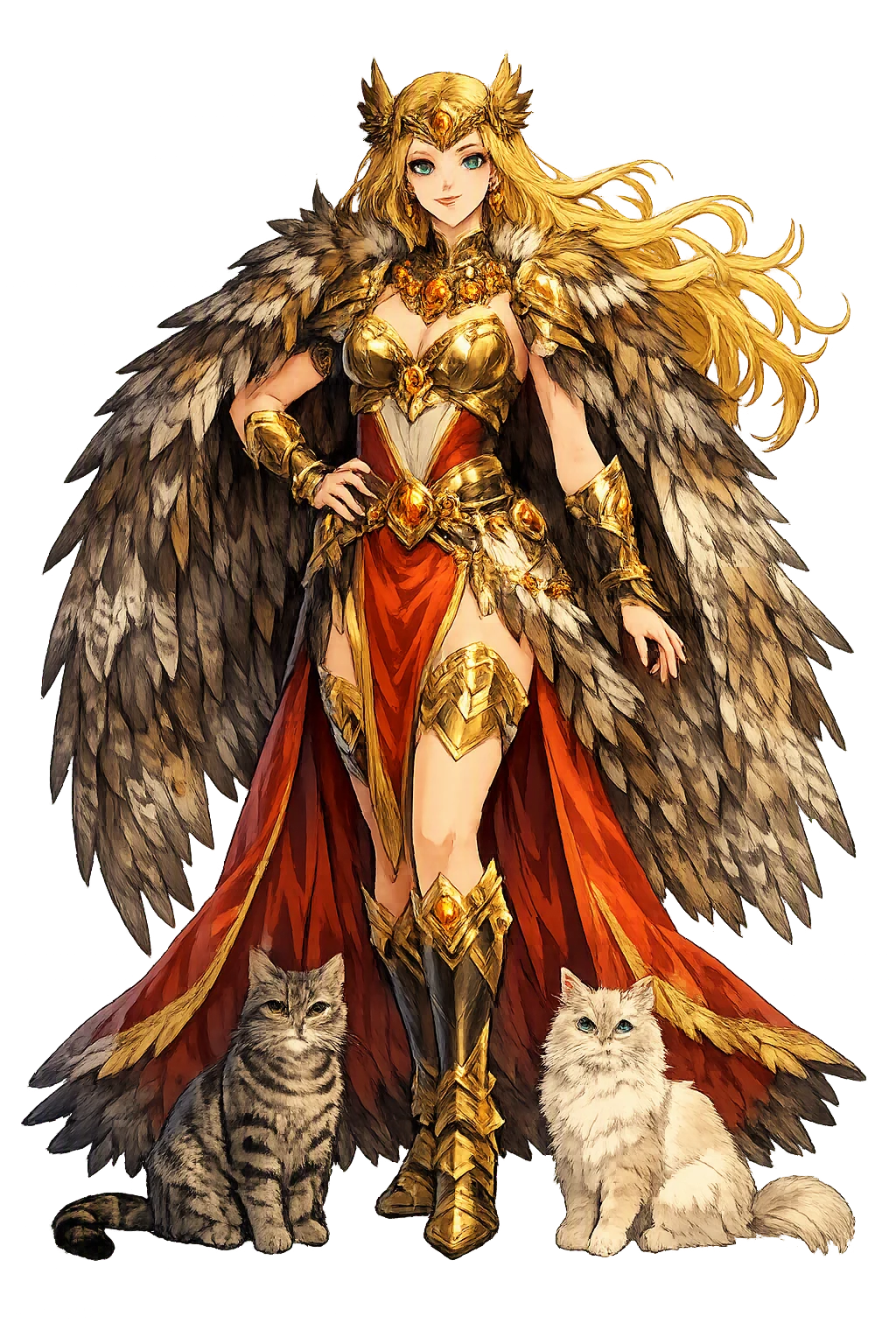
Stories of Freyja
Freyja is everywhere in the Norse corpus: the Poetic Edda, Snorri's prose, and the opening chapters of Heimskringla all circle her — her hall among the dead, her magic, her necklace, her lost husband, and the flyting in which Loki names her last.
Snorri places Freyja beside Frigg as foremost among the goddesses, and gives her what no other goddess has: a share of the battle-dead. 'Her hall is called Sessrúmnir, and it is large and fair. Whenever she rides to battle, she takes half of the slain, and half belong to Óðinn.' Her field is Fólkvangr, the folk-plain; her hall is 'seat-roomy'. The Grímnismál preserves the same division in verse — Freyja chooses the half of the slain each day, Óðinn the other — so the doctrine is older than Snorri: the Lord of the Slain does not keep them all. The Lady keeps a war-dead of her own.
Heimskringla's euhemerized history makes Freyja the magic's transmitter: 'Freyja was a blótgyðja, a sacrificial priestess, and she was the first to teach the Æsir seiðr, which had been customary among the Vanir.' Seiðr — the far-reaching, fate-working magic that let its practitioner know the future and shape events — was Vanir craft, and it crossed into the Æsir's world through her; Ynglinga saga adds that Óðinn himself learned it and wielded it beyond anyone. Modern scholarship on seiðr, above all Neil Price's work, treats this notice as the tradition's own memory of a real ritual complex — staffs, seeresses, and performances attested in sagas and graves alike.
When the giant Þrymr steals Mjölnir and names his price — Freyja as his bride — the gods bring her the offer. Her refusal is one of the Poetic Edda's great moments: 'Freyja was enraged, and snorted, so that the whole hall of the Æsir shook beneath her, and the great necklace of the Brísings burst: “You will know me to be most mad for a man, if I drive with you to the realm of the giants.”' No marriage happens. Instead Þórr is dressed in Freyja's bridal linen, with the necklace Brísingamen at his throat and Loki as his handmaid, and goes to Jötunheimr as the false bride — recovering the hammer under the veil. The poem's joke rests on a fixed point: Freyja cannot be given away; she can only be impersonated.
Freyja protects her devotee Óttarr, who has wagered his inheritance on his ancestry, and carries him to the giantess Hyndla to force out the genealogy he needs. She has transformed Óttarr into her boar Hildisvíni, 'battle-swine', and rides him to the giantess's cave; when Hyndla sees through the shape, Freyja answers without flinching and compels the recitation anyway, demanding the memory-ale that will let Óttarr keep the lore through his lawsuit. The poem also preserves, in its catalogue of Óðinn's gifts, the standing notice that Freyja rides to battle and takes her due of the slain — the prose doctrine of Gylfaginning in older verse.
Skáldskaparmál assembles Freyja's poetic dossier. Her husband is Óðr; their daughters are Hnoss and Gersimi — 'Treasure' and 'Gem' — names so precious that what is costly is still called by them. Óðr went away on long journeys, and Freyja weeps for him, 'and her tears are red gold' — the myth behind the skaldic kenning that calls gold Freyja's tears. Snorri lists her aliases: Vanadís, 'the dís of the Vanir'; Hörn; Gefn; Sýr, 'Sow'; Mardöll — and she is called Valfreyja, 'Lady of the Slain'. The necklace appears too: gold may be called 'Brísingamen' for her, and Húsdrápa remembers that Loki and Heimdallr once fought for the jewel at Singasteinn, each in the shape of a seal.
In Loki's feast of insults, Freyja speaks against him and receives the flyting's standard charge — that she has been the lover of all in the hall, Æsir and elves alike. Njǫrðr her father answers for her: 'It is no great harm though a woman gets herself a man, a husband or a lover or both.' The exchange is the Edda's shorthand for what the whole corpus shows: Freyja's sexuality is hers, ungoverned by the marriage bargains others try to make of her — and the tradition itself, in Njǫrðr's voice, declines to call it shame.
Brísingamen, Seiðr, and the Choice of the Slain
Freyja is the preeminent goddess of the Norse pantheon: a Vanir among the Æsir, mistress of seiðr magic, owner of the necklace Brísingamen, rider of a chariot drawn by cats, and chooser of half the slain — for she keeps a hall, Sessrúmnir in the field Fólkvangr, and divides the battle-dead with Óðinn himself.
The necklace of the Brísings, Freyja's great treasure — the jewel Loki steals and Heimdallr wins back, fighting for it in seal-shape.
Freyja drives a wagon pulled by two cats — the only chariot-team of its kind in the Eddas, and the image her cult made famous.
Her valshamr, the falcon-feather coat that lets the wearer fly between worlds — borrowed twice by Loki, and coveted by the giant Þjazi.
'The field of the host', Freyja's domain among the slain: her hall there is Sessrúmnir, 'seat-roomy', and half the battle-dead are hers.
From the original script to the living URL
ᚠᚱᛅᚢᛁᛅ
The name in its original Norse form. Freyja (ᚠᚱᛅᚢᛁᛅ) is attested in the source tradition — “Lady (from *frawjōn)”. Its original diacritics and script distinctions carry the full phonetic and orthographic weight of the source tradition.
freyja
The plain freyja form is identical to the Unicode restoration. Because this name is already written in Latin letters, no diacritics, stress, or script information were lost — only capitalization differs.
Freyja
The Unicode restoration does not need to recover lost marks for Freyja. Its value is canonical spelling and consistent cataloguing, not the reconstruction of erased orthography. The domain is readable as-is to both DNS and humanity.
Freyja.com
This restoration is written entirely in ASCII letters — no Punycode encoding stands between Freyja and the DNS. The domain reads identically to machines and to human eyes.
Owned, ideal, and ASCII forms of Freyja
Freyja
Restores ᚠᚱᛅᚢᛁᛅ. The full Unicode restoration. freyja.com is not in the PuniCodex collection — it is watched for release; if it drops, this temple upgrades to an owned flagship.
How Freyja was spoken
How Freyja travels from ancient script to the modern URL
The lore you have read is the living myth. Extended Lore opens the scholarly vault beneath it: the cult and its material remains, a history of the image, the name after antiquity, a meditation on what the name still means, and the full scholarly apparatus — etymology, orthography, sources.
Enter Extended Lore