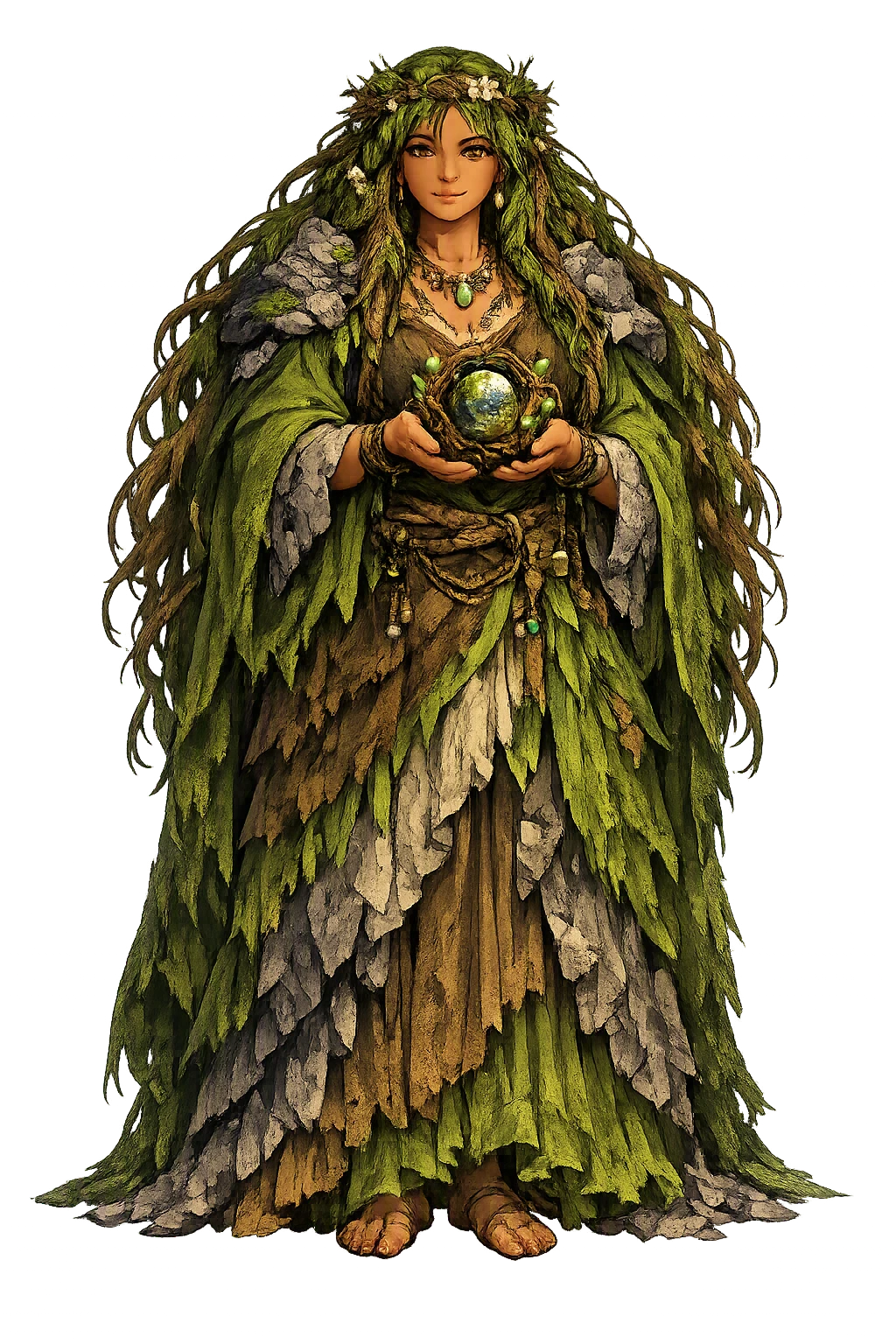
Stories of Fjǫrgyn
Fjǫrgyn appears briefly in the Eddas, but her appearances are weighty: she is the mother of the most popular god and the earth that hears every oath.
Völuspá's seeress, counting the doom of the gods, says that “then comes the famous son of Fjǫrgyn” — Þórr marching to his last battle with the World-Serpent. The manuscripts do not agree on the mother's name: Hauksbók reads Fjǫrgyn, while the Codex Regius reads Hlóðyn, and editors have long treated the two as interchangeable names for the same earth-goddess. Either way the kenning makes its point with quiet force: the thunder-god is the earth's son, and the storm that walks the sky was born of the ground it strikes. It is one of only two Eddic verses where Þórr's mother is named at all — the earth is otherwise so present she needs no introduction. When Ragnarök comes, it is the land itself that sends its child out to die defending it.
In the flyting across the fjord between Þórr and the disguised Óðinn, Þórr announces his plan to press east, and Óðinn answers with the only verse that lets the earth-goddess act: “Keep to the left of the road until you reach Verland; there Fjǫrgyn will find Þórr, her son, and she will teach him the ways of kinship to Óðinn's lands” (Hárbarðsljóð 56, trans. Lindow). The lines are remarkable because Fjǫrgyn appears here not as a kenning inside a list but as a character who will meet and counsel her son — the one moment in the Poetic Edda where the earth-goddess does something rather than being invoked. A mother who teaches her son “the ways of kinsmen” is the quiet counterweight to the poem's comic abuse: beneath every insult traded over that water, the family of gods stands on her ground, and it is she who will orient the son for the road ahead.
The masculine twin Fjǫrgynn plays the other side of the family drama. When Loki turns his venom on Frigg in the flyting, his opening gibe is genealogical: “Be silent, Frigg — you are Fjǫrgynn's daughter, and have ever been most eager for men” (Lokasenna 26). Snorri repeats the lineage as fact, naming Fjǫrgynn as Frigg's father in Gylfaginning (9) and Skáldskaparmál (19). Thus the same name, in feminine and masculine form, mothers Þórr and fathers Frigg — two of the most important gods of the pantheon issue from a divine pair of whom almost nothing else is recorded. Hilda Ellis Davidson proposed that Fjǫrgyn and Fjǫrgynn were once a mated pair like Njǫrðr and Nerthus or Freyr and Freyja; the surviving evidence is only the grammar of the names and this one insult. What remains is suggestive: Óðinn's household is rooted in a single, ancient earth-name.
The etymology the older handbooks proposed — a link to fjor, “life,” or to fura, “fir” — has been superseded. Modern comparative work (Kroonen, Etymological Dictionary of Proto-Germanic; West, Indo-European Poetry and Myth) traces Fjǫrgyn to Proto-Germanic *fergunja, “mountain” or “mountainous forest,” cognate with Gothic fairguni, Old English firgen (as in Firgenhǫæg, “mountain-slope”), and the Old High German name of the Ore Mountains, Firgunnea. An older stratum still may bind the word to the thunder-god *Perkwunos — the wooded mountain as the thunderer's realm — through the family of Lithuanian Perkūnas, Slavic Perun, and Vedic Parjanya; scholars note the resemblance without insisting on it. Whether Fjǫrgyn is simply Jǫrð under another name or a distinct goddess of the wooded heights, the name records what the poets saw: not a flat world-floor but a mountainous green earth — the kind of land Scandinavia is.
The Land That Brings Forth
Fjǫrgyn is one of the names by which the Norse earth appears as a goddess. She is the mother of Þórr, the thunder-god, and in the sources she is invoked as the ground that receives oaths, the field that bears grain, and the ancient power beneath every footstep. Whether she is a distinct goddess or another name for Jǫrð is debated, but her name carries its own resonance: life, oak, and the green world.
The Poetic Edda names Fjǫrgyn as the mother of Þórr, linking the thunder-god to the earth itself.
Her name may connect to words for tree and life; she is the green force that supports the world-tree.
Like Jǫrð, she is the land invoked in oaths and the ground that endures storm and war.
Lokasenna invokes Fjǫrgyn as the earth beneath, the silent witness to sworn words.
From the original script to the living URL
ᚠᛁᚢᚱᚴᚢᚾ
The name in its original Norse form. Fjǫrgyn (ᚠᛁᚢᚱᚴᚢᚾ) is attested in the source tradition — “Earth (Fjǫrgyn)”. Its original diacritics and script distinctions carry the full phonetic and orthographic weight of the source tradition.
fjorgyn
Reduced to plain fjorgyn, the name loses everything that made it specific: original diacritics and script distinctions. What remains is an ASCII string that machines can parse but that no longer speaks with its original voice.
Fjǫrgyn
The Unicode restoration recovers what ASCII flattened. Fjǫrgyn restores original diacritics and script distinctions, returning the name to its original written dignity. The domain encodes to Punycode, but the browser displays the truth.
Fjǫrgyn.com → xn--fjrgyn-xcc.com
The non-ASCII characters in Fjǫrgyn are encoded while the ASCII remains visible. To the DNS, it is Punycode. To humanity, it is Fjǫrgyn.
Owned, ideal, and ASCII forms of Fjǫrgyn
Fjǫrgyn
Restores ᚠᛁᚢᚱᚴᚢᚾ. The live temple domain — fjǫrgyn.com.
fjorgyn
Flattens ᚠᛁᚢᚱᚴᚢᚾ. The plain ASCII fallback — what DNS and legacy systems see.
How Fjǫrgyn was spoken
How Fjǫrgyn travels from ancient script to the modern URL
The lore you have read is the living myth. Extended Lore opens the scholarly vault beneath it: the cult and its material remains, a history of the image, the name after antiquity, a meditation on what the name still means, and the full scholarly apparatus — etymology, orthography, sources.
Enter Extended Lore