PuniCodex

Extended Lore

Fionn

Etymology · Orthography · Cult · Iconography · Reception · Sources

Tier 2 Fionn
Fionn — Hunter, Seer, Leader
01

Quick Facts

Essential information about Fionn, Hunter, Seer, Leader

Scholarly TransliterationFionn
Unicode RestorationFionn
Reconstructed Pronunciation/ˈfʲiːn̪ˠ/
PantheonCeltic
DomainHunter, Seer, Leader
MeaningFair, white
ClassificationTier 2
Primary DomainFionn
Sacred SymbolsThe salmon of knowledge, The thumb, The magic spear, The hounds Bran and Sceólang, Ben Bulben
02

Etymology & Word Family

From original script to Unicode restoration

Scholarly Transliteration Fionn Fionn — "Fair, white"
Unicode Restoration Fionn Canonical scholarly spelling — ASCII-identical
Modern ASCII fionn Plain-ASCII fallback

The name Fionn reaches the modern world through scholarly transliteration of the celtic tradition. Because the conventional spelling uses only Latin letters, its Unicode and ASCII forms coincide — the tradition it carries is in the name itself, not in diacritics.

03

Unicode Character Breakdown

Character-by-character philological analysis

CharacterUnicodeNameBlockPhonetic Role
FU+0046Latin Capital Letter FBasic LatinSame, capitalized
iU+0069Latin Small Letter IBasic LatinSame
oU+006FLatin Small Letter OBasic LatinSame
nU+006ELatin Small Letter NBasic LatinSame

The Tier 2 classification here reflects fidelity to the attested tradition, not recovered diacritics: every character of Fionn already survives in ASCII. What the restoration preserves is the canonical spelling itself — the form scholarship standardised.

04

Cult & Worship

How the sacred was kept — rites, sanctuaries, remains

The Cult

Fionn received no temple cult — no shrine, festival, or priesthood is recorded for him anywhere in the Irish evidence — but to call him uncultivated would miss the record entirely. His 'worship' was performed in the vernacular, and it was sung: the Fenian ballads carried his name across Ireland, the Scottish Highlands, and Gaelic Nova Scotia as living repertoire into the twentieth century, collected from oral singers long after the manuscripts were old. Folk practice preserved him too — the 'thumb of knowledge', suck the thumb when wisdom is wanted, survived in the Scottish Highlands as Fionn's own gift, recorded by the nineteenth-century collectors from informants who still used it. His landscape was honored by being named: the Giant's Causeway explained as his road to Scotland, Ben Bulben as his hunting ground. No altar, then; but singing, thumb, and map, kept longer than many altars were.

In the Earth

Fionn is a textual hero: no ogham stone names him, and his cycle survives in the great Irish codices — the Acallam in the Book of Lismore and its sister manuscripts, the Boyhood Deeds and the Fenian lays across the Laud and Book of Leinster traditions. His landscape, by contrast, is real and visitable. The salmon of knowledge was caught in the Boyne, the river that bends around Brú na Bóinne — the Newgrange passage-tomb complex (c. 3200 BCE) that the myths make the síd of Óengus, Diarmaid's protector. Tara, the royal seat Aillén burned every Samain, is the hill of Teamhair in County Meath, an Iron Age ceremonial complex of earthworks and standing stones. Ben Bulben, where the boar killed Diarmaid, stands over Sligo as the tales describe it. The Fenian cycle is unusual among Irish corpora for how densely it maps onto ground that can still be walked.

05

Iconography

How Fionn was imaged across the ages

The Image

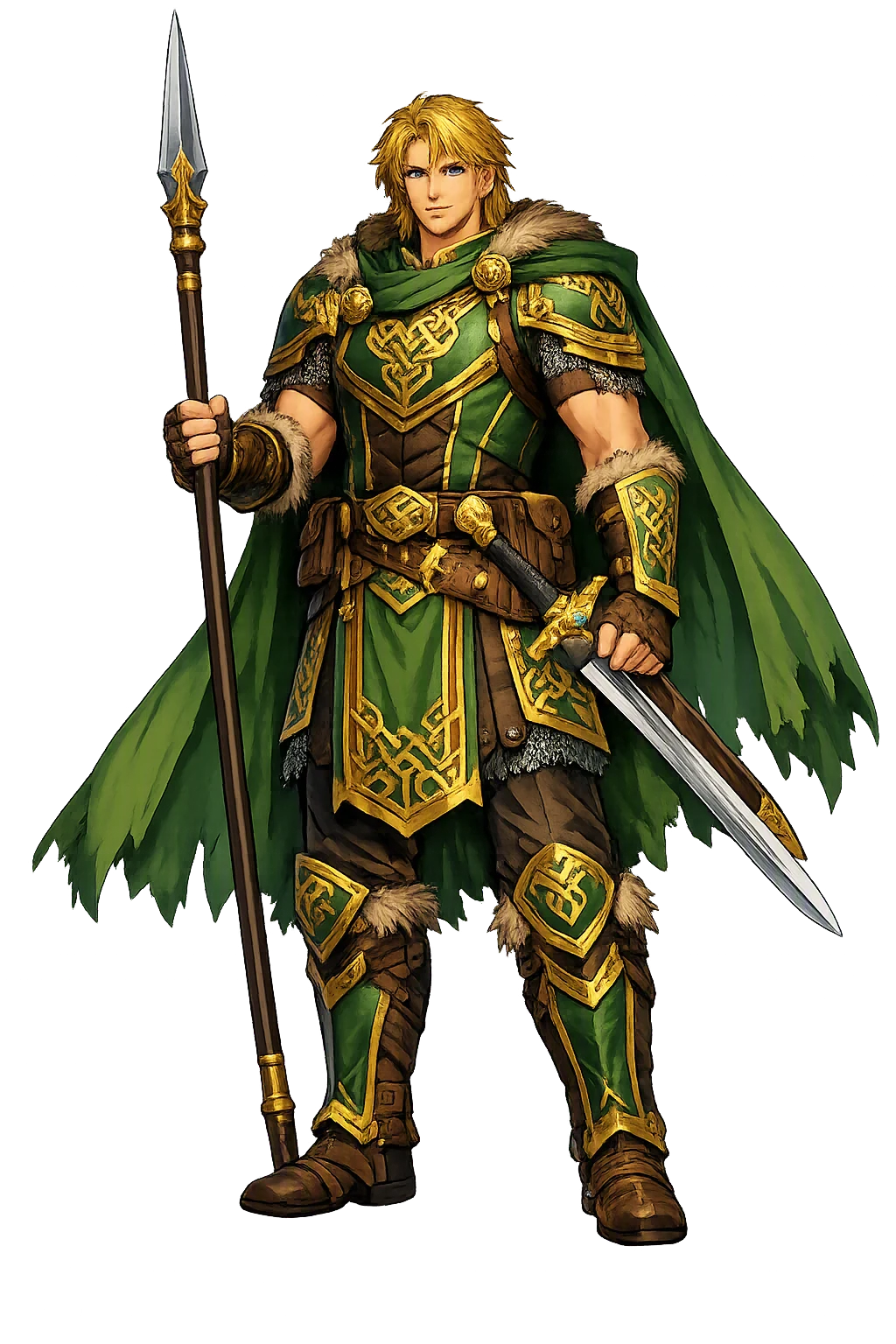
Medieval Ireland never imaged Fionn: no cross, no manuscript page, no shrine shows him, and the earliest painted Fionns belong to a Scottish invention. When Macpherson's Ossian swept Europe, the Ossianic canvases followed — Girodet's great apotheosis of 1802, Ingres's Dream of Ossian of 1813 — a Fingal seen through neoclassical eyes as a northern Homer. The genuine Fionn acquired his visual canon with the Celtic Revival: the hounds Bran and Sceolang, the mantle, the spear Birga with its rivets of red gold, fixed in the public mind by book illustration — Stephen Reid's plates for Rolleston's High Deeds of Finn (1910) remain the classic statement. In the texts the portrait was always one of action: the fair hair, the hunter's gear, the thumb to the lip when the fios comes. Everything earlier is silence; the image of Fionn is a modern print laid over an old outline.

06

Reception & Transformation

The name after its own age — transmission, translation, survival

Afterlives

Fionn's transmission journey is the greatest zigzag in the Celtic record, and it passed through a counterfeit. The genuine corpus — the Boyhood Deeds, the lays, the Acallam na Senórach in the Book of Lismore — stayed in Irish manuscripts, unpublished and largely unread, while Macpherson's Ossian, from 1760, replaced the real Fionn with a Fingal who conquered European literature before the Fenian texts were known at all; the embarrassment of that success became the motor of the recovery. The Irish Texts Society, founded in 1898, gave the cycle its publishing home; Kuno Meyer printed the Boyhood Deeds in Ériu's opening volume (1904) and assembled the Fenian materials in Fianaigecht (1910); Gerard Murphy's Duanaire Finn (1953–54) and the late-twentieth-century Acallam translation rebuilt the corpus from its real witnesses. Through it all the oral stream ran unbroken — Gaelic singers in Scotland and Nova Scotia kept the ballads current — so that when scholarship finally caught up with the hero, it found him alive where he had always lived: in performance, not on the shelf.

Identifications Across Traditions

Fionn's deepest kin are onomastic and Insular. His name descends from Proto-Celtic *windos, 'white, fair', and the handbooks have long set him beside the Welsh Gwyn ap Nudd — 'white son of Nudd', the Otherworld huntsman of Welsh tradition — as two regional developments of a Celtic figure built on the same word: the fair one who rides between this world and the wild. The more famous comparison is with the Norse corpus: like Sigurðr, who tasted the blood of Fáfnir's heart and understood the speech of birds, Fionn receives a whole mode of knowledge through a single accidental taste — the parallel is a commonplace of the comparative literature, though the two traditions grew the motif independently. Within Ireland his nearest mirror is [[cuchulainn|Cú Chulainn]], the Ulster Cycle's solitary champion set against Fionn's communal war-band: the two heroes divide the Irish heroic imagination between them.

Modern Legacy

Fionn became, for a century, the most famous Celt in Europe. James Macpherson's Fragments of Ancient Poetry (1760) and Fingal (1762) presented 'Ossian' — Oisín — as the bard of a northern Homer, with Fingal his mighty father; the poems swept the continent, were carried by Napoleon and quoted by Goethe, and set off a running war over their authenticity in which Samuel Johnson demanded the manuscripts and Macpherson never produced them. The Celtic Revival reclaimed the genuine cycle: Lady Gregory's Gods and Fighting Men (1904) brought the Fenian tales into modern English, and Irish scholarship — Meyer's Fianaigecht, Murphy's Duanaire Finn, Dooley and Roe's Acallam translation — rebuilt the cycle from its real witnesses. In Ireland the name never faded: Fianna Éireann named the warrior-band after him, the political tradition borrowed Fianna Fáil, 'the war-band of Ireland', Finn is once again a living given name, and Tír na nÓg remains the Irish idiom for youth that outlasts its bargain.

07

The Meditation

What Fionn means — beyond the dictionary

Fionn is the patron of accidental wisdom — of the knowledge you were not supposed to have, caught while doing someone else's cooking. The salmon was seven years promised to Finn Éces, and it went to the kitchen-boy's burned thumb instead; the tradition does not call this theft, and it does not pretend the boy planned it. It says something harder: that readiness is the only part of fortune you can control. The rest of Fionn's life is the price and use of that gift — the long captaincy, the saved Tara, the sixteen-year pursuit in which knowledge and desire pulled opposite ways and he let the water fall. The Acallam gives him the last word through his son: wisdom is memory kept against time, and it survives only as long as somebody keeps telling it.

08

Frequently Asked Questions

Common questions about Fionn, Hunter, Seer, Leader, and Unicode restoration

01How do you pronounce Fionn?

In reconstructed pronunciation, Fionn is /ˈfʲiːn̪ˠ/ — approximately 'FEEN' — one syllable; the f is slender and light, the vowel a long ee, the final nn broad against the teeth. 'Fionn mac Cumhaill' runs roughly 'FEEN mak KOO-il'.

02What does Fionn mean?

Fionn means Fair, white in the celtic tradition.

03What are the symbols of Fionn?

Fionn is associated with The salmon of knowledge (Wisdom caught in a single instant — meant for another, given by chance, and never returned), The thumb (Imbas forosnai, the knowledge that illuminates — knowing held in the body, summoned by the bite), The magic spear (The discipline to stay awake when the whole court is lulled — vigilance as a weapon), The hounds Bran and Sceólang (The bond of hunter and hunted bound into one kinship — the wild running at the leader's heel), Ben Bulben (The boar's mountain in Sligo, where the long pursuit of Diarmaid ended and the water slipped through Fionn's fingers).

04Why restore Fionn in Unicode?

Fionn is written entirely in ASCII letters, so its restoration is about canonical fidelity rather than recovered diacritics: the temple fixes the name in its scholarly standard spelling, attested in the source tradition, instead of leaving it to drift.

05What is the most important myth about Fionn?

“The Boy in the Wild” — the Macgnímartha Finn story that anchors the mythology of Fionn, told in full on the lore page.

09

Scholarly Sources

The philological foundations of this restoration

Every claim on this page is grounded in established scholarship. The orthographic restorations follow disciplinary convention. The etymological chain follows the best available reference works. This is not invention — it is resurrection through scholarship.

◈

Lexicography & Philology

  • Acallam na Senórach
  • MacKillop
◎

Primary Texts

  • The Immram Brain (Voyage of Bran); Tochmarc Étaíne; Cóir Anmann; medieval Irish saga literature.
◉

Archaeology & Art History

  • Material evidence — iconography, inscriptions, and temple archaeology — for Fionn and related cults.
✦

Religious Studies

  • Macgnímartha Finn (The Boyhood Deeds of Fionn), ed. and trans. Kuno Meyer — the birth, the salmon of knowledge, the slaying of Aillén at Tara
  • Acallam na Senórach, ed. Whitley Stokes, Irische Texte IV (1900); trans. Ann Dooley and Harry Roe, Tales of the Elders of Ireland (Oxford, 1999) — Oisín and Caílte before Patrick; the Fenian memory
  • Tóruigheacht Dhiarmada agus Ghráinne (The Pursuit of Diarmaid and Gráinne), ed. Nessa Ní Shéaghdha, Irish Texts Society 48 (1967)
  • Duanaire Finn (The Poem-Book of Fionn), ed. Eoin MacNeill and Gerard Murphy, Irish Texts Society — the Fenian lays
  • Michael Comyn, Laoi Oisín ar Thír na nÓg (The Lay of Oisín in the Land of Youth, 18th c.) — Oisín and Niamh of the Golden Hair
  • Dictionary of the Irish Language (eDIL), s.v. find — 'fair, white'
  • Vendryes, Lexique étymologique de l'irlandais ancien, s.v. find — Proto-Celtic *windos
  • MacKillop, Dictionary of Celtic Mythology, s.v. Finn mac Cumaill
  • Ó hÓgáin, Dáithí, Fionn mac Cumhaill: Images of the Gaelic Hero (1988)
  • Nagy, Joseph Falaky, The Wisdom of the Outlaw: The Boyhood Deeds of Finn in Gaelic Narrative Tradition (1985)
  • Koch, ed., Celtic Culture: A Historical Encyclopedia, s.v. Finn mac Cumaill
Return

The Surface Awaits

You have traced the name from its earliest attestation to its Unicode restoration. Now return to the myth. The story is where the name lives.

Back to Lore
Fionn mascot