The Living Myth
Personified Continent of Europe · The Broad-Faced Shore of the West
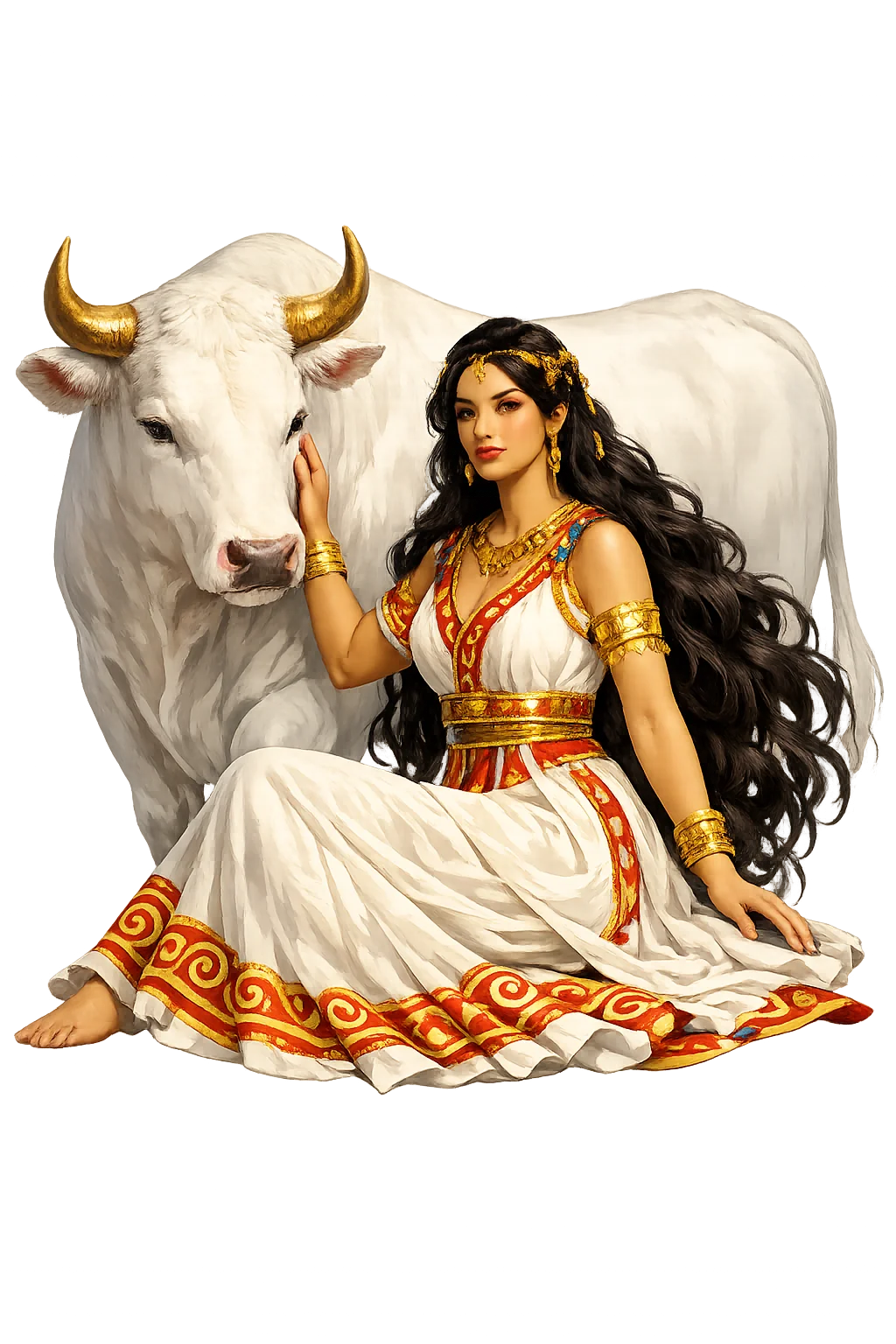
Stories of Eurṓpē
Eurṓpē is a myth of crossing: a Tyrian princess carried west on a god's back, whose name outgrew her story to label a continent. The sources delight in her — Moschus makes her the heroine of a little epic, Herodotus doubts her etymology, and Homer gives her a different father than Hesiod does. What survives every correction is the current she rides: from East to West, forever.
In Moschus' little epic Europa (2nd century BCE) the story opens inside a dream. The Tyrian princess sleeps, and two women struggle over her body: one in foreign dress, one Greek-speaking — Asia and Europe, fighting for the girl (Moschus, Europa 1–45). Europa wakes to gather flowers on the shore with her companions, and among the herds a great white bull stands, gentle as a pet, its breath sweet with crocus. The dream has already told us what the bull is: geography itself, come to carry her west. Ovid retells the omen (Metamorphoses 2.836–875) and gives the scene its permanent tension — a child playing on a god. The myth's first move is its most honest one: before any abduction happens, Europa already belongs to a quarrel between continents. A name on every modern map began as a dispute over one Phoenician girl.
Europa climbed onto the bull's back among the flowers, and the beast plunged into the sea. Moschus (Europa 46–165) makes the crossing gorgeous and terrifying: her veil streams, the Nereids rise and dance, Poseidon leads his train beneath the waves, and still she clutches one horn, her free arm lifted to the vanishing shore. Landfall came in Crete, in a grove of Gortyn, where the bull became Zeus and the marriage was divine. Her father Agenor sent her brothers Kadmos, Kilix, and Phoenix to find her or never return (Apollodorus, Library 3.1.1): the search failed, and each brother founded a land instead — Kilikia from Kilix, Phoenicia's royal line from Phoenix, and Thebes from Kadmos, who carried westward the alphabet itself. The myth quietly accounts for how the East reached Greece: Europa was carried, but her brothers walked, and everything they planted followed her.
Europa bore Zeus three sons — but the sources quarrel over the third. Homer knows Minos as her son and knows Sarpedon too, yet in the Iliad (6.198–199) Sarpedon is son of Zeus by Laodamia of Lycia; the Cretan tradition (Apollodorus, Library 3.1.1–2) makes him Europa's, and says she married Asterius, king of Crete, who adopted the boys. The middle son, Rhadamanthys, is the one Greek conscience loved: he ruled so justly that Plato stations him, with Minos and Aiakos, as a judge of the dead (Apology 41a; Gorgias 523e–524a). Apollodorus adds Europa's dowry-chest of wonders — Talos the bronze guardian, the dog Laelaps that never missed, the spear that never failed (3.2.1). One abduction thus produces the labyrinth's king, an afterlife judiciary, and a mythic arsenal. Whatever the genealogists dispute, the pattern holds: law itself, in the Greek imagination, descends from the carried girl.
How did a Phoenician princess become a continent? Herodotus reports the Greeks' own answer — and his doubts: the lands were named for women, Asia for a wife of Prometheus, Libya for a nymph, and Europe 'after the Tyrian Europa', though whether the earth is really divided so 'no man knows' (Herodotus 4.45). Behind the etymology stands an older, different genealogy: Hesiod's Theogony (357) lists Europa among the Oceanids, daughters of Ocean, and Homer (Iliad 14.321–322) calls her daughter of Phoenix. The land-name itself appears among the early geographers (Hecataeus, FGrHist 1) before any heroine; many philologists hear a Semitic word behind it — ʿereb, 'west, sunset', the direction from which evening comes. Europe, in the most economical reading, was the West before it was a girl. But myth out-argues philology: for two and a half millennia the West has preferred to be named for someone carried toward it.
The Tyrian Princess Who Named a Continent
Eurṓpē begins as a Phoenician princess gathering flowers on the Tyrian shore and ends as the name of a continent. Zeus, in the form of a white bull, carries her across the sea to Crete, where her sons — Minos, Rhadamanthys, and Sarpedon — found the dynasties and afterlife judges of Greek imagination. Her myth is the charter of the West named for an Eastern girl: geography won in a single crossing.
Zeus took the form of a white bull and carried the Phoenician princess Eurṓpē across the sea to Crete.
The land that received her took her name, making Europe a mythic body as well as a geographical space.
Eurṓpē bore Minos, Rhadamanthys, and Sarpedon, founding the Cretan dynasty and a judge of the dead.
Europe lay where the sun set; its name may echo a Semitic word for 'west', the realm of the setting sun.
From the original script to the living URL
Εὐρώπη
The name in its original Greek form. Eurṓpē (Εὐρώπη) is attested in the source tradition — “Broad-faced (from εὐρύς + ὤψ)”. Its long vowels and acute accents carry the full phonetic and orthographic weight of the source tradition.
europe
Reduced to plain europe, the name loses everything that made it specific: long vowels and acute accents. What remains is an ASCII string that machines can parse but that no longer speaks with its original voice.
Eurṓpē
The Unicode restoration recovers what ASCII flattened. Eurṓpē restores long vowels and acute accents, returning the name to its original written dignity. The domain encodes to Punycode, but the browser displays the truth.
Eurṓpē.com → xn--eurp-eva0406b.com
The non-ASCII characters in Eurṓpē are encoded while the ASCII remains visible. To the DNS, it is Punycode. To humanity, it is Eurṓpē.
Owned, ideal, and ASCII forms of Eurṓpē
Eurṓpē
Restores Εὐρώπη. The live temple domain — eurṓpē.com.
Eurōpē
Restores Εὐρώπη. A second live spelling — eurōpē.com.
europe
Flattens Εὐρώπη. The plain ASCII fallback — what DNS and legacy systems see.
How Eurṓpē was spoken
How Eurṓpē travels from ancient script to the modern URL
Greek Εὐρώπη; from εὐρύς “wide" + ὤψ “face, eye", hence “broad-faced".
Personified Continent of Europe
The Unicode restoration Eurṓpē preserves Greek stress and length; the ASCII form europe loses these features.
The lore you have read is the living myth. Extended Lore opens the scholarly vault beneath it: the cult and its material remains, a history of the image, the name after antiquity, a meditation on what the name still means, and the full scholarly apparatus — etymology, orthography, sources.
Enter Extended Lore