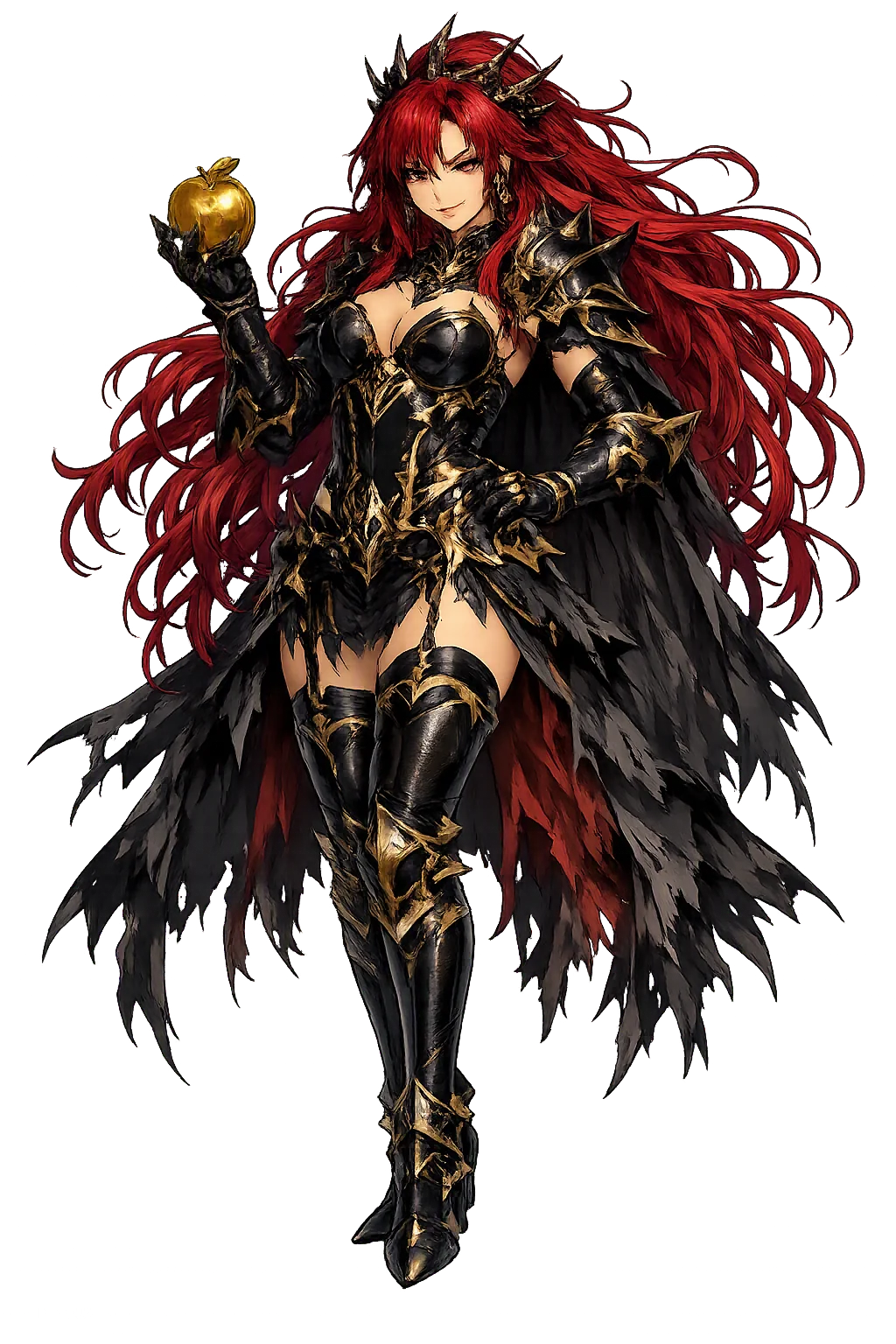
Stories of Éris
Éris has no temples and almost no cult — her mythology is her meaning. Every surviving story is an anatomy of strife itself: where it comes from, whom it feeds, and how it grows from a whisper into a thing with its head in heaven.
In the Theogony (224–232) Hesiod makes Éris a child of Nyx, Night, who bears her without a father among the other dark abstractions — Death, Sleep, Blame, Woe, the Hesperides, the Moirai. Éris then breeds her own terrible brood, the Kakodaimones: Toil, Forgetfulness, Famine, Pains, Combats, Battles, Murders, Manslaughters, Quarrels, Lies, Disputes, Lawlessness, Ruin (Atē), and Oath — and Oath, Hesiod adds, troubling most of all, ‘brings the most pain to men on earth when anyone swears falsely knowing it’. The genealogy is a single claim stated as a family tree: from one quarrel, every misery descends. It also fixes Éris’s cosmological position — she is not one of the stormy passions that trouble the daylight gods but a permanent resident of the dark, born of the Night that was there before anything else, including the quarrel between heaven and earth.
The Works and Days (11–26) opens by amending the poet's own Theogony: 'there was not one kind of Strife after all — on earth there are two.' The first, the elder, men blame, for she 'fosters evil war and slaughter'. The second, whom Zeus set in the roots of the earth, is much better for mortals: she rouses even the shiftless to work, for 'potter rivals potter, carpenter carpenter; beggar envies beggar, and poet poet'. Here Éris is split in two — envy as destroyer and emulation as the engine of all human striving — one of the earliest pieces of moral reflection in Greek literature. The passage matters beyond theology: it is the first time a Greek writer argues with himself in print, correcting a genealogy because experience demanded it.
At the wedding of Peleus and Thetis, all the gods were feasted — except Éris, whose very nature barred her from the invitation list. The Cypria, as summarized in Proclus' Chrestomathy, tells that she came anyway and threw among the guests a golden apple 'to be a prize of beauty', inscribed kallistēi — 'for the fairest'. Hēra, Athēnâ, and Aphrodítē each claimed it; the dispute was sent for judgment to Paris on Mount Ida, and from that judgment, Proclus says flatly, came the Trojan War. Hyginus (Fabulae 92) retells the same scene. It is the founding myth of discord: exclusion breeds the quarrel that topples a kingdom. The wedding meant to bind heaven's new order together became the place where it split, and the instrument was not malice but a superlative — the mere existence of 'fairest' among three proud goddesses.
Homer's most haunting personification of war comes in Iliad 4 (440–445), as the two armies close: among them walks Éris, 'the sister and companion of man-slaying Ares — she rears only a small crest at first, but then she fixes her head in the heavens while her feet walk the earth', hurling bitterness into the midst of both hosts. She reappears on the shield of Achilles (Iliad 18.535–540), bloody-robed among the wounded and the dead. The image is precise and it has never stopped being true: discord begins as a murmur and ends with its head in the clouds — and once she stands, no god can pull her down. That Homer gives the abstraction a growth spurt, and lets her delight in the din, shows the Greeks watching strife the way one watches weather: not as sin but as force.
Goddess of Strife and Discord — the quarrel that topples kingdoms and the rivalry that builds them
Éris is strife personified — the quarrel, the feud, the rivalry Greeks both cursed and quietly praised. Born of Nyx, Night herself, she was never asked to the feast and therefore changed the world. Hesiod insists there are two Erises: the hateful one who sows war, and the better one who stirs even the idle to work.
Uninvited to the wedding of Peleus and Thetis, she rolls the golden apple ‘for the fairest’ — the first cause of the Trojan War (Cypria).
Hesiod separates the hateful Strife from her elder sister, the good Eris who stirs idle men to work (Works and Days 11–26).
In the Iliad she walks the battle small at first, her head striking the sky as she delights in the din (Iliad 4.440–443).
The Theogony (224–232) makes her a motherless child of Nyx, who then bears her own brood of calamities without any father.
From the original script to the living URL
Ἔρις
The name in its original Greek form. Éris (Ἔρις) is attested in the source tradition — “Strife”. Its acute accents carry the full phonetic and orthographic weight of the source tradition.
eris
Reduced to plain eris, the name loses everything that made it specific: acute accents. What remains is an ASCII string that machines can parse but that no longer speaks with its original voice.
Éris
The Unicode restoration recovers what ASCII flattened. Éris restores acute accents, returning the name to its original written dignity. The domain encodes to Punycode, but the browser displays the truth.
Éris.com → xn--ris-9la.com
The non-ASCII characters in Éris are encoded while the ASCII remains visible. To the DNS, it is Punycode. To humanity, it is Éris.
Owned, ideal, and ASCII forms of Éris
Éris
Restores Ἔρις. The live temple domain — éris.com.
eris
Flattens Ἔρις. The plain ASCII fallback — what DNS and legacy systems see.
How Éris was spoken
How Éris is preserved in writing
A bespoke provenance study for Éris is being prepared by the PUNICODEX scholarly team.
Contribute scholarly provenance →The lore you have read is the living myth. Extended Lore opens the scholarly vault beneath it: the cult and its material remains, a history of the image, the name after antiquity, a meditation on what the name still means, and the full scholarly apparatus — etymology, orthography, sources.
Enter Extended Lore