PuniCodex

Extended Lore

Ēōs — The Deeper Record

Etymology · Orthography · Cult · Iconography · Reception · Sources

Preserves vowel length Ēōs.com · eōs.com
Ēōs — Dawn, Morning Red
01

At a Glance

Ēōs — every fact links to its home

PantheonGreek
DomainDawn, Morning Red
Original ScriptἨώς →
Primary Sources5 cited →
02

Etymology & Word Family

From original script to Unicode restoration — the full etymology page →

Original Script Ἠώς Ēōs — "Dawn (from ἠώς)"
Unicode Restoration Ēōs Restored stress, length, and script
Modern ASCII eos Plain-ASCII fallback

The name Ēōs carries the orthographic signature of the greek tradition: Ἠώς. Unicode restoration recovers what ASCII flattens.

03

Unicode Character Breakdown

Character-by-character philological analysis

CharacterUnicodeNameBlockPhonetic Role
ĒU+0112Latin Capital Letter E with MacronLatin Extended-AEta: long epsilon
ōU+014DLatin Small Letter O with MacronLatin Extended-AOmega: long omicron
sU+0073Latin Small Letter SBasic LatinSigma

More than one historically valid Unicode spelling of Ēōs exists — each variant is a real, attested restoration, and the owned forms live as temples.

04

Cult & Worship

How the sacred was kept — rites, sanctuaries, remains

The Cult

Eos had no Panhellenic temple or organized priesthood. The regular salutations to dawn in Homer and the Homeric Hymns—'rosy-fingered Eos'—are poetic, not liturgical. Yet the figure clearly absorbed some cultic color: local rites at dawn, the leaving of offerings on housetops or shorelines, and the naming of the morning star and the east wind all point to a diffuse, everyday piety rather than a centralized sanctuary. Roman ritual retained the personified Aurora in calendars and poetry but likewise built no great temple to her. The absence of monumental cult means Eos is best understood as a personification sustained by epic diction and household habit.

In the Earth

Eos is a favorite of Attic vase-painters: red-figure cups show her rising from the sea, departing the couch of Tithonos, or sweeping up Kephalos — one of the most-painted abductions of the classical repertoire. The motif of Dawn withdrawing from her sleeping lover became a consolation image on Roman sarcophagi, where Aurora leaving Tithonus reads as the gentlest rehearsal of death. No Panhellenic sanctuary was ever hers; her cult lived dispersed in dawn-worship, in epithets, and in the Homeric formula itself.

05

Iconography

How Ēōs was imaged across the ages

The Image

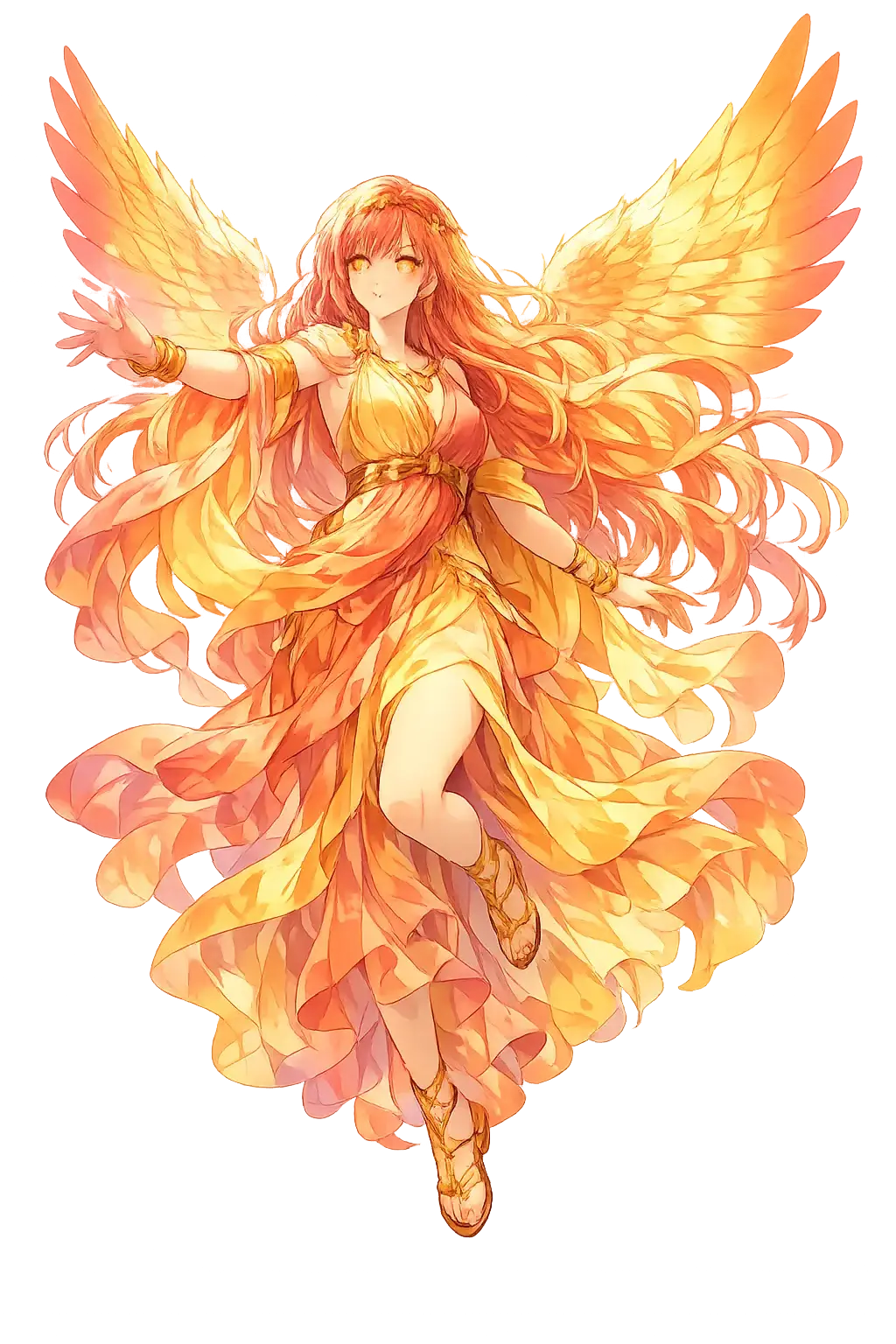
Eos is one of the most-painted figures of Attic vase painting. Red-figure cups show her rising from the sea in a chariot, wearing a saffron robe, her arms outstretched in 'rosy fingers'; other scenes depict her abduction of Kephalos or Tithonos. The motif became a consolation image on Roman sarcophagi, where Aurora leaves the sleeping Tithonus as a gentle allegory of death. Hellenistic and Roman wall paintings repeat the chariot and winged figure. In the Renaissance she reappears in ceiling frescoes of Aurora guiding the sun, and in nineteenth-century academic painting; her visual signature—golden light, billowing drapery, and outstretched arms—remains instantly legible.

06

Reception & Transformation

The name after its own age — transmission, translation, survival

Afterlives

Eos entered Western literature with Homer and never left: 'rosy-fingered Dawn' became a fixed formula transmitted through Roman poets such as Ovid and Virgil into medieval and Renaissance Latin. The personification of dawn shaped Christian imagery—the resurrection, the Annunciation—and Baroque ceiling painters loved her chariot. In the nineteenth century Tennyson and other poets reworked her tears for Memnon into elegies about empire and mortality, while the motif of Tithonus aging under immortality became a meditation on time. Modern scholarship has traced her Indo-European kinship with Vedic Uṣas and Lithuanian Aušrinė, making her a test case for comparative mythology. Her afterlife is therefore linguistic and poetic as much as religious: she is how the ancient world taught the West to imagine morning.

Identifications Across Traditions

The Romans called her Aurora and kept her nearly entire — the chariot, the lovers, the morning conquests all survived the translation intact. Her deeper family is Indo-European: the name descends from *h₂éws-ōs, sister of Sanskrit uṣás, Avestan ušā, and Lithuanian aušrinė, making Ēōs one of the best-attested inherited goddesses in the family — the dawn was divine before Greek existed. Late antique Christianity drafted her into the resurrection: Christ's rising 'early, while it was still dark' (Mark 16.2) gave the old goddess a new calendar, and medieval art kept her chariot for Easter morning and the dawn of the Last Judgment. The scientific era named a dawn-age fossil bird Eos and kept the name for spacecraft — the goddess of first light passing, as she always does, into every new day that claims her.

Modern Legacy

Ēōs survives wherever dawn is greeted rather than merely timed: in Homer's formula quoted by every generation of classicists, in the 'rosy-fingered' trope of poetry workshops, in the Eos of zoology and of space-program names. Her Tithonos story still disciplines wish-making — the cautionary tale of the gift that forgot its second half — and fantasy art keeps returning to dawn-personifications in her image, from medieval illuminations of Aurora to modern book covers. Restoring Ēōs restores the Greek name of the day's soft opening: not sunrise as weather or clock-time, but as a goddess arriving — on schedule, beautiful, and heartbreakingly brief.

09

The Original Script Note

What the written record preserves — and what it does not

Original Script

The name is written in Greek as Ἠώς, with an acute on a long omega and a rough breathing — the word was felt to be *hāwōs. It descends from the same Indo-European dawn-goddess as Sanskrit uṣas, Latin Aurora, and the Germanic root behind English 'east' and 'Easter': all of them name the glowing quarter of morning. Homer knows her intimately as the rosy-fingered goddess who opens the gates of day (Iliad 1.477 and throughout). The restoration Ēōs marks the initial length and the final stress that the ASCII eos flattens.

10

The Meditation

What Ēōs means — beyond the dictionary

Ēōs is persistence with a wound. She returns every morning whether the world deserves it or not — the one deity whose reliability Homer could count on twenty times a book. Yet her own stories are about what her light cannot fix: Tithonos, who will not die and cannot be young; Kephalos, returned to a marriage already poisoned; Orion, carried off and then destroyed. The dawn goddess, of all beings, knows that beginnings are not cures.

In her the Greeks lodged the most honest theology of time: that renewal is real but not redemptive, that each morning is genuinely new and yet carries all the old griefs in its baggage. To wake with Ēōs is to accept that condition — and to love the light anyway, because it comes.

11

Frequently Asked Questions

Deep-dives into the cult, attestation, reception, and sources of Ēōs

01How do we know how Ēōs was worshipped?

Eos is a favorite of Attic vase-painters: red-figure cups show her rising from the sea, departing the couch of Tithonos, or sweeping up Kephalos — one of the most-painted abductions of the classical repertoire. The full cult record →

02Where do the earliest attestations of Ēōs come from?

The record rests on LSJ, Beekes, Etymological Dictionary of Greek, Homer, Iliad and Odyssey, among 7 cited works. The full source apparatus →

03How did later traditions reinterpret Ēōs?

Eos entered Western literature with Homer and never left: 'rosy-fingered Dawn' became a fixed formula transmitted through Roman poets such as Ovid and Virgil into medieval and Renaissance Latin. Reception & transformation →

04What do the surviving images of Ēōs actually show?

Eos is one of the most-painted figures of Attic vase painting. The iconography →

05What does the written record of Ēōs actually preserve?

The name is written in Greek as Ἠώς, with an acute on a long omega and a rough breathing — the word was felt to be *hāwōs. The Original Script note →

12

Scholarly Sources

The philological foundations of this restoration

Every claim on this page is grounded in established scholarship. The orthographic restorations follow disciplinary convention. The etymological chain follows the best available reference works. This is not invention — it is resurrection through scholarship.

◈

Lexicography & Philology

  • Liddell, H. G., Scott, R., & Jones, H. S. A Greek-English Lexicon. Oxford: Clarendon Press, 9th ed. 1996.
  • Pape, W., & Benseler, G. E. Wörterbuch der griechischen Eigennamen. Braunschweig: Vieweg, 1884.
  • Beekes, R. S. P. Etymological Dictionary of Greek. Leiden: Brill, 2010.
◎

Primary Texts

  • Homer, Iliad and Odyssey
  • Homeric Hymn to Aphrodite
  • Hesiod, Theogony and Catalogue of Women (fr.)
  • Apollodorus, Bibliotheca
  • Ovid, Metamorphoses 7
◉

Archaeology & Art History

  • Boardman, J. Greek Sculpture: The Classical Period; Carpenter, T. H. Art and Myth in Ancient Greece.
✦

Religious Studies

  • Beekes, Etymological Dictionary of Greek
Return

The Surface Awaits

You have traced the name from its earliest attestation to its Unicode restoration. Now return to the myth. The story is where the name lives.

Back to Lore
Ēōs mascot