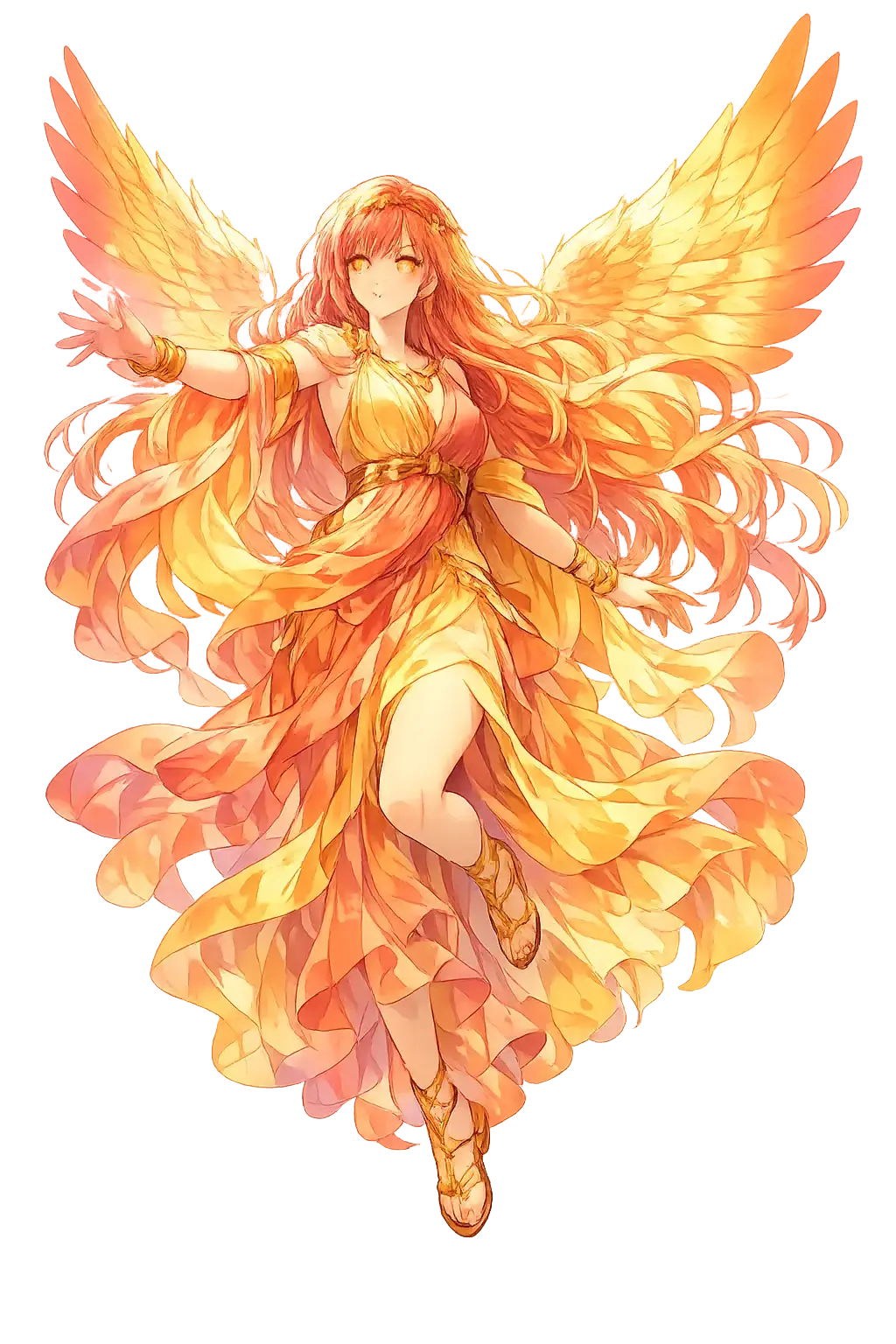
Stories of Ēōs
Ēōs is the dawn made divine — the rosy-fingered goddess who rises each morning from Oceanus to open the gates of day. Daughter of Hyperion and Theía, sister of Hēlios and Selḗnē, she belongs to the oldest generation of sky powers. Her myths are myths of desire: she loves mortals, and her love keeps asking the gods for gifts they only half grant.
The Homeric Hymn to Aphrodite (218–238) tells the saddest of the goddess's affairs. Smitten by the Trojan Tithonos, 'he of the yellow hair', Ēōs asked Zeus to grant him immortality — and, the poet says, she forgot to ask for endless youth. So Tithonos lives forever, but age creeps on: his voice thins, his hair whitens, his limbs fail, until he babbles endlessly and shrinks into the body of a cicada, chirruping at the ends of the earth. Homer already knows the opening of the story: the Iliad wakes its warriors as Dawn rises 'from her bed beside noble Tithonos' (11.1–2). Sappho, in the fragment long read as her old-age lament (fr. 58), has the goddess herself discover that youth once lost cannot be recovered. The myth reads time itself as a failed negotiation: love can win exemption from death, but not from aging.
Ēōs's second great mortal love was Kephalos, the beautiful hunter — and here the sources openly disagree. In Hesiod's version (fr. in the Catalogue) and Apollodorus (1.9.4), the goddess simply carries Kephalos off and bears him a son, Phaethōn — a different boy from Hēlios's doomed driver — whom Aphrodítē later steals away to be night-watchman of her sanctuary. But the later, tragic tradition (reworked by Ovid, Metamorphoses 7.700–865) reverses the direction: Kephalos, tested by a disguised Ēōs, resists the goddess and is restored to his beloved wife Prókris — only for the suspicion planted by the failed seduction to destroy the marriage anyway. Half-convinced of her infidelity, Kephalos hurls the javelin that kills Prókris in the thicket. Whether the goddess wins or loses the mortal, the tale insists that divine desire visited upon a marriage leaves wreckage: even a resisted temptation, once spoken, cannot be unsaid.
Homer needs no story for Ēōs because he has a formula: ēmós d' ērigéneia phánē rhododáktylos Ēṓs — 'when early-born, rosy-fingered Dawn appeared' (Iliad 1.477 and passim). Twenty times the Iliad opens a day with her. She rises from Oceanus or from her couch beside Tithonos, harnessing the swift horses whom the Odyssey names Lampós and Phaethōn, 'Shining' and 'Blazing' (23.244–246), and climbs until her light touches the armies at Troy. The epithet rhododáktylos, 'rose-fingered', paints the moment her first rays spread across the horizon like fingers over the sleeping world. To Homer's audience the formula was prayer-adjacent: a new day was not a mechanism but a goddess arriving on schedule. In the epic's economy Ēōs is the one power that never breaks a promise — the war pauses, the feasting ends, the heroes die, and still, book after book, she comes.
Why does Ēōs, alone among goddesses, burn for mortal men? Later antiquity supplied an answer and a warning. The mythographers (Apollodorus 3.14.3) report that Aphrodíté, angered because Ēōs had lain with her lover Árēs, cursed her with an insatiable longing for mortals — Orion, Kephalos, Kleitos, Tithonos. The oldest trace of the pattern is Homer's own: in Odyssey 5.121–124 the nymph Kalypso complains that the gods begrudge goddesses their mortal lovers, 'as when rosy-fingered Dawn rose and carried off Orion, until Artemis of the golden throne... slew him' in Ortygia. Orion's fate stays chillingly ambiguous — some say Artemis killed him at Ēōs's own jealous request, others in divine anger at the pairing. The tradition, fragmentary and contradictory as it is, makes one point clearly: love between an immortal and a mortal always ends with the mortal's end — the goddess keeps rising; her beloveds do not.
Dawn, Morning Light, New Beginnings
Ēōs is the dawn personified: the rosy-fingered goddess who rises each morning from the Ocean stream, harnessing her bright horses while the world still sleeps. Daughter of Hyperion and Theía, sister of Hēlios and Selḗnē, she is the night's release and the day's herald — beautiful, punctual, and quietly tragic.
She opens the gates of heaven and harnesses her horses Lampós and Phaethōn so Hēlios can ride (Odyssey 23.244–246).
The epithet rhododáktylos paints her first rays spreading across the horizon — the formula opens book after book of the Iliad.
She carried off Tithonos, Kephalos, and Orion; her affairs with mortals are a study in gifts that backfire.
The crimson-saffron garment of early light, which she puts on as she climbs from the eastern Ocean.
From the original script to the living URL
Ἠώς
The name in its original Greek form. Ēōs (Ἠώς) is attested in the source tradition — “Dawn (from ἠώς)”. Its long vowels and acute accents carry the full phonetic and orthographic weight of the source tradition.
eos
Reduced to plain eos, the name loses everything that made it specific: long vowels and acute accents. What remains is an ASCII string that machines can parse but that no longer speaks with its original voice.
Ēōs
The Unicode restoration recovers what ASCII flattened. Ēōs restores long vowels and acute accents, returning the name to its original written dignity. The domain encodes to Punycode, but the browser displays the truth.
Ēōs.com → xn--s-oia8o.com
The non-ASCII characters in Ēōs are encoded while the ASCII remains visible. To the DNS, it is Punycode. To humanity, it is Ēōs.
Owned, ideal, and ASCII forms of Ēōs
Ēōs
Restores Ἠώς. The live temple domain — ēōs.com.
eōs
Restores Ἠώς. A second live spelling — eōs.com.
Ēṓs
Restores Ἠώς. Stacked macron+acute on the stressed long vowel, matching Greek Ἠώς; philologically ideal but often untypeable on phones.. Not in the PuniCodex collection.
eos
Flattens Ἠώς. The plain ASCII fallback — what DNS and legacy systems see.
How Ēōs was spoken
How Ēōs is preserved in writing
A bespoke provenance study for Ēōs is being prepared by the PUNICODEX scholarly team.
Contribute scholarly provenance →The lore you have read is the living myth. Extended Lore opens the scholarly vault beneath it: the cult and its material remains, a history of the image, the name after antiquity, a meditation on what the name still means, and the full scholarly apparatus — etymology, orthography, sources.
Enter Extended Lore