Stories of Ekkeko
Ekeko's mythology is unusual: nearly all of it is modern. A colonial Jesuit notices the household idol in 1653; a founding legend is printed in 1904; the January fair of Alasitas keeps the cult alive in the streets of La Paz. Beneath all of it lie burden-carrier figurines from Tiwanaku, a thousand years older than the name.
The best-known story of Ekeko is surprisingly recent: it was printed in 1904 by the Bolivian writer Antonio Díaz Villamil in his Exaltación de la Alasita. In the time of drought, when the storehouses stood empty, the little man Ekeko fed his beloved Coya from his own flesh, cutting pieces from his body so that she would not starve. When the rains finally returned, Coya searched the hills for him and found only a small clay figure bowed under an enormous load. She recognized her lover in the idol, carried it home, and set it on the household altar; from that day, abundance never left her house. Scholars treat the legend as modern folklore rather than pre-Columbian scripture — and say so openly — yet it explains everything the ritual actually does: the little body, the heavy pack, the beloved who keeps him. The myth reads Ekeko as love converted into provision.
Bernabé Cobo, writing his Historia del Nuevo Mundo in 1653, is the earliest secure witness. Among the household devotions of the Andean people he describes a small idol called Equeco, revered as a god of wealth and contentment: his image was a little figure loaded with packs and bundles, set up in the house and offered food, so that he would keep the family supplied with the small goods of life — food, clothing, coin. Cobo's Equeco is no state god of the Sun's rank but a humble domestic numen, carried and coddled by ordinary households. That a Jesuit chronicler should pause over so modest a deity is itself testimony to how thoroughly the little god had entered daily life. The passage anchors Ekeko in the colonial record and shows what he was always for: not empire or war, but the prosperity of the kitchen and the storeroom.
Every January the city of La Paz holds the Alasitas fair, and the streets fill with miniature versions of everything people want: tiny houses, banknotes, cars, diplomas, sewing machines, even tiny marriage certificates. The name is Aymara — 'buy for me' — and the transaction is a prayer: you purchase the miniature, carry it to be blessed — by priest and by the ritual ch'alla of sprinkled alcohol alike — and set it on the household altar before your Ekeko, who is charged with growing the little thing into the real one during the coming year. The fair's patron is Ekeko himself; his image, pipe in mouth and pack on back, presides over the commerce. The rite was inscribed by UNESCO on the Representative List of the Intangible Cultural Heritage of Humanity in the 2010s. Its engine is sympathetic magic, but its meaning is bolder: it treats desire as a legitimate offering and commerce as a form of hope.
Long before any text named him, the high plateau produced his image. Among the burial goods of Tiwanaku (c. 500–1000 CE), archaeologists recover small ceramic figurines of men bent under packs, head-straps cutting across their foreheads — exactly the posture of the modern Ekeko. Whether these burden-carriers were 'Ekeko' in any sense we can recover is honestly unknown: the Tiwanaku left no deciphered writings, and the identification is the work of modern scholarship and artisan tradition rather than proof. But the continuity is visual and, in a way, theological — a culture imagined prosperity as something carried on a humble human back. The museums of La Paz display the ancient figurines beside the modern ones. The myth's deepest layer says that luck is not lightning but load-bearing: abundance arrives as something small, bowed, and patient.
Luck
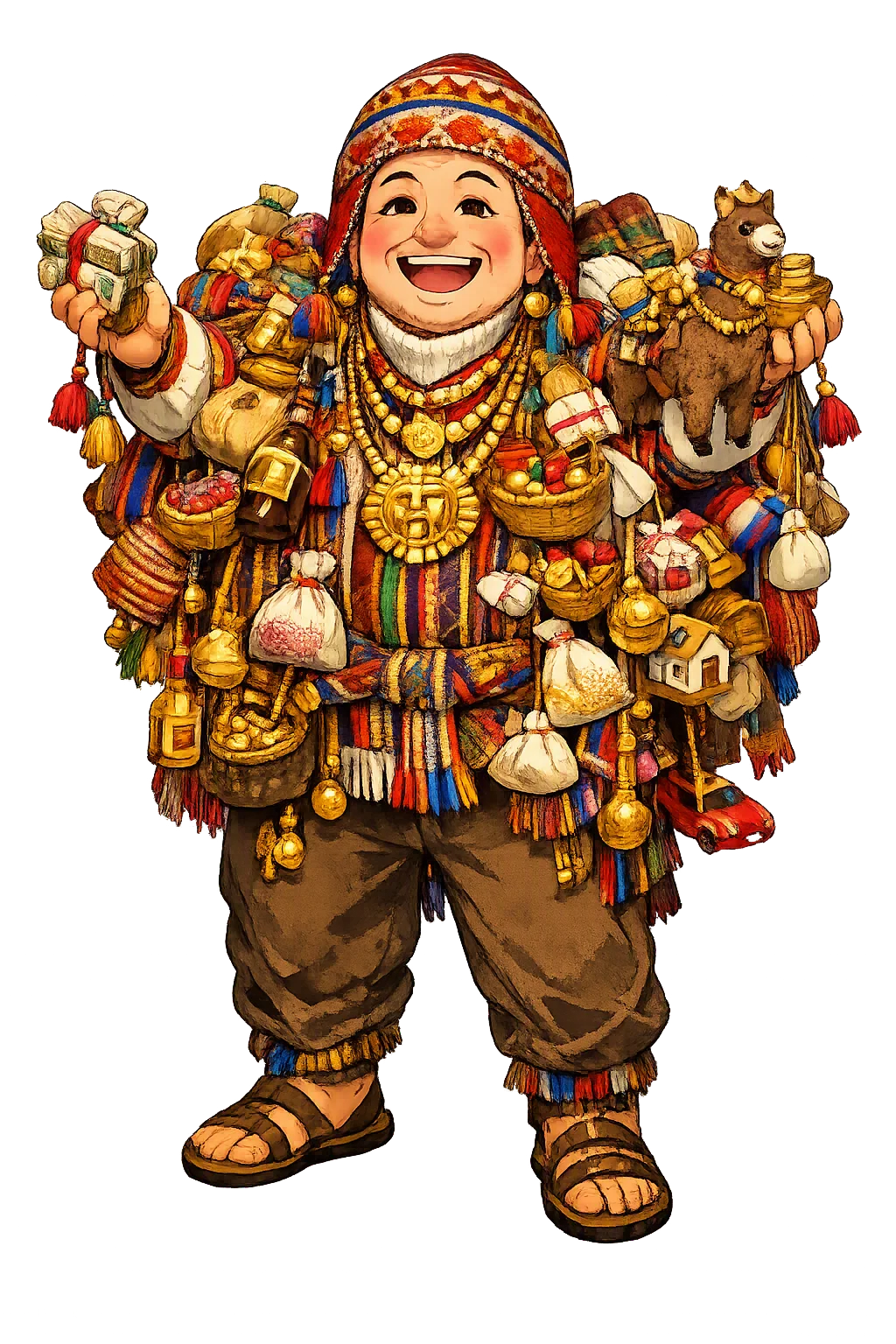
Ekkeko is the Andean god of luck and abundance: a smiling little man bowed under a pack holding everything a household could wish for. His mythology is young as myths go — a colonial chronicler's notice, a founding legend printed in 1904, and a January fair where all of La Paz buys its dreams in miniature — but it rests on burden-carrier figurines far older than the name.
The loaded pack on his back carries every good thing a household can hope for: grain, coin, houses, health, and a lit pipe besides.
Every 24 January the streets of La Paz fill with miniatures of everything people want, bought, blessed, and set on his altar to be grown into reality.
Bernabé Cobo described how Andean families kept his little image by the hearth, loading it with tiny packs and offerings so prosperity would stay in the house.
In the legend recorded in 1904, Ekeko fed his beloved Coya from his own flesh during a famine; her faithful search restored him as the little clay god.
From the original script to the living URL
Ekkeko
The name survives in scholarly transliteration. Ekkeko is the standard Incan romanisation, documented in academic sources — “The dwarf”. Because the spelling uses only Latin letters, the form is the same in both ASCII and Unicode.
No indigenous writing system is securely attested for individual incan names. The form shown is a modern scholarly transliteration.
ekkeko
The plain ekkeko form is identical to the Unicode restoration. Because this name is already written in Latin letters, no diacritics, stress, or script information were lost — only capitalization differs.
Ekkeko
The Unicode restoration does not need to recover lost marks for Ekkeko. Its value is canonical spelling and consistent cataloguing, not the reconstruction of erased orthography. The domain is readable as-is to both DNS and humanity.
Ekkeko.com
This restoration is written entirely in ASCII letters — no Punycode encoding stands between Ekkeko and the DNS. The domain reads identically to machines and to human eyes.
Owned, ideal, and ASCII forms of Ekkeko
Ekkeko
The full Unicode restoration. ekkeko.com is not in the PuniCodex collection — it is watched for release; if it drops, this temple upgrades to an owned flagship.
How Ekkeko was spoken
How Ekkeko is preserved in writing
No indigenous writing system is securely attested for individual incan names. The form shown is a modern scholarly transliteration.
Contribute scholarly provenance →The lore you have read is the living myth. Extended Lore opens the scholarly vault beneath it: the cult and its material remains, a history of the image, the name after antiquity, a meditation on what the name still means, and the full scholarly apparatus — etymology, orthography, sources.
Enter Extended Lore