PuniCodex

Extended Lore

Eingana

Etymology · Phonology · Orthography · Cultural Legacy · Primary Sources

Tier 2 Eingana
Eingana — Creator Mother Snake
01

Quick Facts

Essential information about Eingana, Creator Mother Snake

Scholarly TransliterationEingana
Unicode RestorationEingana
Reconstructed Pronunciation/aɪˈŋɑːnə/
PantheonAboriginal
DomainCreator Mother Snake
MeaningThe mother
ClassificationTier 2
Primary DomainEingana
Sacred SymbolsRainbow serpent / water snake, Waterhole and billabong, Stone spear points and ochre, The wet-season storm
02

Etymology & Word Family

From original script to Unicode restoration

Scholarly Transliteration Eingana Eingana — "The mother"
Unicode Restoration Eingana Restored stress, length, and script
Modern ASCII eingana Plain-ASCII fallback

The spelling Eingana is an English-language transcription of an oral name. Indigenous Australian languages did not traditionally use the Latin alphabet, and pronunciations vary by language group and song cycle. The PuniCodex restoration capitalises the conventional scholarly form; no diacritic or special letter is added, so the name is Tier 2.

03

Unicode Character Breakdown

Character-by-character philological analysis

CharacterUnicodeNameBlockPhonetic Role
EU+0045Latin Capital Letter EBasic LatinSame, capitalized
iU+0069Latin Small Letter IBasic LatinSame
nU+006ELatin Small Letter NBasic LatinSame
gU+0067Latin Small Letter GBasic LatinSame
aU+0061Latin Small Letter ABasic LatinSame
nU+006ELatin Small Letter NBasic LatinSame
aU+0061Latin Small Letter ABasic LatinSame

The Tier 2 classification reflects how much of the original phonology this restoration preserves — stress and vowel length for Greek names, distinctive letters and diacritics for every other tradition.

04

Cultural Significance

From ancient cult to modern Unicode

Ancient Domain

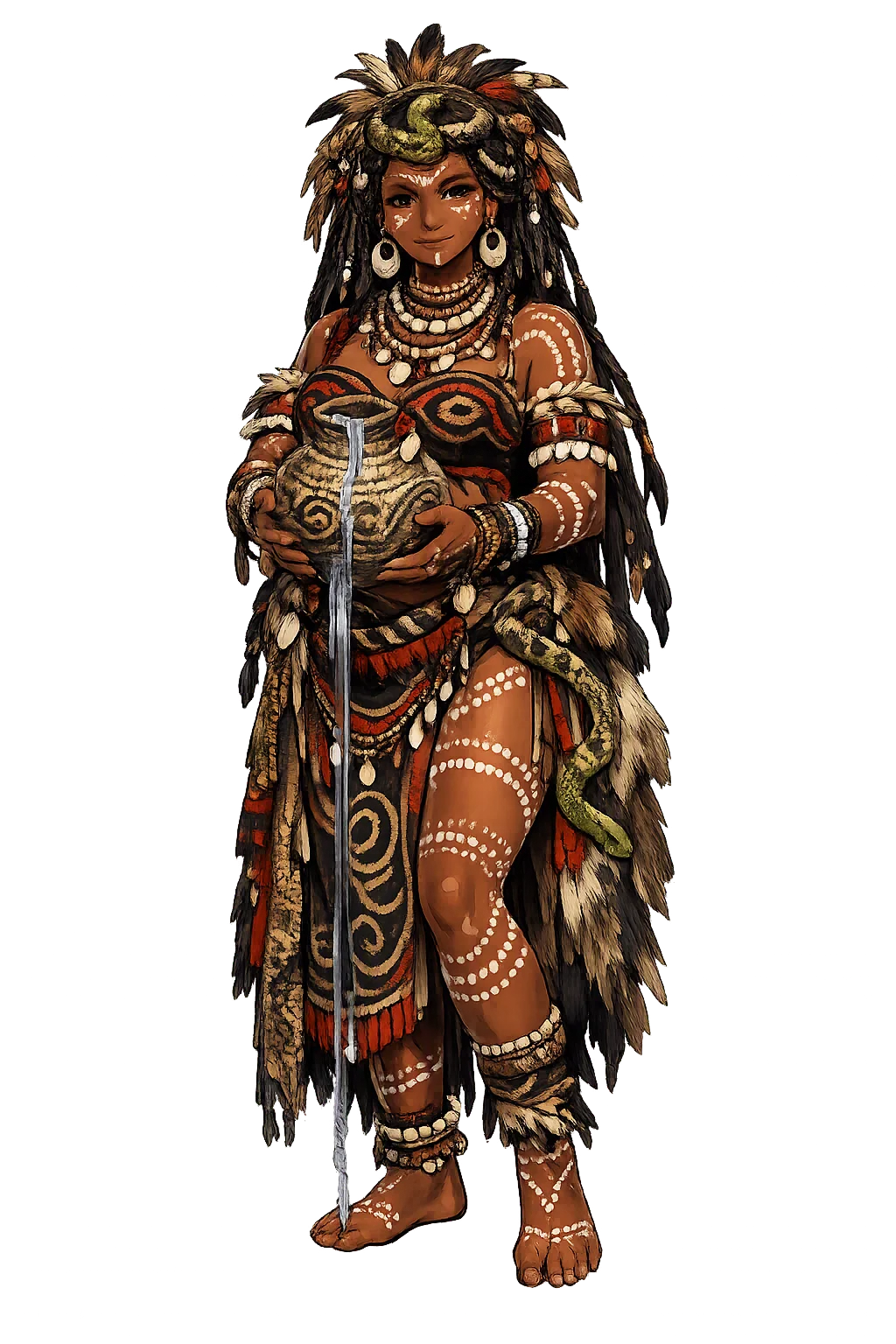
Eingana is the great Mother Snake of the Aboriginal Australian cosmology recorded in the western Arnhem Land region. She is not merely a serpent but the living body from which the land, water, plants, animals, and human beings emerged. In the Creation Time — the epoch Aboriginal English calls the Dreaming — she moved beneath the surface of the world, raised hills and watercourses, and gave birth to all life. Where she rests, water collects; where she travels, the country remembers her shape in rivers, rocks, and springs.

Eingana in Later Traditions

Eingana belongs to the Rainbow Serpent family of beings that stretches across Aboriginal Australia, from the Wagyl of Noongar country in the southwest to Yurlunggur and Barramundi in Arnhem Land. Each figure is distinct, named in its own language, and tied to specific country, but all share the grammar of a creative water-being who shapes the land and punishes transgression. Scholars such as A. P. Elkin and later anthropologists traced this distribution while warning against collapsing local differences into a single pan-Australian 'Rainbow Serpent.' In non-Indigenous reception, Eingana has sometimes been flattened into a generic 'mother goddess,' a reading that obscures the specific kinship, site-based, and ceremonial dimensions of her Jawoyn and Arnhem Land context.

Modern Legacy

Eingana is part of the living heritage of the Aboriginal peoples of western Arnhem Land. Her image appears in rock art galleries of the region — among the oldest continuous artistic traditions on Earth — and her stories continue to be performed in ceremony under the authority of traditional custodians. Outside those communities, her name has entered anthropological literature, environmental writing, and popular accounts of Aboriginal spirituality as an emblem of the creative, serpentine powers of the Australian landscape. The challenge for contemporary use is to cite her respectfully: not as a brand or a decorative motif, but as a named figure within a specific system of country, law, and custodianship.

Unicode Restoration as Cultural Act

Restoring Eingana in a domain name is more than orthographic accuracy. It is a statement that the internet should recognize the full range of human writing — not only the ASCII keyboard.

05

Frequently Asked Questions

Common questions about Eingana, Creator Mother Snake, and Unicode restoration

01How do you pronounce Eingana?

In reconstructed pronunciation, Eingana is /aɪˈŋɑːnə/ — approximately 'eye-NGAH-nuh' — begin with the vowel of 'eye,' add the 'ng' of 'sing,' and end softly. Avoid breaking the 'ng' into two consonants..

02What does Eingana mean?

Eingana means The mother in the aboriginal tradition.

03What are the symbols of Eingana?

Eingana is associated with Rainbow serpent / water snake (Her body is the river, the rainbow, and the serpent-shape seen in rock art and sacred design.), Waterhole and billabong (Places where she rests are sources of life, healing, and danger; they demand respect and correct behaviour.), Stone spear points and ochre (Sacred objects linked to her ceremonies and to the authority of those who keep her law.), The wet-season storm (Her power is felt in the thunder and rain that transform the Arnhem Land landscape each year.).

04Why restore Eingana in Unicode?

Plain ASCII eingana strips the stress, length, and script that make the name specific. Unicode restoration returns the name to its original written dignity.

05What is the most important myth about Eingana?

In the beginning Eingana lay beneath the surface of the world, huge and pregnant with all life. She moved through the darkness, and where she pushed upward the land rose into hills and escarpments; where she rested, water pooled into billabongs and rivers. One by one she gave birth to the animals, the plants, and the first people, each of whom carried a portion of her law. The country itself is therefore her descendant: every rock, waterhole, and plant is a memory of her body.

06

Scholarly Sources

The philological foundations of this restoration

Every claim on this page is grounded in established scholarship. The orthographic restorations follow disciplinary convention. The etymological chain follows the best available reference works. This is not invention — it is resurrection through scholarship.

Lexicography & Philology

  • AIATSIS
  • Berndt

Primary Texts

  • Primary sources in the aboriginal tradition for Eingana.

Archaeology & Art History

  • Material evidence — iconography, inscriptions, and temple archaeology — for Eingana and related cults.
  • The material record of Eingana and related Rainbow Serpent figures is preserved in the rock art of western and northern Arnhem Land, one of the world's longest continuous artistic sequences. Paintings of serpentine beings, waterholes, and ancestral episodes appear in shelter galleries from the Dynamic Figure period onward, with later X-ray and contact-period styles adding internal detail. The American-Australian Scientific Expedition to Arnhem Land (1948) and subsequent AIATSIS documentation recorded sites, designs, and associated narratives. Because the most sacred dimensions of the tradition are restricted to initiated custodians, the public archaeological record represents only the outer layer of a much deeper corpus of knowledge.

Religious Studies

  • AIATSIS — Australian Institute of Aboriginal and Torres Strait Islander Studies, Canberra
  • Berndt, Ronald M. & Catherine H. Berndt, The World of the First Australians, 5th ed. (Canberra: Aboriginal Studies Press, 1999)
  • Berndt, Ronald M. & Catherine H. Berndt, Speaking Land: The Sacred Geography of Aboriginal Australia (Melbourne: Penguin, 1989)
  • Elkin, A. P., The Australian Aborigines: How to Understand Them, 5th ed. (Sydney: Angus & Robertson, 1964)
  • Stanner, W. E. H., 'The Dreaming' (1953) and On Aboriginal Religion, Oceania Monographs (Sydney, 1959–1961)
  • Kolig, Erich, The Silent Revolution: The Effects of Modernization on Australian Aboriginal Religion (Philadelphia: ISHI, 1981)
  • Mountford, Charles P., Records of the American-Australian Scientific Expedition to Arnhem Land, vol. 1: Art, Myth and Symbolism (Melbourne: Melbourne University Press, 1956)
  • Swain, Tony, A Place for Strangers: Towards a History of Australian Aboriginal Being (Cambridge: Cambridge University Press, 1993)
Return

The Surface Awaits

You have traced the name from its earliest attestation to its Unicode restoration. Now return to the myth. The story is where the name lives.

Back to Lore
Eingana mascot