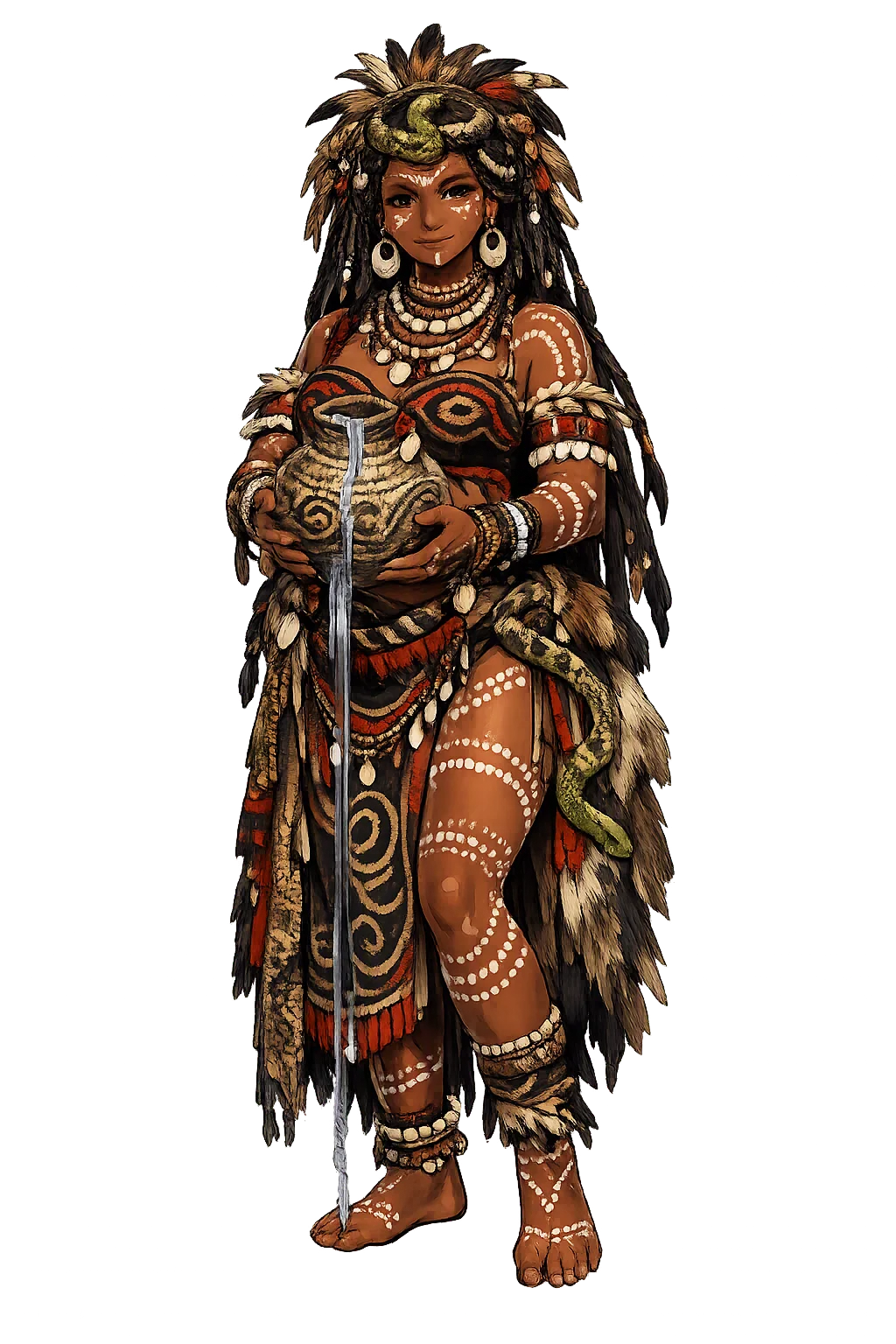
Stories of Eingana
Eingana's mythology belongs to the oral traditions of the stone country and adjacent regions of western Arnhem Land. It is not a single fixed narrative but a corpus of songs, dances, and designs held by senior custodians. The common threads are her primordial motherhood, her shaping of the country, and the enduring obligation of human beings to care for the land she made.
The fullest published accounts of Eingana come from twentieth-century ethnographers working in western Arnhem Land — Mountford's Arnhem Land expedition records, the Berndts' studies, Elkin's syntheses — and from custodians of the stone country who have spoken for their country in more recent decades. The shared core is immense and simple: in the Creation Time, Eingana lay beneath the surface of the world, huge and pregnant with all life. She moved through the darkness, and where she pushed upward the land rose into ranges and escarpments; where she rested, water pooled into billabongs and rivers. She gave birth to the animals, the plants, and the first people, each carrying a portion of her law, and then — in most tellings — withdrew into the deep waterholes to sleep. The country is therefore her descendant and her body: every rock and spring a memory of her movement, every songline a tracing of her track. Details belong to particular custodians and are properly withheld from publication; what can be said publicly is the architecture — a creation that is not an event of the past but the permanent structure of the present land.
Eingana's power is life-giving but not safe, and the tradition is honest about both halves. Stories recorded in the Arnhem Land literature tell of her swallowing the dead, or those who transgress her law, and of her power to restore or transform what she has taken. This double nature — mother and devourer — is characteristic of the Rainbow Serpent family across Australia, from the Murngin's Yurlunggur to the Noongar's Wagyl: the same being who creates the world punishes those who forget their obligations to it. The danger is not malice; it is law. A waterhole where she rests must not be fouled; a site of her story must not be spoken of by the wrong people; resources must be taken with the proper observances and in season. Those who keep the law receive her abundance; those who break it meet her body. Modern commentators sometimes soften the swallowing into symbolism, but the older accounts present it plainly — the mother who made every life remains sovereign over each, and sovereignty includes the taking back.
Eingana is read in the annual transformation of Arnhem Land itself. Through the long dry she sleeps in the deep waterholes, her presence contracting to those few surviving pools where life clusters; when the first storms of the wet break, she stirs — and the thunder is her voice, the flooding rivers her movement, the green explosion of the country her waking body. The monsoon's violence is not a disruption of creation but its renewal: the land dies back each year and is born again when the great snake moves. Ceremonies at the turning of the seasons re-enact this cycle and re-commit the human community to its part — proper burning of the country, care of the waterplaces, observance of the right songs. Stanner named the underlying ontology the Dreaming: a time that is not past but continuous, in which the ancestors' acts remain available to the present. Eingana's breathing — dry sleep, wet waking — is the Dreaming's clearest annual signature, written across a third of the continent each year in fire, smoke, rain, and green.
The stories of Eingana are not entertainment and not antiquarian record; they are the charter under which her country is looked after. Specific clans, families, and individuals hold the right to speak for particular sites, songs, and designs — a system anthropologists have described as a marriage of land tenure, intellectual property, and liturgy. To sing her name without authority, to damage her waterholes, to take resources out of season or without observance is to break a living relationship, and the tradition is explicit that the consequences are real: the water fails, the law's keepers sicken, the country itself suffers. Because the most sacred dimensions are restricted to initiated custodians, the public record — books, museums, even this entry — holds only the outer layer of a much deeper corpus; the centre is deliberately not published. The mythology therefore encodes land management, kinship, and ethics in a single narrative field, and its modern force has been proven: Aboriginal land-rights claims across Australia have succeeded precisely by demonstrating this continuous custodianship, with the old songs and sites as evidence that the relationship with country never lapsed.
Creation, Water, Fertility, and the Law of Country
Eingana is the great Mother Snake of the Aboriginal Australian cosmology recorded in the western Arnhem Land region. She is not merely a serpent but the living body from which the land, water, plants, animals, and human beings emerged. In the Creation Time — the epoch Aboriginal English calls the Dreaming — she moved beneath the surface of the world, raised hills and watercourses, and gave birth to all life. Where she rests, water collects; where she travels, the country remembers her shape in rivers, rocks, and springs.
She is the primordial mother: from her body come the first people, animals, and the very contours of the land.
Her presence fills billabongs and brings the rains; she governs the renewal that follows the dry.
The stories, songs, and designs that belong to her country encode moral and ecological law for those who hold them.
She is mother of peoples and species alike; her mythology binds human lineage to the land that gave it form.
From the original script to the living URL
Eingana
The name survives in scholarly transliteration. Eingana is the standard Aboriginal romanisation, documented in academic sources — “The mother”. Because the spelling uses only Latin letters, the form is the same in both ASCII and Unicode.
No indigenous writing system is securely attested for individual aboriginal names. The form shown is a modern scholarly transliteration.
eingana
The plain eingana form is identical to the Unicode restoration. Because this name is already written in Latin letters, no diacritics, stress, or script information were lost — only capitalization differs.
Eingana
The Unicode restoration does not need to recover lost marks for Eingana. Its value is canonical spelling and consistent cataloguing, not the reconstruction of erased orthography. The domain is readable as-is to both DNS and humanity.
Eingana.com
This restoration is written entirely in ASCII letters — no Punycode encoding stands between Eingana and the DNS. The domain reads identically to machines and to human eyes.
Owned, ideal, and ASCII forms of Eingana
Eingana
The full Unicode restoration. eingana.com is not in the PuniCodex collection — it is watched for release; if it drops, this temple upgrades to an owned flagship.
How Eingana was spoken
How Eingana is preserved in writing
No indigenous writing system is securely attested for individual aboriginal names. The form shown is a modern scholarly transliteration.
Contribute scholarly provenance →The lore you have read is the living myth. Extended Lore opens the scholarly vault beneath it: the cult and its material remains, a history of the image, the name after antiquity, a meditation on what the name still means, and the full scholarly apparatus — etymology, orthography, sources.
Enter Extended Lore