The Living Myth
Watchman, Ragnarök Herald · The Watchman of the Last Morning
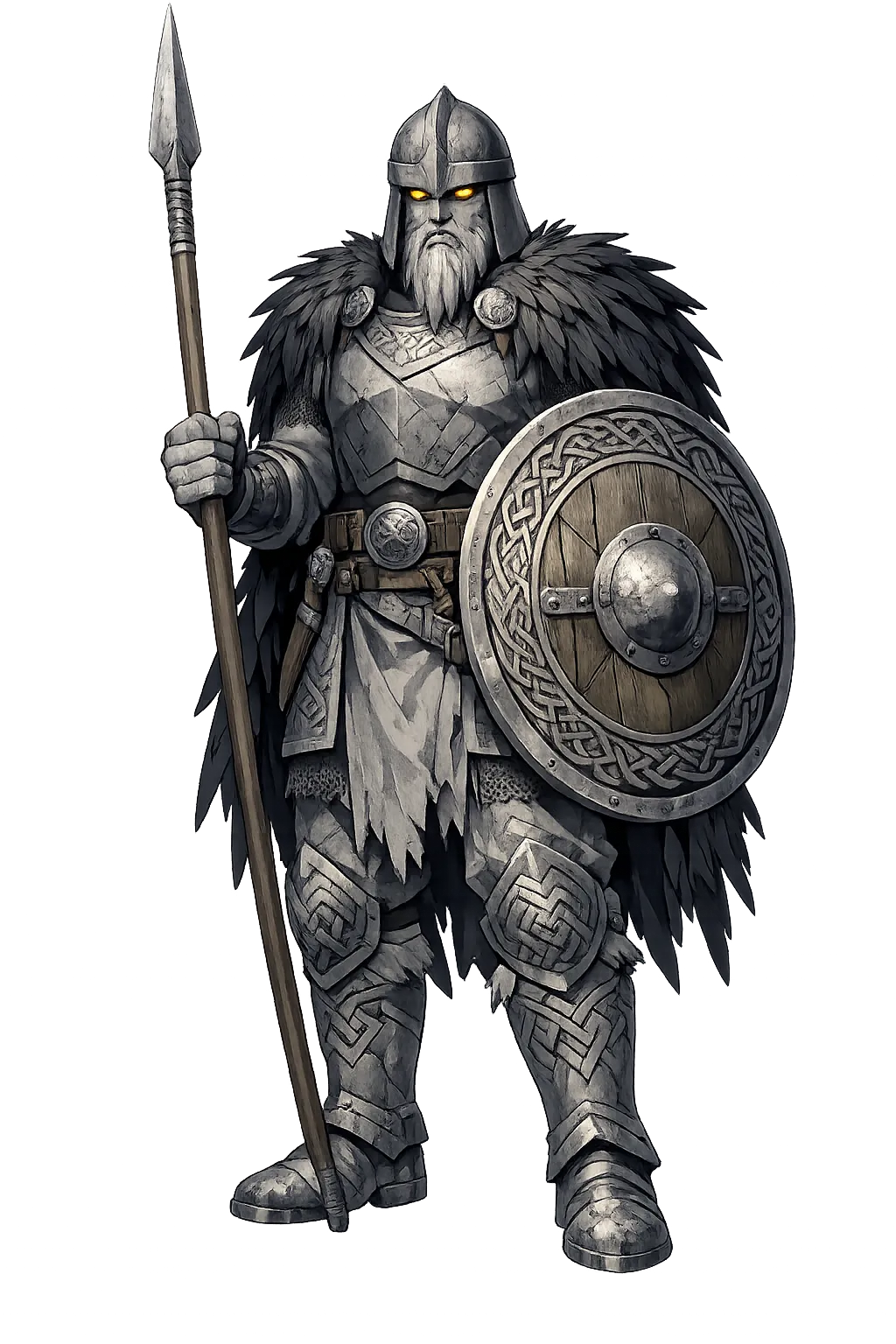
Stories of Eggþér
Eggþér is one of the most enigmatic figures in Norse myth. He has no extended story, no family tree, no cult. Yet his single appearance in Völuspá makes him unforgettable: the herdsman on the mound, playing while the world ends.
The völva's prophecy pauses, just before the final battle, on a pastoral scene: 'He sat on the howe and plucked his harp, the giantess's herdsman, the cheerful Eggþér; the cockerel Fjalarr crowed in the garth' (Völuspá 42, Codex Regius recension). A herdsman sits on a howe — a burial mound, the dead's own architecture — and makes music. Nothing in the scene explains him: he fights no one, speaks no line, advances no plot. That is precisely his power. While the gods arm and the wolf strains at his chain, the world's end has a soundtrack, and it is a harp. The verse holds together the three things the Norse imagination never separated: farm, grave, and apocalypse. And it gives annihilation an accompaniment — the most social of arts, played to an audience of one giantess, at the hour when every other audience is about to vanish.
Eggþér sits inside a sequence, and the sequence is terror. In the stanzas around him, the wolf Garmr bays before Gnipahellir's cave; the fetters of Fenrir burst; the giant Hrymr steers Naglfar, the ship built from dead men's nails, from the east; Loki slips his bonds; and the sons of Muspell ride the rainbow bridge until it breaks beneath them (Völuspá 40–52). The völva narrates it flatly, item by item, like a woman reading a weather report she cannot stop. Eggþér's harp belongs to the interval — after the signs, before the clash on Vígríðr's field, where Óðinn will fall to Fenrir and the earth sink into the sea. To the poets who shaped Völuspá, the end of the world was not a single event but a slow unbinding, strand by strand. And mid-strand they placed a musician: someone, at least, would meet doom with art rather than with weapons.
The stanza after Eggþér's is a census of alarm. Gullinkambi — 'golden-combed' — crows over the Æsir and wakens the heroes at the War-Father's home; another cock cries in the gods' dwellings; and 'a soot-red cock calls in the halls of Hel' (Völuspá 43). Three worlds, three cocks, three warnings: the whole cosmos is awake and cannot say it did not know. Eggþér's music and the cocks' crowing perform the same office from opposite directions — one artful, one animal — announcing that time's structure has failed. The detail that the bird below the earth is soot-red, stained like a thing already burned, reaches past the poem's end: Ragnarök's fire is smudged on the underworld's herald before a single flame is lit. When Fjalarr had crowed in the garth beside the harpist, the sequence had already begun; no one in that yard could claim surprise.
The name itself is the surviving puzzle. Cleasby–Vigfusson's dictionary read Eggþér as 'edge-servant', from egg, 'the edge of a sword', with a second element related to þjónn, 'servant' — a warlike name for a man who does nothing warlike in the poem. Simek and Lindow keep the question open: the first element could equally be the common egg, 'edge, point', used of cliffs and ridges, and some have suspected that the whole name belongs to an older layer of the stanza than the herdsman who now bears it. The manuscripts themselves disagree — Hauksbók's recension compresses the scene nearly out of existence — so any certainty here would be borrowed. What the tradition gives us is a figure whose identity dissolves on inspection, yet whose image survives intact: the harpist on the mound, playing at the end. Perhaps that is the honest way to keep him — an omen that refuses to resolve into a person.
The Giant Herdsman on the Mound
Eggþér appears in the sources only once, but the moment is unforgettable. At Ragnarök he sits on a mound and plays his harp, while the giantess guarding him joyfully keeps watch. His music is the soundtrack of the world's end — a strange, pastoral prelude to annihilation.
He sits on a grave-mound or howe — the dead's own architecture — a liminal seat between living and dead.
His playing accompanies the final age; music becomes an omen of doom (Völuspá 42).
A gýgjar hirðir — the giantess's herdsman — keeps cheerful company with his monstrous ward.
His presence in the prophecy marks the transition from uneasy order to the final unbinding.
From the original script to the living URL
ᛁᚴᚴᚦᛁᚱ
The name in its original Norse form. Eggþér (ᛁᚴᚴᚦᛁᚱ) is attested in the source tradition — “Sword guardian”. Its acute stress marks carry the full phonetic and orthographic weight of the source tradition.
eggther
Reduced to plain eggther, the name loses everything that made it specific: acute stress marks. What remains is an ASCII string that machines can parse but that no longer speaks with its original voice.
Eggþér
The Unicode restoration recovers what ASCII flattened. Eggþér restores acute stress marks, returning the name to its original written dignity. The domain encodes to Punycode, but the browser displays the truth.
Eggþér.com → xn--eggr-dpa9j.com
The non-ASCII characters in Eggþér are encoded while the ASCII remains visible. To the DNS, it is Punycode. To humanity, it is Eggþér.
Owned, ideal, and ASCII forms of Eggþér
Eggþér
Restores ᛁᚴᚴᚦᛁᚱ. The live temple domain — eggþér.com.
eggther
Flattens ᛁᚴᚴᚦᛁᚱ. The plain ASCII fallback — what DNS and legacy systems see.
How Eggþér was spoken
How Eggþér travels from ancient script to the modern URL
The lore you have read is the living myth. Extended Lore opens the scholarly vault beneath it: the cult and its material remains, a history of the image, the name after antiquity, a meditation on what the name still means, and the full scholarly apparatus — etymology, orthography, sources.
Enter Extended Lore