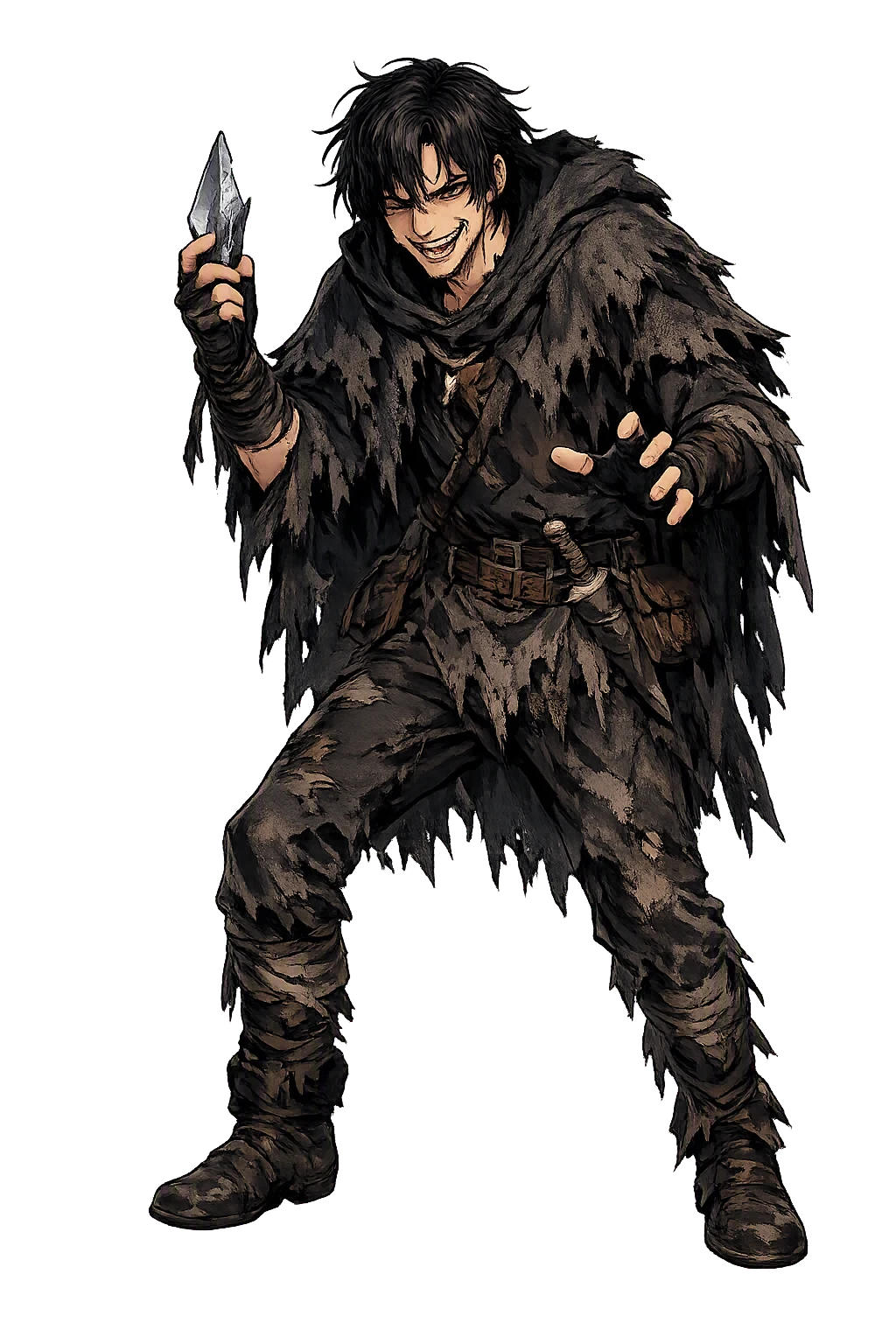
Stories of Efnysien
Efnysien belongs to one tale and fills it: the Second Branch of the Mabinogi, Branwen ferch Llŷr. The branch is the story of a compensation that failed, and Efnysien is the reason — twice over the author of the injury, and at the end the author of the only sacrifice that stopped the ruin.
The tale introduces him by contrast. Penarddun ferch Beli, mother of Brân the Blessed, Branwen, and Manawydan by Llŷr, bore two sons to Euroswydd: Nisien and Efnysien. Of Nisien the branch says he was a good man and a gentle youth, who could bring peace between two armies at their most embittered; of Efnysien it says he would set two brothers at strife when they loved each other most. The balance of the phrasing is deliberate — peace between armies set against strife between brothers, the public against the intimate, and the intimate wins. The narrator does not call Efnysien evil; he says only what the man did to love: he could unmake it, at will, and did. The whole Second Branch is the working-out of that one sentence, and it will never once pause to explain how a woman of Beli's line and Llŷr's house came to bear such a son.
When Brân gave his half-sister Branwen to Matholwch, king of Ireland, the wedding feast was held at Aberffraw, and the horses of the Irish king were stabled for the night. Efnysien asked why they were there, and was told they belonged to Matholwch, who had married his sister. 'Is this what they have done with a maiden as fine as her, my own sister — given her away without asking me?' In his rage he went under the horses and cut off their lips to the teeth, their ears to the head, their tails to the rumps, and their eyelids to the bone. Matholwch rose in silence and made for his ships; only Brân's embassy — Manawydan among them — and the offer of honour-price brought him back: a silver staff as tall as himself, a gold plate as broad as his face, fresh horses, and the Cauldron of Rebirth, which Brân had from Llasar Llaes Gyfnewid and Cymidei Cymeinfoll, wanderers who had fled to his court out of Ireland.
The compensation did not hold. In Ireland the insult was remembered, Matholwch was shamed by his own nobles, and Branwen was sent to the kitchen with a box on the ear from the butcher every day — until she tamed a starling and sent word across the sea. Brân waded the channel, for no ship could carry him, and lay across the river when the Irish destroyed the bridge: 'He who would be a leader, let him be a bridge.' The Irish sued for terms: the kingship would pass to Gwern, Branwen's son, and they would build Brân a house great enough to hold him — the first house he had ever entered. But in that house they hung a hundred bags, an armed man in each. Efnysien walked the row ahead of the feast, laid his hand on each bag — 'What is in here?' 'Flour.' — and squeezed each head through the sacking until he felt the skull give, a hundred times down the hall.
At the feast of reconciliation the boy Gwern was invested as king, and — charming everyone, the branch says — he went from lap to lap among his kinsmen, from Brân to Manawydan to Nisien, until he came to Efnysien's lap. 'Why does my nephew not come to me?' Efnysien asked; and when the boy was put into his arms he seized him by the feet and threw him headlong into the great fire. Branwen would have leapt in after her son, but Brân caught her with one hand and took up his shield with the other, and the hall rose in war. It is the tale's darkest sentence, and its hinge: after Gwern, no negotiation is possible. The branch does not stop to mourn the boy, and it has never once stopped for Efnysien; the child-killer is not given a single word of excuse or grief. That silence is the point — the deed is meant to be looked at straight, and judged.
In the battle that followed, the Irish had the advantage that could not be beaten: every night they cast their slain into the Cauldron of Rebirth, and every morning the dead rose as fighting men again — speechless, but unkillable in any final sense. Then Efnysien, seeing the ruin he had made, did the one thing only he could do. He lay down among the Irish dead as if he were a corpse, was thrown into the cauldron with them, and stretched himself out inside it until the vessel burst into four pieces — and his own heart burst with it, and so he died. The branch gives him no speech of repentance and no eulogy: the destroyer ends the war his own hand started, at the price of his life, and the narration passes on. Of the hosts of Britain only seven men came home, bearing Brân's head; Branwen died of a broken heart on the shore of Anglesey and was buried in a four-sided grave on the bank of the Alaw.
The Strife-Maker of the Second Branch, and the Cauldron He Died Breaking
Efnysien is the destroyer of the Mabinogi: introduced by the Second Branch in a single balanced sentence — his brother Nisien could make peace between two armies at their most embittered; Efnysien could make two brothers quarrel when they loved each other best. One act, the maiming of the Irish king's horses, sets two kingdoms on the road to ruin; his last act, breaking the Cauldron of Rebirth, ends the slaughter.
At the wedding feast of Aberffraw, in a rage that no one had asked his consent, he cuts the lips, ears, tails, and eyelids of Matholwch's horses — the insult that compensation could not bury.
Pair Dadeni — the vessel Brân gives in compensation: a slain man thrown in today rises tomorrow a fighting man, but speechless. Efnysien dies stretching it to pieces.
In the great house the Irish built for Brân, a hundred armed men hide in flour-bags hung on the pillars. Efnysien walks the row, asks what is in each bag, and crushes a skull through the sacking with his fingers.
At the peace feast his nephew Gwern — Branwen's child, newly made king — goes from lap to lap; at Efnysien's lap he is seized and thrown into the flames. After that there is no peace to be made.
From the original script to the living URL
Efnysien
The name survives in scholarly transliteration. Efnysien is the standard Celtic romanisation, documented in academic sources — “Double enemy”. Because the spelling uses only Latin letters, the form is the same in both ASCII and Unicode.
No indigenous writing system is securely attested for individual celtic names. The form shown is a modern scholarly transliteration.
efnysien
The plain efnysien form is identical to the Unicode restoration. Because this name is already written in Latin letters, no diacritics, stress, or script information were lost — only capitalization differs.
Efnysien
The Unicode restoration does not need to recover lost marks for Efnysien. Its value is canonical spelling and consistent cataloguing, not the reconstruction of erased orthography. The domain is readable as-is to both DNS and humanity.
Efnysien.com
This restoration is written entirely in ASCII letters — no Punycode encoding stands between Efnysien and the DNS. The domain reads identically to machines and to human eyes.
Owned, ideal, and ASCII forms of Efnysien
Efnysien
The full Unicode restoration. efnysien.com is not in the PuniCodex collection — it is watched for release; if it drops, this temple upgrades to an owned flagship.
How Efnysien was spoken
How Efnysien is preserved in writing
No indigenous writing system is securely attested for individual celtic names. The form shown is a modern scholarly transliteration.
Contribute scholarly provenance →The lore you have read is the living myth. Extended Lore opens the scholarly vault beneath it: the cult and its material remains, a history of the image, the name after antiquity, a meditation on what the name still means, and the full scholarly apparatus — etymology, orthography, sources.
Enter Extended Lore