PuniCodex

Extended Lore

Efnysien

Etymology · Orthography · Cult · Iconography · Reception · Sources

Tier 2 Efnysien
Efnysien — Trouble, Mischief
01

Quick Facts

Essential information about Efnysien, Trouble, Mischief

Scholarly TransliterationEfnysien
Unicode RestorationEfnysien
Reconstructed Pronunciation/ɛvˈnɪs.jɛn/
PantheonCeltic
DomainTrouble, Mischief
MeaningDouble enemy
ClassificationTier 2
Primary DomainEfnysien
Sacred SymbolsThe mutilated horses, The Cauldron of Rebirth (Pair Dadeni), The flour-bags on the pillars, Gwern cast into the flames, The broken heart
02

Etymology & Word Family

From original script to Unicode restoration

Scholarly Transliteration Efnysien Efnysien — "Double enemy"
Unicode Restoration Efnysien Canonical scholarly spelling — ASCII-identical
Modern ASCII efnysien Plain-ASCII fallback

The name Efnysien reaches the modern world through scholarly transliteration of the celtic tradition. Because the conventional spelling uses only Latin letters, its Unicode and ASCII forms coincide — the tradition it carries is in the name itself, not in diacritics.

03

Unicode Character Breakdown

Character-by-character philological analysis

CharacterUnicodeNameBlockPhonetic Role
EU+0045Latin Capital Letter EBasic LatinSame, capitalized
fU+0066Latin Small Letter FBasic LatinSame
nU+006ELatin Small Letter NBasic LatinSame
yU+0079Latin Small Letter YBasic LatinSame
sU+0073Latin Small Letter SBasic LatinSame
iU+0069Latin Small Letter IBasic LatinSame
eU+0065Latin Small Letter EBasic LatinSame
nU+006ELatin Small Letter NBasic LatinSame

The Tier 2 classification here reflects fidelity to the attested tradition, not recovered diacritics: every character of Efnysien already survives in ASCII. What the restoration preserves is the canonical spelling itself — the form scholarship standardised.

04

Cult & Worship

How the sacred was kept — rites, sanctuaries, remains

The Cult

No cult attaches to Efnysien, and none should be invented: he is a literary figure, the strife-maker of a single branch of the Mabinogi, written down in the fourteenth century from a tale probably composed two centuries earlier. No shrine, festival, votive, or priesthood names him, and the Welsh landscape keeps no grave of his: Bedd Branwen, the cairn by the Alaw, belongs to the sister his deeds helped kill, not to him. The only 'service' the tradition ever paid him was narrative — the Second Branch needs its breaker, and it made him superb at the work. How he was honored is simply not a question the record asks.

In the Earth

Efnysien is an entirely literary figure: no inscription, cult site, or votive deposit names him, and the Welsh theonymic record of the period survives in literature rather than stone. His evidence is manuscript evidence — the Second Branch complete in the White Book of Rhydderch (Aberystwyth, NLW Peniarth MSS 4–5, c. 1350) and the Red Book of Hergest (Oxford, Jesus College MS 111, c. 1382–1410), with the tales' composition argued to the later eleventh or early twelfth century. The geography of his story is real and walkable: Aberffraw, the royal court of Gwynedd where the horses were maimed; Harlech, where Brân's court sat; and the shore of Anglesey where the survivors landed. The tradition's one material anchor is Bedd Branwen, a cairn on the bank of the Afon Alaw in Anglesey identified since the Middle Ages with Branwen's 'four-sided grave' — excavated by Frances Lynch in 1969 and found to hold Early Bronze Age cremations, far older than any Mabinogi event: the identification is the folklore, not the archaeology, and it is precisely that honesty the record keeps.

05

Iconography

How Efnysien was imaged across the ages

The Image

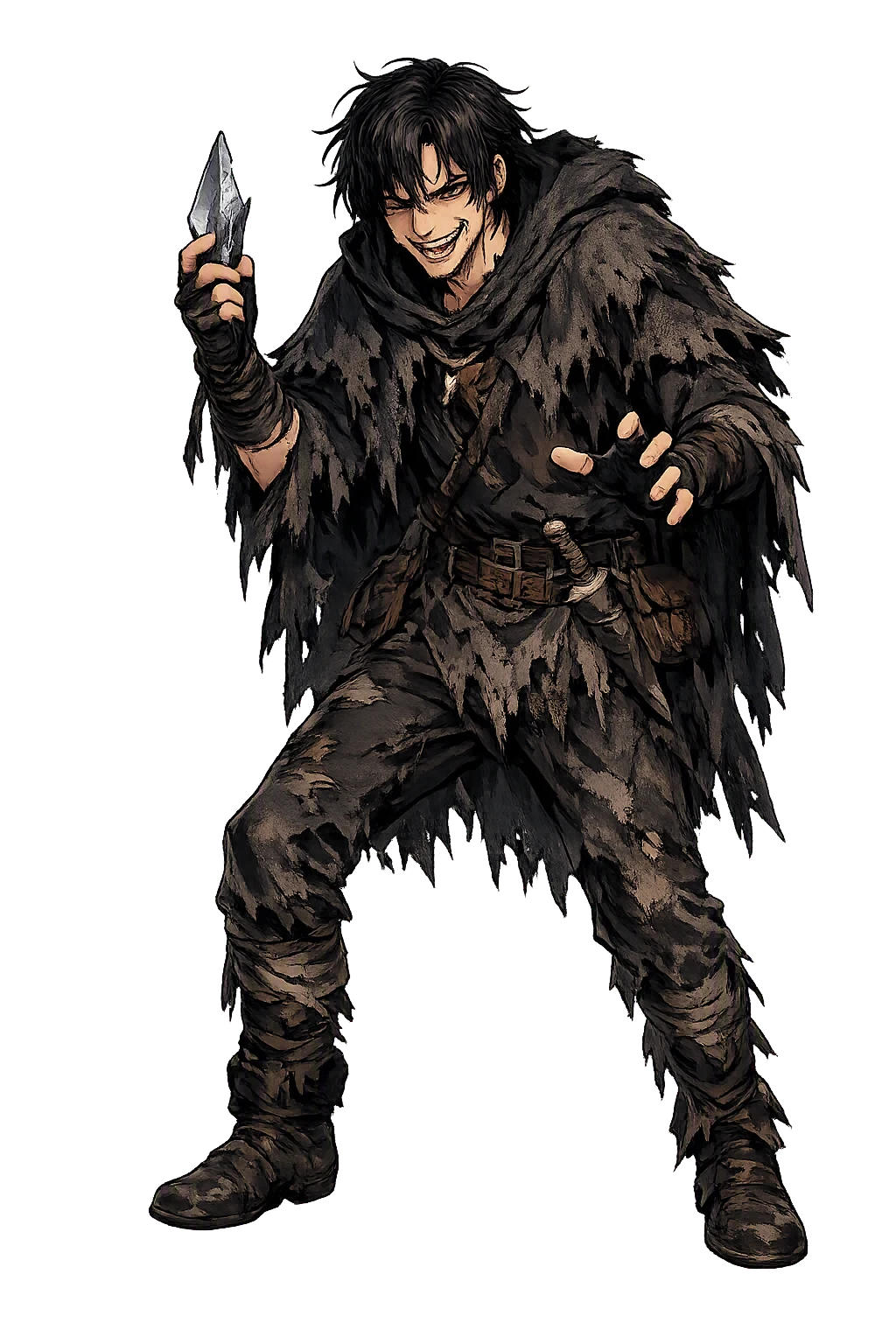
Efnysien has no image. The Second Branch gives him no described appearance and no emblem to hold, and the manuscripts that carry the tale — the White Book and the Red Book — are unillustrated prose codices, so medieval Wales never showed his face. What the text supplies instead is an iconography of acts: the maimed horses lying at Aberffraw, the hundred sacks of flour he pinched to test what was inside, the cauldron he entered smiling and burst from within. Readers have always had to imagine him, and the imagining runs one way — toward the scarred, grinning troublemaker — a face supplied by retellers from the nineteenth century onward rather than by any medieval hand. The image evidence, strictly, is nil; the acting evidence is superb.

06

Reception & Transformation

The name after its own age — transmission, translation, survival

Afterlives

Efnysien rides through the centuries on the Second Branch's back. The tale reached print with the Myvyrian Archaiology (1801–07), which gave the world the Welsh text from the Red Book, and he acquired his English-speaking audience in the nineteenth century, when the branch's cruelties became set-pieces of the Celtic revival. Twentieth-century scholarship made the text a thing to be studied rather than merely read: Ifor Williams's Pedeir Keinc y Mabinogi (1930) grounded the criticism; the succession of standard translations — Gwyn Jones and Thomas Jones in 1949, Sioned Davies's Oxford version in 2007 — carried him into the classroom; and the reference tradition fixed him as the Mabinogi's great study in ungovernable pride, the anti-social twin whose function scholarship learned to read as the branch's dark engine. Modern Welsh has even kept his name in speech, where Efnisien remains a usable personal name — proof that a nation can cherish its troublemaker. He never gained a cult, a picture, or a shrine; he gained something rarer, a permanent place in the canon as the figure a masterpiece cannot do without.

Identifications Across Traditions

The comparison that follows Efnysien everywhere is with [[loki|Loki]]: the malice inside the house, the sworn kin whose mischief costs the gods their peace, the trickster the tale can neither spare nor save. MacKillop and the handbooks register the parallel as typological rather than genealogical — the Mabinogi's strife-maker is a human prince of the Children of Llŷr, not a god, and his story answers to Welsh concerns: the honour-price, the insult remembered, the compensation that fails. The truer Celtic company is the cauldron-complex: the Cauldron of Rebirth belongs to the same deep stock as the Dagda's cauldron from Murias in the Lebor Gabála Érenn, from which no company went away unsatisfied, and the branch itself gives the vessel an Irish provenance through the fugitive Llasar Llaes Gyfnewid. Within the corpus his closest kin are [[nisien|Nisien]], the brother he was written as the opposite of, and [[matholwch|Matholwch]], the king his pride destroyed; [[manawydan|Manawydan]] and [[taliesin|Taliesin]] are among the seven who carried Brân's head home.

Modern Legacy

Lady Charlotte Guest's translation of the Mabinogion (1838–49) carried the Second Branch into the English-speaking world, and Efnysien's maiming of the horses and death in the cauldron became set-pieces of the Victorian Celtic revival. Evangeline Walton retold the branch at full length in The Children of Llyr (1971), the second volume of her Mabinogion tetralogy, and gave him the modern novel's inside view without softening him. His widest-reaching legacy is the cauldron itself: Lloyd Alexander drew the deathless cauldron-born warriors of his Prydain chronicles — The Black Cauldron (1965), filmed by Disney in 1985 — directly from the Welsh matter, where a cauldron that returns the slain to silent service is broken at terrible cost. In Welsh memory the branch left two landmarks: the proverb 'A fo ben, bid bont' — he who would be a leader, let him be a bridge — and Bedd Branwen, the grave by the Alaw where the tradition buried the sister his acts helped kill.

07

The Meditation

What Efnysien means — beyond the dictionary

Efnysien is what a story looks like when it refuses to flatter anyone — including itself. The Second Branch never explains him. He is not possessed, not wronged first, not mad; the tale simply pairs him with Nisien and lets the contrast stand: what one brother binds, the other unbinds, and the world has both kinds of man in it. His evil is small in scale and total in consequence — a night with a knife in a stable, and two kingdoms bleed for a generation. That is the branch's hardest teaching about trouble: it does not need to be great, only timely, and no compensation is large enough to make an injured king forget.

And then the ending, which the Welsh text declines to call redemption. Efnysien sees what his mischief has cost — the speechless dead rising nightly from the cauldron — and lies down among the corpses of the enemy to be thrown in with them. No one forgives him in the text; no one praises him; the branch records only that the cauldron broke and his heart broke. The destroyer is allowed one act of destruction aimed at destruction itself, and it costs exactly everything he has. The Mabinogi does not promise that the man who sets the fire can put it out. It shows him choosing to burn with it.

08

Frequently Asked Questions

Common questions about Efnysien, Trouble, Mischief, and Unicode restoration

01How do you pronounce Efnysien?

In reconstructed pronunciation, Efnysien is /ɛvˈnɪs.jɛn/ — approximately 'ev-NIS-yen' — the f sounds as v, the stress lands on the middle syllable, and the last syllable is a quick, light 'yen'.

02What does Efnysien mean?

Efnysien means Double enemy in the celtic tradition.

03What are the symbols of Efnysien?

Efnysien is associated with The mutilated horses (Pride made visible — an insult so literal that no payment could make the injured king forget it), The Cauldron of Rebirth (Pair Dadeni) (War stripped of death's limit — the gift that became a weapon, until the one who broke it broke himself), The flour-bags on the pillars (Treachery hidden in hospitality — seen through only by the man whose own mind worked that way), Gwern cast into the flames (The murder of the heir at the moment of his investiture — the point past which the tale permits no return), The broken heart (His only death-wound: he stretched himself inside the cauldron until it burst into four pieces, and his heart broke with it).

04Why restore Efnysien in Unicode?

Efnysien is written entirely in ASCII letters, so its restoration is about canonical fidelity rather than recovered diacritics: the temple fixes the name in its scholarly standard spelling, attested in the source tradition, instead of leaving it to drift.

05What is the most important myth about Efnysien?

“The Two Brothers” — the Mabinogi, Second Branch story that anchors the mythology of Efnysien, told in full on the lore page.

09

Scholarly Sources

The philological foundations of this restoration

Every claim on this page is grounded in established scholarship. The orthographic restorations follow disciplinary convention. The etymological chain follows the best available reference works. This is not invention — it is resurrection through scholarship.

◈

Lexicography & Philology

  • Mabinogion
  • MacKillop
◎

Primary Texts

  • The Immram Brain (Voyage of Bran); Tochmarc Étaíne; Cóir Anmann; medieval Irish saga literature.
◉

Archaeology & Art History

  • Material evidence — iconography, inscriptions, and temple archaeology — for Efnysien and related cults.
✦

Religious Studies

  • The Mabinogi, Second Branch (Branwen ferch Llŷr), trans. Sioned Davies (Oxford, 2007); Welsh text ed. Ifor Williams, Pedeir Keinc y Mabinogi (1930) — the whole dossier: the two brothers, the horses, the bags, Gwern, the cauldron
  • The Mabinogion, trans. Lady Charlotte Guest, 3 vols. (London, 1838–49) — the first Englishing of the Second Branch
  • Mac Cana, Proinsias, Branwen Daughter of Llŷr: A Study of the Irish Affinities and of the Composition of the Second Branch of the Mabinogi (Cardiff, 1958), and The Mabinogi, 2nd ed. (Cardiff, 1992)
  • Koch, John T., ed., Celtic Culture: A Historical Encyclopedia (ABC-CLIO, 2006), s.vv. Efnisien, Branwen ferch Llŷr, Mabinogi
  • MacKillop, James, Dictionary of Celtic Mythology (Oxford, 1998), s.vv. Efnisien, Nisien, Pair Dadeni — the name's gloss and the cauldron-complex
  • Geiriadur Prifysgol Cymru / A Dictionary of the Welsh Language (University of Wales Press), s.v. Efnisien
Return

The Surface Awaits

You have traced the name from its earliest attestation to its Unicode restoration. Now return to the myth. The story is where the name lives.

Back to Lore
Efnysien mascot