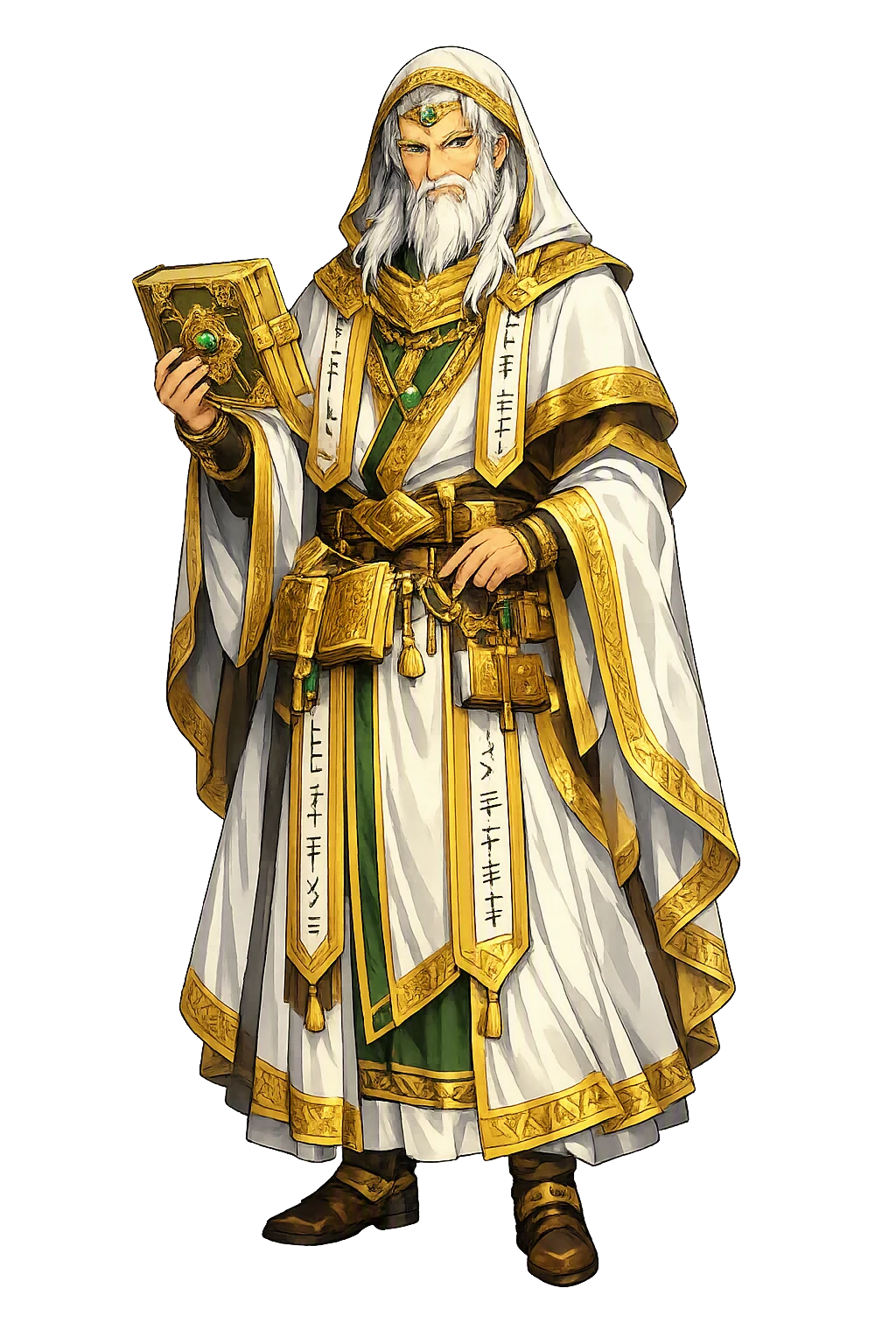
Stories of Ecne
Écne has the thinnest dossier of any figure in this collection — no surviving tale acts him, no epithet colors him, no treasure is laid in his hand. The tradition gives a name, a word, and a seat among the poets of the Túatha Dé Danann, and then it does something stranger and more honest: it tells the myths of the thing the name means. The mythology of Écne is the mythology of knowledge itself — the well, the hazels, the salmon, and everyone who ever burned a thumb on it.
Old Irish écne — also written eicne — is the common noun for knowledge, wisdom, understanding, the word the glossators reach for when they mean knowing of the deepest kind. The medieval tradition also knew it as a personal name: Écne, a poet of the Túatha Dé Danann, wisdom personified and given a seat among the divine race. That is nearly all that survives — no adventure, no contest, no death-tale. The dictionaries and the handbooks, from the Dictionary of the Irish Language to MacKillop, record the figure and then fall back on the word.
The thinness is itself the tradition's comment. Irish myth is lavish with its kings and its cattle-raids, but when it personifies wisdom it falls silent on purpose: the file, the poet, was the one who knew that the highest knowledge does not submit to narrative. Écne stands in the lists the way a word stands in a glossary — complete, and pointing elsewhere.
Around the year 900, Cormac mac Cuilennáin's glossary — Sanas Cormaic, the first etymological dictionary in any vernacular of western Europe — took the word in hand and explained it in the manner medieval Ireland loved: écne comes from cnú, the nut, for knowledge comes from nuts. Modern philology treats the derivation as learned play rather than history, and the word's deeper etymology remains unsettled. But the gloss was never really about linguistics.
It was a compressed myth. Everyone who heard it knew the image the gloss was invoking: the hazels of wisdom and the well beneath them, the nuts that carry knowing in their shells. Cormac's etymology is the tradition folding its whole doctrine of wisdom into a dictionary entry — the sense that knowledge is something grown, ripened, dropped, and only then taken up.
The Irish learned tradition kept the physics of wisdom exact. In the Otherworld stands a well — Connla's well, or the well of Segais — and over it grow the nine hazels of wisdom, which blossom and fruit in a single hour so that flower and nut hang together. The nuts of knowledge fall into the water, and the salmon of the well feed on them, and whoever would drink wisdom must wait for what the trees let fall.
The image runs through the medieval teaching tradition and the mythological handbooks that preserve it, and it never varies in its essentials: the source is hidden, the fruit drops on its own season, and the water carries the knowing outward into every river of the world. It is the exact opposite of a treasure-hoard. Wisdom in this tradition is not stored; it flows, and the best any person can do is stand downstream of it.
The tradition's great story of wisdom received belongs to Fionn mac Cumhaill. In the Boyhood Deeds of Finn, the boy — still called Demne — comes to the poet Finnéces, who has waited seven years by the Boyne for the salmon of knowledge, the fish that fed on the nuts of the well. On the day the boy arrives, the salmon is caught at last; Finnéces gives it to Demne to cook, with one command: eat none of it.
The boy burns his thumb on the fish and thrusts it into his mouth — and the knowledge that seven years of watching could not win passes into him by accident. When Finnéces asks whether he ate of the salmon, the boy answers no, and tells the truth of the thumb; the poet, who waited longest, surrenders the fish and the gift to him. It is the tradition's perfect parable of its wisdom-word: knowledge is not inherited, purchased, or even earned by patience. It is tasted — and it goes where it will.
The oldest bearer of the tradition's knowledge is Fintan mac Bóchra, the survivor who outlived the Flood itself. When the nobles of Ireland disputed the divisions of Tara, the judgment had to be sought from memory deeper than any living man's — and Fintan was found at last, ancient beyond reckoning, having passed through the shapes of salmon, eagle, and hawk, remembering every wave and every king since the waters rose.
Fintan settles the manor from the store of what he has witnessed, and the tale makes explicit what the well-and-salmon complex implies: knowledge in the Irish imagination is fundamentally memory — not a set of answers but the long holding of what the world has let fall. Écne's tradition keeps both halves: wisdom flows like water, and yet somewhere, in some salmon of the well, nothing is ever forgotten.
The Poet of the Hidden Meanings; the Sense That Can Be Taken but Not Held
Écne is Old Irish for knowledge itself — and the name of the wisdom of the Túatha Dé Danann made personal: a poet of the divine race whose dossier is a single luminous word and a place on the list. Around the name the Irish learned tradition built its whole physics of wisdom: nine hazels over the well, nuts of knowledge falling into the water, and the salmon that feeds on them — sense that can be tasted, carried, and passed on, but never dammed or owned.
The hazels of wisdom stood over the well in the Otherworld, blossoming and fruiting in a single hour, dropping their nuts into the water below.
Connla's well, the well of Segais — the hidden source beneath the hazels, from which the rivers of knowledge flow and to which none may walk who is not called.
The fish that feeds on the fallen nuts and wears their wisdom as spots — knowledge that must be caught, cooked, and tasted, never kept.
The poet's illumination — the flash of knowing that comes unbidden, burns the thumb that touches it first, and belongs to no one for long.
From the original script to the living URL
Ecne
The name survives in scholarly transliteration. Ecne is the standard Celtic romanisation, documented in academic sources — “Knowledge”. Because the spelling uses only Latin letters, the form is the same in both ASCII and Unicode.
No indigenous writing system is securely attested for individual celtic names. The form shown is a modern scholarly transliteration.
ecne
The plain ecne form is identical to the Unicode restoration. Because this name is already written in Latin letters, no diacritics, stress, or script information were lost — only capitalization differs.
Ecne
The Unicode restoration does not need to recover lost marks for Ecne. Its value is canonical spelling and consistent cataloguing, not the reconstruction of erased orthography. The domain is readable as-is to both DNS and humanity.
Ecne.com
This restoration is written entirely in ASCII letters — no Punycode encoding stands between Ecne and the DNS. The domain reads identically to machines and to human eyes.
Owned, ideal, and ASCII forms of Ecne
Ecne
The full Unicode restoration. ecne.com is not in the PuniCodex collection — it is watched for release; if it drops, this temple upgrades to an owned flagship.
How Ecne was spoken
How Ecne is preserved in writing
No indigenous writing system is securely attested for individual celtic names. The form shown is a modern scholarly transliteration.
Contribute scholarly provenance →The lore you have read is the living myth. Extended Lore opens the scholarly vault beneath it: the cult and its material remains, a history of the image, the name after antiquity, a meditation on what the name still means, and the full scholarly apparatus — etymology, orthography, sources.
Enter Extended Lore