
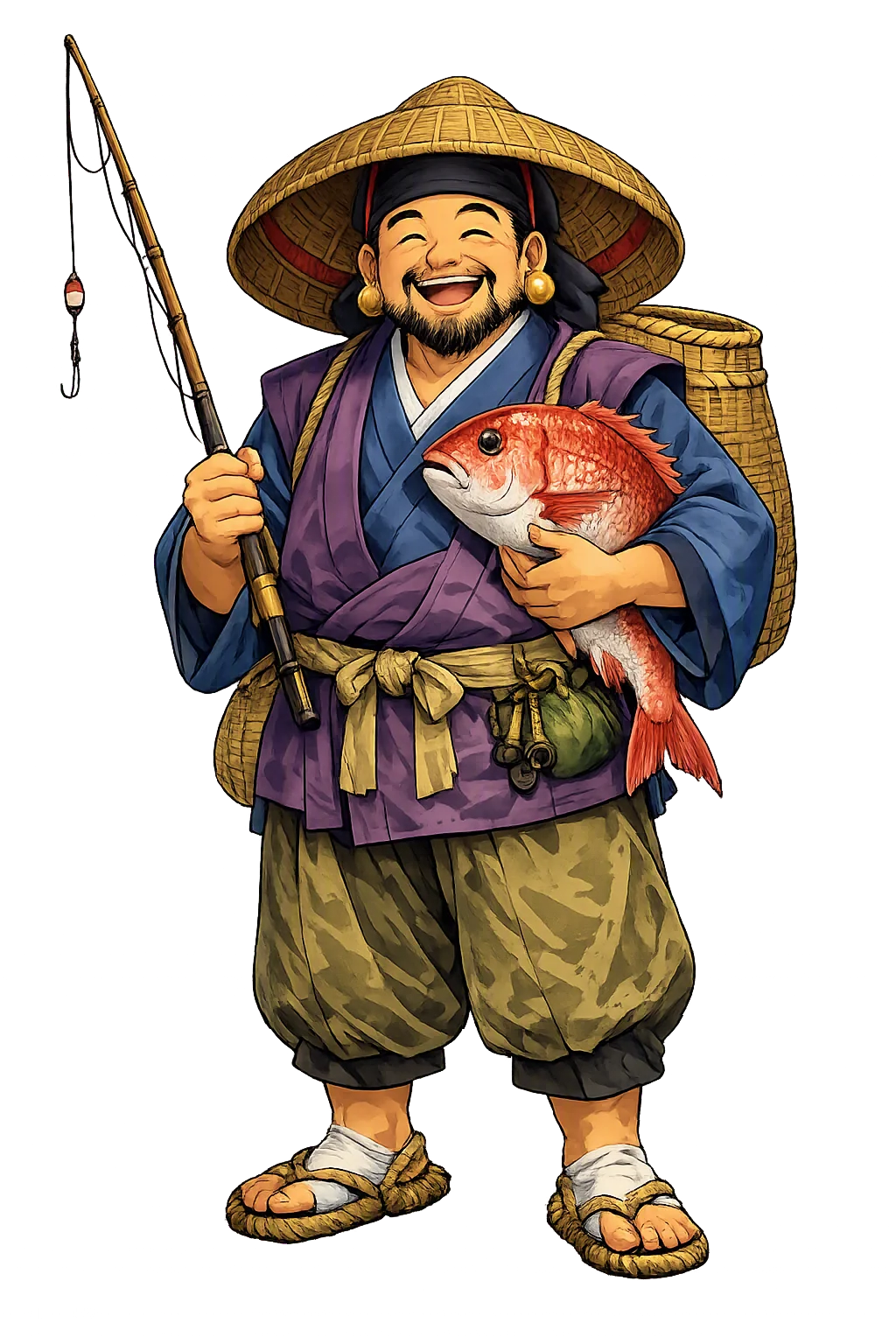
Ebisu: the stories first, then the spelling
You cannot weigh an accent without knowing what it carries. Here is what Ebisu has been carrying.
The Stories That Carry the Name
Hiruko, the Leech Child. The Kojiki tells that when Izanagi and Izanami first coupled, their child Hiruko was born 'without bones', like a leech or a premature thing; at three he could not yet stand. The dismayed parents set him adrift in a boat of reeds and let the sea decide. He survived — and later tradition, above all at Nishinomiya Shrine near Kōbe, identified the foundling with Ebisu: the child the gods abandoned who became the god of those who make their own living from the water.
Kotoshironushi and the Yielding of the Land. Another line of descent runs through Kotoshironushi, son of Ōkuninushi, the great god of the land. When the heavenly grandchild's envoys demanded that the earth be yielded, Ōkuninushi deferred to his son's counsel: Kotoshironushi answered on his father's behalf and then withdrew to the sea, or hid his body, leaving the land to the new line (Kojiki; Nihon Shoki). He was a god of oracles, of fishing, and of the boundary between the human settlement and the deep water; he is still enshrined at Shirayama-hime in Kaga and at Miho in Izumo, shrines that keep exactly the oracle-and-fishing profile the Ebisu cult later borrowed.
Ebisu the Smiling Merchant. By the Edo period the composite figure had found his final form: the smiling god with a fishing rod in one hand and a great red sea bream (tai) under the other arm, guardian of shops, fish markets, and honest trade. His image stood by the cash box and the shop curtain; his festival, Tōka Ebisu at Osaka's Imamiya Ebisu Shrine (10–12 January), became one of Japan's greatest commercial rites, with its lucky-straw charms (kichi-zuna) and the red-and-white 'lucky maidens' (fuku-musume) who crowd the lanes. The sea bream is itself a pun: tai echoes medetai, 'auspicious.
And Here Is What the Spelling Preserves
Against those stories, the attestation: 恵比寿, on the evidence Kojiki (Hiruko episode; the land-transfer and Kotoshironushi) and Nihon Shoki (the land-transfer narrative) set down. The name means "The foreigner, straggler".
At a Glance
- Restored name: Ebisu
- ASCII form: ebisu
- Meaning: "The foreigner, straggler"
- Domain of influence: Fishermen, Commerce, Luck
- Pantheon: Japanese
- Classification: Tier 2
- Original script: 恵比寿
- Series: The Restoration Files, No. 136 of 548
The Name Travels
Ebisu is the great combiner of Japanese religion. His roots are the Kojiki figures Hiruko and Kotoshironushi; his body is the medieval cult of the 'foreign' sea gods; his career is pure Edo merchant culture; and his congregation is the imported circle of the Shichifukujin, the Seven Gods of Fortune — six of whom arrived from China and India by way of Buddhism, while Ebisu alone is native.
The Address It Earned
The temple of Ebisu stands at /ebisu/ — lore, scholars, patterns — because a name carrying this much story deserves more than a parking page. Tier-2 here means one preserved truth — not less important, just singular. The temple shows it and names it.
The Sources Are Open
The myths above are retold from the temple's record; the primary voices are in the Sacred Texts: Kojiki and Nihon Shoki. Nothing in this file outranks them.
The File Continues
Read the founding dispatch for the name's full story, the Resonance File for the archetype at work — or the whole archive in one sitting.
Continue the series — previous file: Eachuisge (read it here) · next file: Ecne (read it here).
The Restoration Files are written from the same canonical record as the temples themselves: the lexicon, the lore catalog, the pattern atlas, and the cited scholarly sources. If a file ever disagrees with its temple, the temple is right — tell us, and the file will be corrected.