
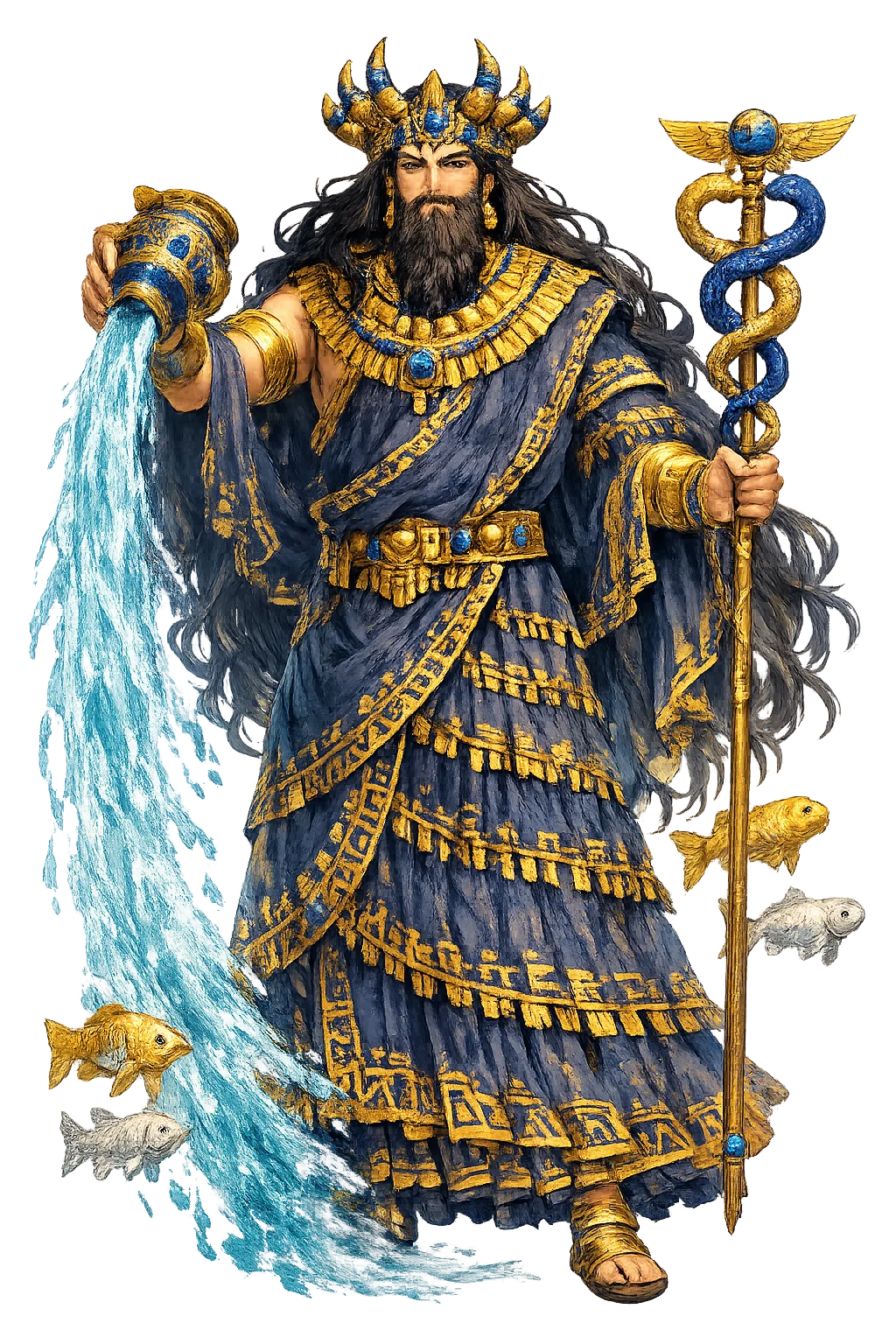
The provenance file on Ēa
Catalogue entry — Ēa. Every claim below carries its chain of custody.
Provenance
1. The attestation. 𒀭𒂍𒀀, from the tradition's own record. On record: ETCSL, CAD (Chicago Assyrian Dictionary); AHw (von Soden), Black & Green, Gods, Demons and Symbols of Ancient Mesopotamia, Enuma Elish, Tablet I.
2. The preserved evidence. e → Ē (Macron: a visible question mark — the length of Ea's first vowel is discussable, not certain) — absent from the ASCII form ea, present in the restoration, verifiable against the sources above.
3. The narrative record. Enki and Ninhursag — In the Sumerian myth Enki and Ninhursag (ETCSL 1. 1. Enki Warns the Flood's Survivor — In the Atrahasis epic and the Sumerian Eridu Genesis, the gods, worn out by the noise of humankind, decree a flood to destroy their creation, and Enki is bound by the assembly's oath of silence. He breaks it anyway — not face to face, but through the reed wall of the pious king's house, so that technically the warning goes to a wall (Atrahasis, Tablet I; Eridu Genesis, where the deity speaks to Ziusudra in a dream).
4. The physical record. The E-abzu temple of Enki at Eridu, excavated by Iraqi and British teams across the twentieth century, lies at the edge of the ancient marshland. Its sequence of shrines, bitumen-lined platforms, and fish-offering deposits marks one of Mesopotamia's longest continuous cults. Babylonian cylinder seals depict Enki/Ea with water streams or in the goat-fish (suhurmašu) form; temple libraries at Nineveh and Babylon preserve the Adapa myth and incantations invoking his wisdom.
5. The current holding. The temple at /ea/, classified Tier 1. What survives here cannot be shown in ASCII: a feature of the original that the fallback alphabet flattens. That is the Tier-1 test, and this name passes it without argument.
6. The documented resonances. Freshwater & Hydrology, AI, Data & Predictive Intelligence, Disaster Resilience & Recovery — seats argued and weighted in the pattern atlas, read through the myths in this temple's Resonance File.
7. The primary sources. Enūma Eliš, The Epic of Gilgamesh — the library this file answers to, open at the Sacred Texts collection.
8. The continuing record. Ea survives most visibly as a method: the deity who knows secrets and uses them to save rather than destroy. The flood story, transmitted through Atrahasis and the Epic of Gilgamesh, entered the biblical Noah narrative.
At a Glance
- Restored name: Ēa
- ASCII form: ea
- Meaning: "Reconstruction node for the Akkadian deity Ea (Sumerian Enki): the macron marks a discussable vowel length, not a canonical spelling."
- Domain of influence: Phonological Reconstruction, Water, Wisdom
- Pantheon: Mesopotamian
- Classification: Tier 1
- Original script: 𒀭𒂍𒀀
- Series: The Restoration Files, No. 134 of 546
The File Continues
Read the founding dispatch for the name's full story, the Resonance File for the archetype at work — or the whole archive in one sitting.
Continue the series — previous file: Durgā (read it here) · next file: Eachuisge (read it here).
The Restoration Files are written from the same canonical record as the temples themselves: the lexicon, the lore catalog, the pattern atlas, and the cited scholarly sources. If a file ever disagrees with its temple, the temple is right — tell us, and the file will be corrected.