PuniCodex

Extended Lore

𒀭𒂍𒀀 Ēa

Etymology · Orthography · Cult · Iconography · Reception · Sources

Tier 1 Ēa.com · 𒀭𒂍.com
Ēa — Phonological Reconstruction, Water, Wisdom
01

Quick Facts

Essential information about Ēa, Phonological Reconstruction, Water, Wisdom

Original Script𒀭𒂍𒀀
Unicode RestorationĒa
Reconstructed Pronunciation/ˈeː.a/
PantheonMesopotamian
DomainPhonological Reconstruction, Water, Wisdom
MeaningReconstruction node for the Akkadian deity Ea (Sumerian Enki): the macron marks a discussable vowel length, not a canonical spelling.
ClassificationTier 1
Primary DomainĒa.com
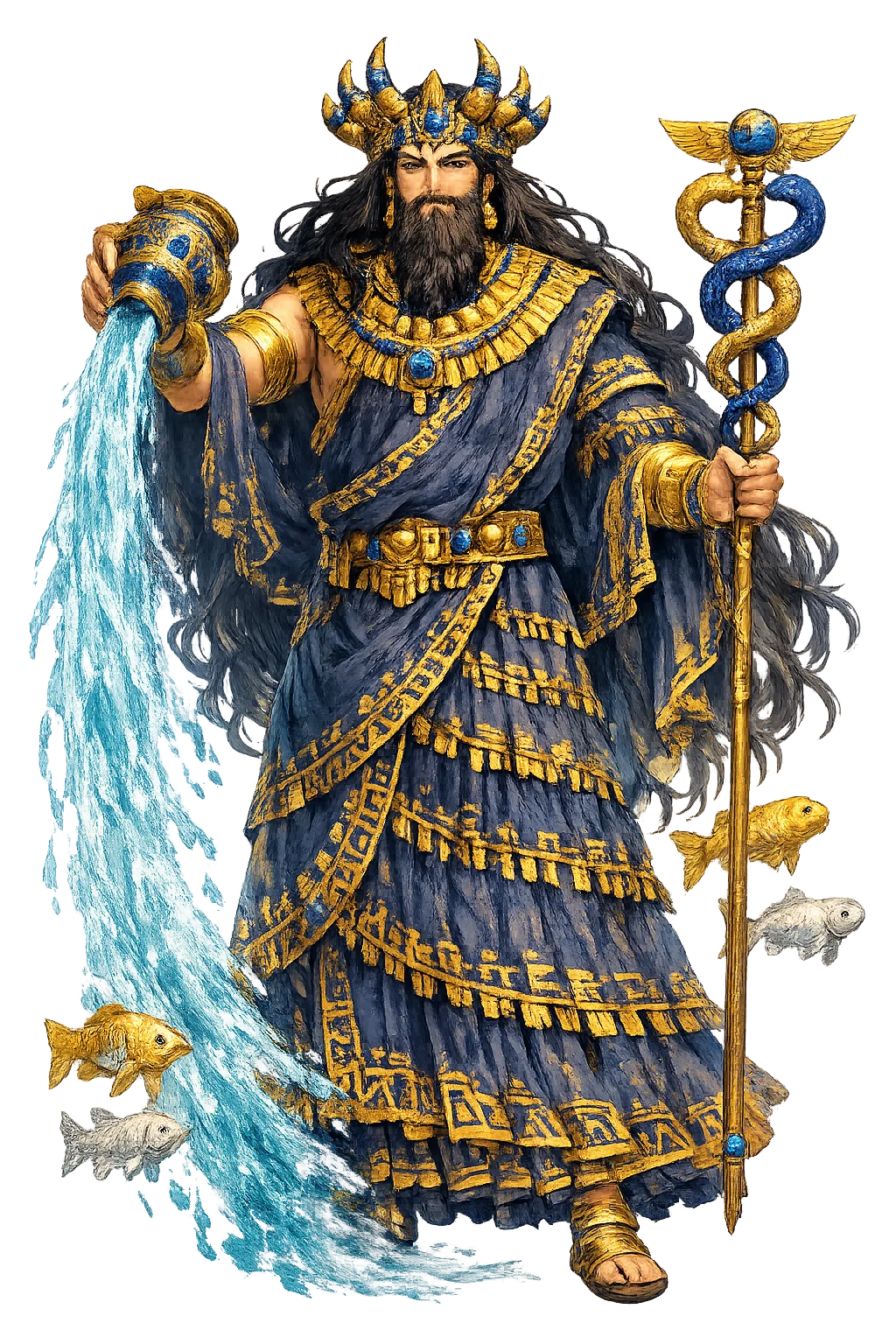
Sacred SymbolsGoat-fish (suhurmašu), Flowing water, Tortoise, Eridu, Caduceus-like staff
02

Etymology & Word Family

From original script to Unicode restoration

Original Script 𒀭𒂍𒀀 Ēa — "Reconstruction node for the Akkadian deity Ea (Sumerian Enki): the macron marks a discussable vowel length, not a canonical spelling."
Unicode Restoration Ēa Restored stress, length, and script
Modern ASCII ea Plain-ASCII fallback

Standard Assyriology transliterates the god as Ea (𒀭𒂍𒀀). The Sumerian counterpart is Enki (EN.KI), 'lord of the earth.' The length of the first vowel in Akkadian Ea is an open phonological question; the macron on Ēa is a pedagogical mark that makes that question visible, not a claim of canonical spelling.

03

Unicode Character Breakdown

Character-by-character philological analysis

CharacterUnicodeNameBlockPhonetic Role
ĒU+0112Latin Capital Letter E with MacronLatin Extended-AMacron: a visible question mark — the length of Ea's first vowel is discussable, not certain
aU+0061Latin Small Letter ABasic LatinSame

The Tier 1 classification reflects how much of the original phonology this restoration preserves — stress and vowel length for Greek names, distinctive letters and diacritics for every other tradition.

04

Cult & Worship

How the sacred was kept — rites, sanctuaries, remains

The Cult

Ea’s cult had one address and a thousand agents. The address was Eridu: the E-abzu, the “House of the Deep”, stood at the marsh’s edge above the subterranean freshwater ocean and remained a living sanctuary from the Early Dynastic age into the first millennium BCE — one of Mesopotamia’s longest continuously maintained cult centers. The agents were the exorcists. Every āšipu who undid a curse, a demon, or a sickness invoked Ea by profession: the great series Maqlû and Šurpu and the anti-demon collection Udug-hul open their rites to him as lord of incantation, and the bīt rimki lustrations seat him with Shamash in judgment over the patient. No festival of Ea is preserved — he never owned an akītu — but his priesthood was the ritual-specialist class itself, and his liturgy was the technical literature of healing. Kings, for their part, courted his counsel; wisdom, not arms, was the gift they begged of the god of the deep.

In the Earth

The E-abzu temple of Enki at Eridu, excavated by Iraqi and British teams across the twentieth century, lies at the edge of the ancient marshland. Its sequence of shrines, bitumen-lined platforms, and fish-offering deposits marks one of Mesopotamia's longest continuous cults. Babylonian cylinder seals depict Enki/Ea with water streams or in the goat-fish (suhurmašu) form; temple libraries at Nineveh and Babylon preserve the Adapa myth and incantations invoking his wisdom.

05

Iconography

How Ēa was imaged across the ages

The Image

Learn to spot Ea by the water. From the Early Dynastic period onward the god of the deep is a seated figure with streams issuing from his shoulders or from a vase he holds, fish swimming up the flow; the goat-fish suhurmašu stands at his feet, and a tortoise sometimes shares the scene. The canonical statement is the Akkadian-period cylinder seal of Adda in the British Museum: Ea enthroned in his watery house, streams and fish around him, flanked by attendant deities. The image proved astonishingly conservative — the flowing-vase type survives on Kassite kudurru boundary stones and into Neo-Assyrian glyptic — because the attribute was unambiguous and the theology behind it never changed: the source of all fresh water sits enthroned, doing nothing more dramatic than dispensing life. When Marduk rose to supremacy, his father kept the older, quieter portrait.

06

Reception & Transformation

The name after its own age — transmission, translation, survival

Afterlives

Ea’s afterlife is the afterlife of his texts. When George Smith announced the Gilgamesh flood tablet in 1872, the world met the god who whispers through a reed wall — the Babylonian ancestor of every flood-savior since — and the decipherment that had made him readable had already crowned a generation of scholars from Rawlinson to Oppert. Ashurbanipal’s library at Nineveh, opened by Layard and Rassam’s digs of the 1850s, preserved the Adapa myth and the omen literature that made Ea the patron of arcane knowledge, and Assyriology then built him into its working vocabulary — the Chicago Assyrian Dictionary and von Soden’s AHw made “Ea” a lemma in every reading room. The Enuma Elish gave his line a dynastic arc that modern readers still follow: slayer of Apsu, father of Marduk. In the twentieth century Kramer and Jacobsen returned to the Sumerian originals, and Oxford’s Electronic Text Corpus of Sumerian Literature put the Enki corpus online for anyone to read. Through every channel the same figure arrives: the intelligence that speaks from deep water, and the oldest standing argument about what a written name owes a spoken one.

Identifications Across Traditions

Ea is the Akkadian pronunciation and reinterpretation of the Sumerian Enki. The shift from EN.KI to E-a is not only theological; it is phonological — a new language pronouncing an old name with new vowels. Greek writers later identified him with Poseidôn because of his aquatic domain, though Ea's freshwater wisdom is quite unlike Poseidon's saltwater tempests. In Hellenistic and Gnostic currents, Ea/Enki was linked with Oannes, the fish-tailed culture-bringer described by Berossus. His iconography — water flowing from the shoulders — influenced later depictions of river gods. Each syncretism is a data point in the long history of how the name was heard.

Modern Legacy

Ea survives most visibly as a method: the deity who knows secrets and uses them to save rather than destroy. The flood story, transmitted through Atrahasis and the Epic of Gilgamesh, entered the biblical Noah narrative. The goat-fish became the constellation Capricorn. In modern scholarship, Ea has become a test case for how cuneiform signs map onto spoken sound. The macron on Ēa is our contribution to that conversation — a way of marking uncertainty honestly while keeping the question in view. The name still means: the intelligence that moves in deep water.

07

The Meditation

What Ēa means — beyond the dictionary

This temple does not claim that Ēa is the canonical spelling of the god's name. Standard Assyriology writes Ea, and we honor that convention. What we claim is something different: that the space between the cuneiform sign and the modern pronunciation is worth studying, and that Unicode can be used to make that study visible.

The macron on the first vowel is a pedagogical tool. It says, 'The length of this vowel is discussable.' It turns a silent scholarly debate into a public invitation: learn the grammar, read the tablets, listen to the reconstructions, and decide for yourself. In an era of misinformation, there is radical honesty in marking what we do not know. Ea becomes not a claim, but a question — and questions, like fresh water, are what sustain civilization.

08

Frequently Asked Questions

Common questions about Ēa, Phonological Reconstruction, Water, Wisdom, and Unicode restoration

01How do you pronounce Ēa?

In reconstructed pronunciation, Ēa is /ˈeː.a/ — approximately 'EH-ah' — two level syllables, with the first vowel held slightly longer to signal the open question of length.

02What does Ēa mean?

Ēa means Reconstruction node for the Akkadian deity Ea (Sumerian Enki): the macron marks a discussable vowel length, not a canonical spelling. in the mesopotamian tradition.

03What are the symbols of Ēa?

Ēa is associated with Goat-fish (suhurmašu) (The hybrid sea-goat, Capricorn's ancestor, linking the Abzu with the stars), Flowing water (Streams issuing from his shoulders or a vase — life-giving freshwater), Tortoise (A creature of the marshy border between water and land, sacred to Enki), Eridu (His primordial city, the first city in Sumerian king lists and cosmology), Caduceus-like staff (The rod of magic and authority, sometimes twined with serpents).

04Why restore Ēa in Unicode?

Plain ASCII ea strips the stress, length, and script that make the name specific. Unicode restoration returns the name to its original written dignity.

05What is the most important myth about Ēa?

“Enki and Ninhursag” — the Dilmun story that anchors the mythology of Ēa, told in full on the lore page.

09

Scholarly Sources

The philological foundations of this restoration

Every claim on this page is grounded in established scholarship. The orthographic restorations follow disciplinary convention. The etymological chain follows the best available reference works. This is not invention — it is resurrection through scholarship.

◈

Lexicography & Philology

  • CAD
  • AHw
◎

Primary Texts

  • Enuma Elish, Tablet I
  • Atrahasis
  • Epic of Gilgamesh, Tablets I and XI
◉

Archaeology & Art History

  • Material evidence — iconography, inscriptions, and temple archaeology — for Ēa and related cults.
✦

Religious Studies

  • ETCSL
  • CAD (Chicago Assyrian Dictionary); AHw (von Soden)
  • Black & Green, Gods, Demons and Symbols of Ancient Mesopotamia
Return

The Surface Awaits

You have traced the name from its earliest attestation to its Unicode restoration. Now return to the myth. The story is where the name lives.

Back to Lore
Ēa mascot