PuniCodex

Extended Lore

दुर्गा Durgā

Etymology · Orthography · Cult · Iconography · Reception · Sources

Tier 1 Durgā.com
Durgā — Protection, Strength, War
01

Quick Facts

Essential information about Durgā, Protection, Strength, War

Original Scriptदुर्गा
Unicode RestorationDurgā
Reconstructed Pronunciation/ˈd̪ʊr.ɡaː/
PantheonSanskrit
DomainProtection, Strength, War
Meaning'The Inaccessible One' — the warrior goddess, daughter of Himavat and consort of Śiva, slayer of the buffalo-demon Mahiṣa
ClassificationTier 1
Primary DomainDurgā.com
Sacred SymbolsLion or tiger, Trident (triśūla), Buffalo demon (Mahiṣāsura), Ten weapons, Red garments and vermilion
02

Etymology & Word Family

From original script to Unicode restoration

Original Script दुर्गा Durgā — "'The Inaccessible One' — the warrior goddess, daughter of Himavat and consort of Śiva, slayer of the buffalo-demon Mahiṣa"
Unicode Restoration Durgā Restored stress, length, and script
Modern ASCII durga Plain-ASCII fallback

The name Durgā carries the orthographic signature of the sanskrit tradition: दुर्गा. Unicode restoration recovers what ASCII flattens.

03

Unicode Character Breakdown

Character-by-character philological analysis

CharacterUnicodeNameBlockPhonetic Role
DU+0044Latin Capital Letter DBasic LatinSame
uU+0075Latin Small Letter UBasic LatinShort /u/
rU+0072Latin Small Letter RBasic LatinSame
gU+0067Latin Small Letter GBasic LatinSame
āU+0101Latin Small Letter A with MacronLatin Extended-AMacron: long /aː/

The Tier 1 classification reflects how much of the original phonology this restoration preserves — stress and vowel length for Greek names, distinctive letters and diacritics for every other tradition.

04

Cult & Worship

How the sacred was kept — rites, sanctuaries, remains

The Cult

Durgā's cult is liturgy become festival. The Devī-Māhātmya, embedded in the Mārkaṇḍeya Purāṇa by about the sixth century, became scripture for recitation: its seven hundred verses, the Caṇḍī Pāṭha, are chanted daily in her temples and without pause through Navarātri, the nine autumn nights when the goddess descends. Bengal made the descent public: household and neighborhood pūjās mount her clay image in decorated pandals for communal worship — Shobhabazar Rajbari's great household celebration dates to 1757 — and on Vijayādaśamī she is carried to the river and immersed. Śākta strongholds like the Kāmākhyā temple in Assam kept Tantric ritual and, into modern memory, blood offering, often replaced today by the smashing of a white gourd. Kumārī-pūjā, worshipping a living girl as the goddess, gives the cult its most startling form; in Nepal the royal Taleju devotion tied her to kingship.

In the Earth

Images of Durgā Mahiṣāsuramardinī appear from the Gupta period onward and become especially prominent in medieval temple sculpture across India. The great Durgā temples of Bengal, Odisha, Rajasthan, and the Himalayas preserve elaborate iconographic programs of her battles. Bengal's Durgā Pūjā has produced a vast material culture of clay images (pratimā), decorated pandals, and ritual paraphernalia, some of which is now collected in museums. In Nepal, the Taleju temple in Kathmandu and the Durgā temples of the valley reflect her importance in Newar and royal cult.

05

Iconography

How Durgā was imaged across the ages

The Image

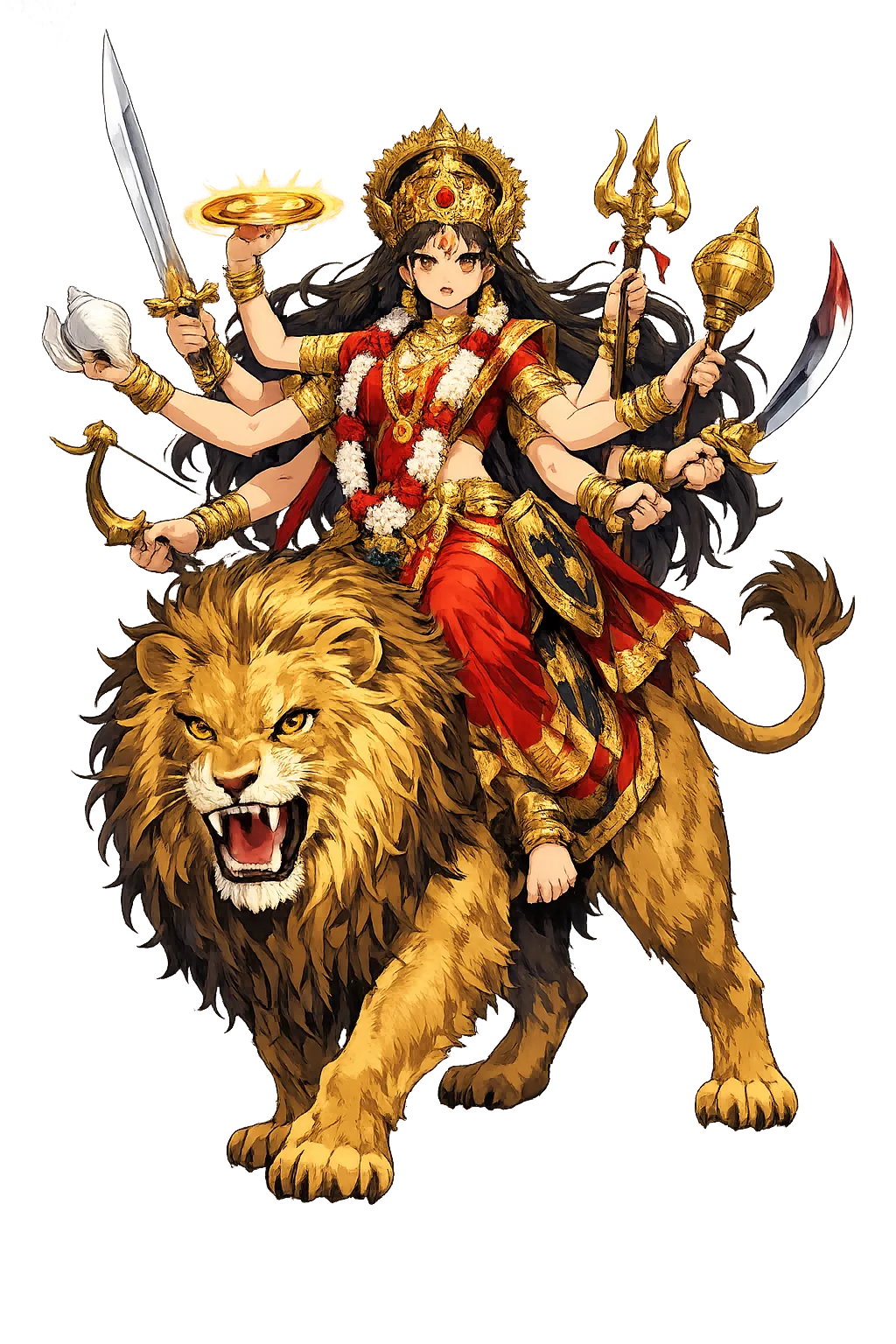
Her iconography is a battlefield inventory. The Mahiṣāsuramardinī — slayer of the buffalo-demon — type shows a multi-armed goddess, usually ten-armed and three-eyed, astride a lion, driving a trident into the buffalo's neck as the demon rises from the severed hide; each hand carries a weapon donated by a god — Śiva's trident, Viṣṇu's discus, Indra's thunderbolt — so the whole pantheon fights through her. The type appears in Gupta sculpture from the fifth–sixth centuries and reached early maturity in rock: the seventh-century Pallava panel at Māmallapuram stages the battle in monumental relief, and the great panels at Ellora (Cave 21) give the demon his canonical muscular agony. In medieval Bengal the battle migrated to terracotta temple façades, and the clay image-makers of Kumārtuli — the kumārs — fixed her annual form: ten arms, silvered weapons, lion over the buffalo, a hundred million worshippers' eyes upon her.

06

Reception & Transformation

The name after its own age — transmission, translation, survival

Afterlives

Durgā's text made her portable. Composed within the Mārkaṇḍeya Purāṇa around the sixth century, the Devī-Māhātmya became the seed of Śākta theology, accumulating commentaries — Bhāskararāya's Setubandha (eighteenth century) remains the ritual standard — and spreading wherever her hundred names were recited. Kingship absorbed her: medieval courts read the demon-slaying as sovereignty, and in Nepal the living-goddess Kumārī and the royal Taleju cult made her the state. Colonial Bengal then turned her into a nation: Bankimchandra's Anandamath (1882) clothed the motherland in the goddess's weapons, and its hymn Bande Mātaram — saluting the mother rich in waters and crops, strong with many arms — became the anthem of the independence movement; her image marched into every nationalist poster. Independence did not retire her. Coburn's 1991 translation of the Devī-Māhātmya is the scholarly standard, feminist scholarship made her a case study of the divine feminine, and the diaspora carried Navarātri to every continent, where the autumn descent is now a calendar of belonging.

Identifications Across Traditions

Durgā is inseparable from the wider Devī tradition and from Pārvatī, Kālī, Caṇḍikā, and the ten Mahāvidyās. In Bengal and Assam she is the central goddess of the autumn festival, while in South India she is worshipped as the victorious form of the Goddess. Tantric traditions see her as the supreme śakti, the active power from whom all gods derive their authority. The motif of the goddess defeating a buffalo-demon has been compared to ancient Near Eastern and Mediterranean images of the victorious goddess, though Durgā's specific iconography — ten arms, lion vehicle, weapons from all the gods — is a distinctively Indian synthesis. In Nepal she is worshipped as the protective deity of the kingdom, and her temples are among the most important in the Kathmandu Valley.

Modern Legacy

Durgā is the heart of the autumn festival season in eastern and northeastern India, especially Durgā Pūjā in Bengal, which transforms cities into open-air art galleries and draws millions to the river for her immersion. In North India the same period is celebrated as Navarātrī and Rāma's victory over Rāvaṇa. Her image as Mahiṣāsuramardinī is one of the most recognizable in Hindu art, reproduced in temples, prints, textiles, and political posters. Feminist and nationalist movements alike have claimed her as a symbol of empowered womanhood and resistance to oppression. The name Durgā is widely given to girls, and her lion-riding, weapon-wielding form remains an enduring icon of divine female power.

07

The Meditation

What Durgā means — beyond the dictionary

Durgā does not negotiate with evil. She confronts it directly, armed with the gifts of every god and the certainty that chaos must be met with force. This makes her uncomfortable for modern sensibilities trained to value dialogue over combat, but her mythology insists that some threats must be destroyed before conversation becomes possible.

Yet her violence is never private or cruel. She fights on behalf of the gods, the cosmos, and her devotees; her wrath is the overflow of a protective love. To meditate on Durgā is to ask where in our own lives we need her clarity: the willingness to name the demon, pick up the weapon, and refuse to be conquered.

08

Frequently Asked Questions

Common questions about Durgā, Protection, Strength, War, and Unicode restoration

01How do you pronounce Durgā?

In reconstructed pronunciation, Durgā is /ˈd̪ʊr.ɡaː/ — approximately 'DOOR-gah' — the first vowel is short and rounded like 'u' in 'put'; hold the final 'gah' long.

02What does Durgā mean?

Durgā means 'The Inaccessible One' — the warrior goddess, daughter of Himavat and consort of Śiva, slayer of the buffalo-demon Mahiṣa in the sanskrit tradition.

03What are the symbols of Durgā?

Durgā is associated with Lion or tiger (Her vehicle — strength, sovereignty, and the courage that walks unafraid into demonic armies), Trident (triśūla) (Gift of Śiva: the destruction of the threefold suffering of ego, mind, and world), Buffalo demon (Mahiṣāsura) (The ego and brute force she conquers; his decapitated form lies beneath her feet), Ten weapons (The collective arsenal of the gods concentrated in one pair of hands — divinity's unity made visible), Red garments and vermilion (The color of power, blood, and auspicious feminine energy).

04Why restore Durgā in Unicode?

Plain ASCII durga strips the stress, length, and script that make the name specific. Unicode restoration returns the name to its original written dignity.

05What is the most important myth about Durgā?

“The Sleep-Power Wakes” — the Madhu-Kaiṭabha story that anchors the mythology of Durgā, told in full on the lore page.

09

Scholarly Sources

The philological foundations of this restoration

Every claim on this page is grounded in established scholarship. The orthographic restorations follow disciplinary convention. The etymological chain follows the best available reference works. This is not invention — it is resurrection through scholarship.

◈

Lexicography & Philology

  • MW
  • KEWA
◎

Primary Texts

  • Devībhāgavata Purāṇa 7.28ff. (Durgama episode); Kālikā Purāṇa
◉

Archaeology & Art History

  • Material evidence — iconography, inscriptions, and temple archaeology — for Durgā and related cults.
✦

Religious Studies

  • Mārkaṇḍeya Purāṇa, Devī-Māhātmya 1–13 (Madhu-Kaiṭabha, Mahiṣāsura, Śumbha-Niśumbha)
  • Mahābhārata, Bhīṣma Parvan 23 (Yudhiṣṭhira's Durgā-stotra)
  • Coburn, Encountering the Goddess: A Translation of the Devī-Māhātmya
  • Kinsley, Hindu Goddesses: Visions of the Divine Feminine
  • Monier-Williams, Sanskrit-English Dictionary (durgā)
  • Rodrigues, Ritual Worship of the Great Goddess
Return

The Surface Awaits

You have traced the name from its earliest attestation to its Unicode restoration. Now return to the myth. The story is where the name lives.

Back to Lore
Durgā mascot