The Living Myth
Protection, Strength, War · The Invincible · Slayer of the Buffalo-Demon
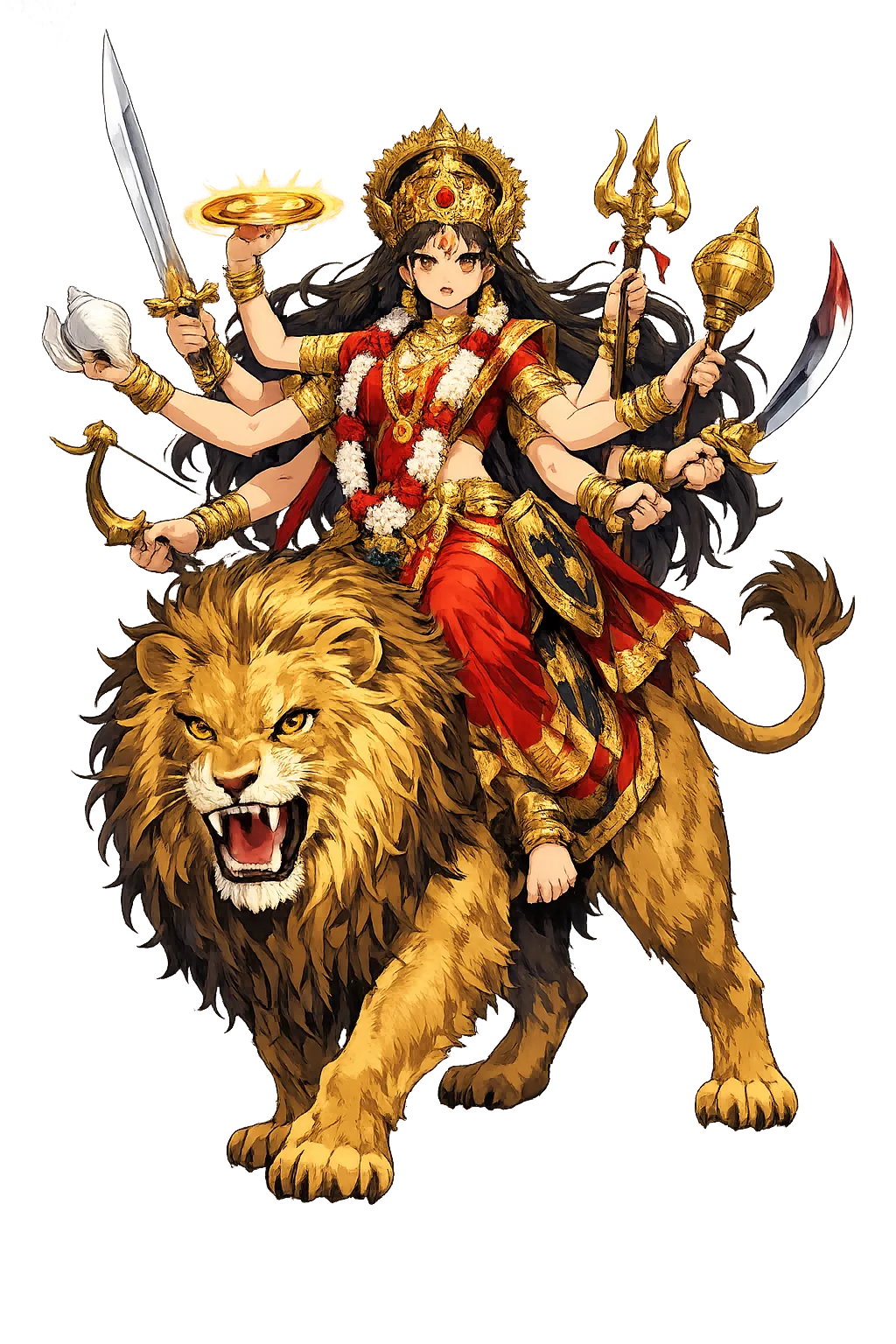
Stories of Durgā
Durgā's mythology reaches its classic form in the Devī-Māhātmya, the 'Glory of the Goddess' embedded in the Mārkaṇḍeya Purāṇa, where she rises from the gods' combined light whenever the worlds are overrun. The Purāṇas then bind her to the divine family as the wrath of gentle Pārvatī, and the Mahābhārata shows kings praying to her at the edge of war.
When a cosmic age ended and the universe dissolved into sleep, Viṣṇu lay upon the waters — and from his ear, in that vast stillness, two demons were born: Madhu and Kaiṭabha, whose names mean 'honey' and 'shell'. They attacked Brahmā himself as he sat upon the lotus rising from Viṣṇu's navel. Brahmā called upon the goddess — not any formed deity, but the sleep-power, Yoganidrā, that enfolds Viṣṇu's eyes — and she released the god from slumber (Devī-Māhātmya 1). The demons fought with a boon's protection: they could only be slain where the earth was not beneath them. Viṣṇu spread his thighs across the waters, lifted the demons onto that living ground, and cut them down. The episode is the Devī-Māhātmya's opening move, and it is deliberate: before the warrior-goddess ever lifts a weapon, the text honors the feminine power that governs sleep, time, and the waking of God. Creation itself, the hymn argues, is kept by a goddess.
The buffalo-demon Mahiṣāsura had seized heaven through battle and austerity, and neither Brahmā, Viṣṇu, nor Śiva could defeat him. From their combined anger — from the gathered energy of all the gods — a blaze arose and took form: a woman with ten arms, three eyes, and a lion for her mount. Each god gave her a weapon: Śiva's trident, Viṣṇu's discus, Indra's thunderbolt, Yama's rod, Varuṇa's noose, Agni's spear (Devī-Māhātmya 2). For nine nights and days she fought the demon, who shifted between forms — buffalo, lion, elephant, warrior — until, charging in buffalo shape, he was caught by the mane, pinned underfoot, and beheaded as he struggled to tear himself from the carcass (ch. 3). Heaven was restored, and the gods sang her praise as Mahiṣāsuramardinī, 'she who crushed the buffalo-demon'. The nine nights are kept still as Navarātrī. The myth's claim is pointed: when every male god's strength has failed, it is the concentrated feminine that fights and wins — and her weapons are proof that the gods knew it.
The demon brothers Śumbha and Niśumbha had conquered the three worlds and demanded that the goddess become Śumbha's consort. Her answer became one of the most quoted speeches in Hindu scripture: he who conquers her in battle, who humbles her pride, who is her equal in strength — he alone may be her husband (Devī-Māhātmya 5). She withdrew to Mount Mandara; the brothers sent their armies; and from the goddess's own body sprang her reinforcements — Kālī from her forehead (ch. 7) and Caṇḍikā, the terrifying emanation who multiplied across the battlefield (ch. 8). Niśumbha fell, then Śumbha, whose death restored the gods to their thrones; and the hymn closes with the goddess's great proclamation that she alone exists upon that field, the many gods and goddesses being her own powers in different forms (ch. 13). The final battle is the Devī-Māhātmya's theological summit: polytheism resolves into one power wearing many faces, and she fights — as the text repeats — for herself.
Outside the Devī-Māhātmya, the Purāṇas anchor Durgā in the family of the gods: she is the fierce form of Pārvatī, daughter of Himavat and Menā, wife of Śiva, mother of Skanda and Gaṇeśa. The Devībhāgavata Purāṇa tells of a demon, Durgama, so named because he was difficult to approach — he stole the Vedas and tormented gods and sages until the goddess, born of the mountain, hunted him down and took his quality as her own name: Durgā (Devībhāgavata Purāṇa 7.28ff.). Later tradition multiplies her weapons, her attendants, and her lore, and Bengal's festival cycles recast her annually as the daughter who comes home from her husband's mountain to her father's city for four days. The theological point is stable across the variants: the goddess who is tender as wife and mother is the same power who, when the worlds are threatened, assumes the form of a fortress. Her name is a promise to her devotees — what is inaccessible to demons is open to children.
The Mahābhārata remembers her at the edge of its greatest crisis. As the two armies faced each other at Kurukṣetra, Yudhiṣṭhira — 'conqueror of enemies' in name only, sick at heart — descended from his chariot, praised Durgā as night-of-time and granter of boons, and begged her for victory in the righteous cause (Mahābhārata, Bhīṣma Parvan 23). The goddess, pleased, promised the Pāṇḍavas success, and the stotra names her with her epithets — Bhadrakālī, Mahāmāyā, the inaccessible one, she whose vehicle is the lion. It is a rare and precious snapshot: Durgā worship inside the epic's own frame rather than as a later overlay, a warrior-king praying to the warrior-goddess on the morning of the war that will consume his line. Her mythology ends, as it began, at the moment the weapons are drawn — with the reminder that victory is hers to give, and that she gives it where righteousness stands.
Protection, Strength, War, and the Destruction of Evil
Durgā is beautiful because she is dangerous. Born from the combined radiance of the gods to defeat the buffalo-demon, she rides a lion, wields the weapons of every deity, and laughs at cosmic chaos. Her name means 'the inaccessible,' 'the fortress': unreachable by enemies, unlosable by devotees — and she is the same goddess who, as Pārvatī, keeps the hearth.
She slays the buffalo-demon Mahiṣāsura after a nine-day battle, restoring the gods to heaven.
Each weapon she holds was given by a god, showing that the divine powers unite in her single form.
She rides a lion or tiger, symbolizing sovereign power and the courage that destroys demonic pride.
As Pārvatī she is wife of Śiva and mother of Gaṇeśa and Skanda; her wrath protects her children.
From the original script to the living URL
दुर्गा
The name in its original Sanskrit form. Durgā (दुर्गा) is attested in the source tradition — “'The Inaccessible One' — the warrior goddess, daughter of Himavat and consort of Śiva, slayer of the buffalo-demon Mahiṣa”. Its macron-length vowels carry the full phonetic and orthographic weight of the source tradition.
durga
Reduced to plain durga, the name loses everything that made it specific: macron-length vowels. What remains is an ASCII string that machines can parse but that no longer speaks with its original voice.
Durgā
The Unicode restoration recovers what ASCII flattened. Durgā restores macron-length vowels, returning the name to its original written dignity. The domain encodes to Punycode, but the browser displays the truth.
Durgā.com → xn--durg-tsa.com
The non-ASCII characters in Durgā are encoded while the ASCII remains visible. To the DNS, it is Punycode. To humanity, it is Durgā.
Owned, ideal, and ASCII forms of Durgā
Durgā
Restores दुर्गा. The live temple domain — durgā.com.
durga
Flattens दुर्गा. The plain ASCII fallback — what DNS and legacy systems see.
How Durgā was spoken
How Durgā travels from ancient script to the modern URL
The lore you have read is the living myth. Extended Lore opens the scholarly vault beneath it: the cult and its material remains, a history of the image, the name after antiquity, a meditation on what the name still means, and the full scholarly apparatus — etymology, orthography, sources.
Enter Extended Lore