The Living Myth
Mother of Demons · Mother of the Daityas · Daughter of Dakṣa and wife of the sage Kaśyapa, mother of the Daityas, the demon race — the counterpart of her sister Aditi, who is mother of the gods
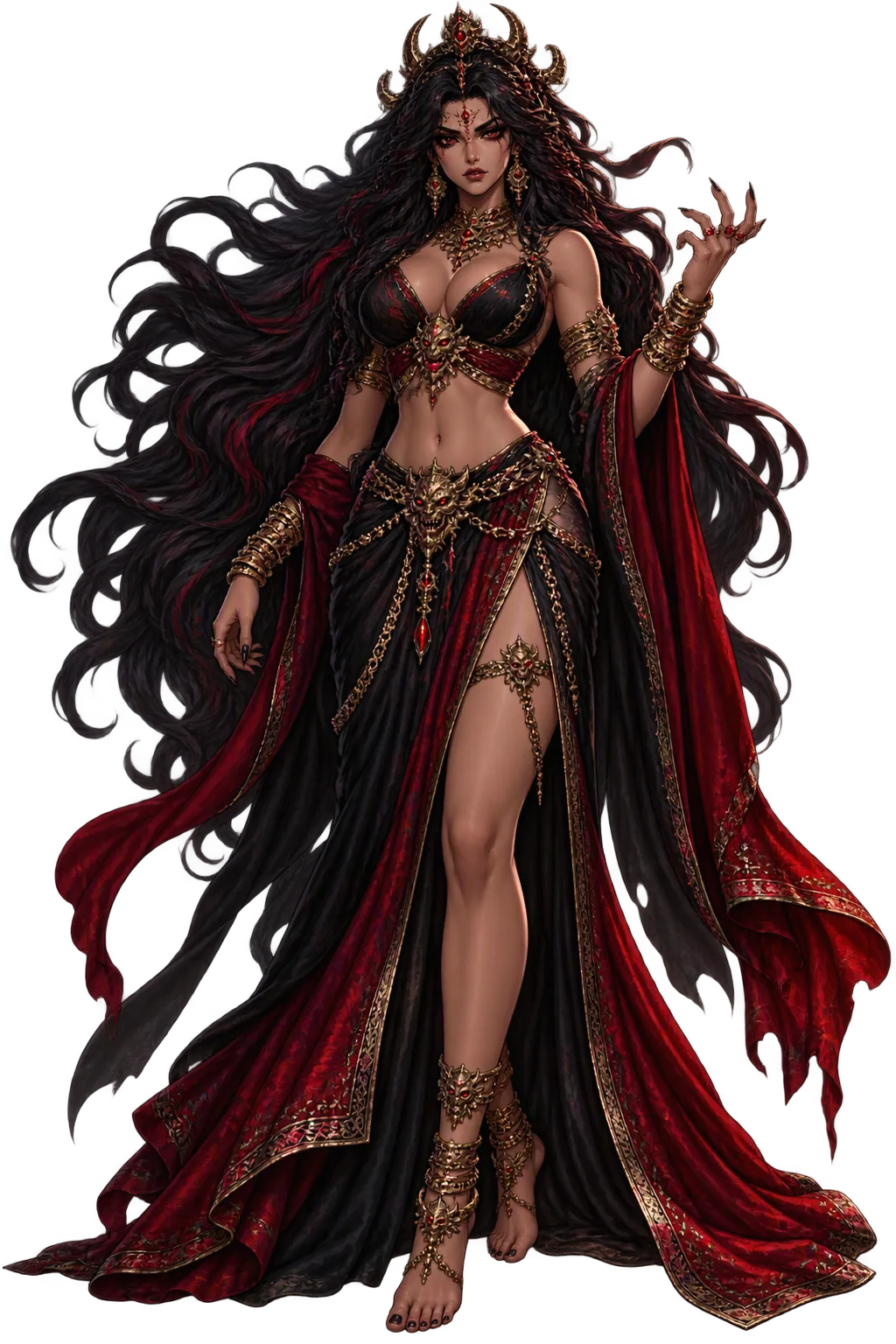
Stories of Diti
Diti’s mythology is her maternity: everything the Daityas do, she enables — and one thing she undoes, in the Maruts episode, where Indra’s violence against her pregnant body produces the storm-gods from the womb’s fragments. She is the anti-mother of the anti-gods, the bound one whose children strain against every bond except hers.
The oldest Diti-story has Indra hurl the vajra into her womb, shattering a hundred sons in embryo; the fragments become the Maruts, the storm-gods who yet serve Indra. Diti’s grief and the storm-gods’ loyalty are the hymn’s tension: the anti-mother’s broken children, adopted by her enemy.
Her son Hiraṇyakaśipu, devastated by his brother Hiraṇyākṣa’s death at Varāha’s tusk, won from Brahmā the boon that he could not die by day or night, indoors or out, by man or beast, on earth or sky. The boon made him lord of the three worlds — until Narasiṃha, the man-lion at dusk on a threshold, ended him. Diti’s line is the engine of the avatāra cycle.
Prahlāda, son of Hiraṇyakaśipu and thus Diti’s grandson, loved Vishnu from the womb — the devotee born in the anti-god’s house. The Purāṇas make his devotion the theology of bhakti itself: the bound dynasty’s finest fruit was the boy who could not be burned, poisoned, or thrown, for his god held him.
The Purāṇic theogonies make Diti one of Dakṣa’s thirteen daughters given to Kaśyapa: Aditi mothers the Ādityas, Diti the Daityas, Danu the Dānavas, and the rest of creation’s factions follow the wives. The marriage-bed of Kaśyapa is, in the genealogists’ scheme, the factory of the cosmos’s parties.
The Bound One, Mother of the Anti-Gods
Diti is the mother of the anti-gods: the Daityas, the demonic dynasty whose wars with the gods drive half the Purāṇic mythology. Daughter of Dakṣa, wife of the sage Kaśyapa, twin in name of the unfettered Aditi, she mothers the bound ones — the race of Hiraṇyākṣa and Hiraṇyakaśipu, whose boons made them nearly invincible.
Her sons are the Daityas — the anti-gods whose wars with the devas fill the Purāṇas.
Daughter of Dakṣa, sister of the unfettered Aditi — her name is Aditi’s negated.
Indra’s thunderbolt shattered her womb mid-pregnancy; the fragments became the Maruts.
Hiraṇyakaśipu’s boon made him deathless by day or night, indoors or out — until Narasiṃha.
From the original script to the living URL
दिति
The name in its original Sanskrit form. Diti (दिति) is attested in the source tradition — “Daughter of Dakṣa and wife of the sage Kaśyapa, mother of the Daityas, the demon race — the counterpart of her sister Aditi, who is mother of the gods.”. Its original diacritics and script distinctions carry the full phonetic and orthographic weight of the source tradition.
diti
The plain diti form is identical to the Unicode restoration. Because this name is already written in Latin letters, no diacritics, stress, or script information were lost — only capitalization differs.
Diti
The Unicode restoration does not need to recover lost marks for Diti. Its value is canonical spelling and consistent cataloguing, not the reconstruction of erased orthography. The domain is readable as-is to both DNS and humanity.
Diti.com
This restoration is written entirely in ASCII letters — no Punycode encoding stands between Diti and the DNS. The domain reads identically to machines and to human eyes.
The attested spelling family of Diti
Diti
Restores दिति. The full Unicode restoration. diti.com is not in the PuniCodex collection — it is watched for release; if it drops, this temple upgrades to an owned flagship. Attested by RV, MW.
How Diti was spoken
How Diti travels from ancient script to the modern URL
The lore you have read is the living myth. Extended Lore opens the scholarly vault beneath it: the cult and its material remains, a history of the image, the name after antiquity, a meditation on what the name still means, and the full scholarly apparatus — etymology, orthography, sources.
Enter Extended Lore