PuniCodex

Extended Lore

DIANA Diāna

Etymology · Orthography · Cult · Iconography · Reception · Sources

Tier 1 Diāna.com
Diāna — Moon, Hunt, Wilderness
01

Quick Facts

Essential information about Diāna, Moon, Hunt, Wilderness

Original ScriptDIANA
Unicode RestorationDiāna
Reconstructed Pronunciation/diˈaː.na/
PantheonRoman
DomainMoon, Hunt, Wilderness
Meaning'The bright one, goddess' (from the root *dyēu-, to shine)
ClassificationTier 1
Primary DomainDiāna.com
Sacred SymbolsThe bow, The crescent, The deer, The oak of Nemi, The shachihoko-less roofline
02

Etymology & Word Family

From original script to Unicode restoration

Original Script DIANA Diāna — "'The bright one, goddess' (from the root *dyēu-, to shine)"
Unicode Restoration Diāna Restored stress, length, and script
Modern ASCII diana Plain-ASCII fallback

The name Diāna carries the orthographic signature of the roman tradition: DIANA. Unicode restoration recovers what ASCII flattens.

03

Unicode Character Breakdown

Character-by-character philological analysis

CharacterUnicodeNameBlockPhonetic Role
DU+0044Latin Capital Letter DBasic LatinSame letter
iU+0069Latin Small Letter IBasic LatinSame letter
āU+0101Latin Small Letter A with MacronLatin Extended-AMacron marks the long vowel
nU+006ELatin Small Letter NBasic LatinSame letter
aU+0061Latin Small Letter ABasic LatinSame letter

The Tier 1 classification reflects how much of the original phonology this restoration preserves — stress and vowel length for Greek names, distinctive letters and diacritics for every other tradition.

04

Cult & Worship

How the sacred was kept — rites, sanctuaries, remains

The Cult

Diana's best-known sanctuary was Diana Nemorensis in the Alban Hills at Lake Nemi, where a terraced precinct, theatre, and scattered vota have yielded thousands of terracotta wombs, limbs, and viscera — anatomical offerings that mark her as a healing goddess of women. The priesthood there, the Rex Nemorensis, was held by a runaway slave who won the office by slaying his predecessor, a rite made famous by Frazer. In Rome itself, the federal temple on the Aventine, traditionally vowed by Servius Tullius, anchored her cult among the Latini and was the site of the Latin Festival. The Ides of August were sacred to her; women processed from the city to Nemi, and torches lit the lake in her honor.

In the Earth

The sanctuary at Nemi — Diana Nemorensis — preserves its theatre, temple platforms, and the famous votive anatomicals (terracotta wombs and limbs) of her healing cult; the lake itself, a volcanic crater, justified 'speculum Dianae.' On the Aventine, the federal temple's foundations underlie the modern street. The Nemi ships' remains — bronze heads of wolves and lions, the Nemi wheels, and lead water pipes stamped CAESARIS — are divided between the Museo delle Navi Romane (partially reconstructed after the fire) and Berlin. At Aricia, the vicus and temple terrace of the grove have been excavated, fixing the topography Strabo described.

05

Iconography

How Diāna was imaged across the ages

The Image

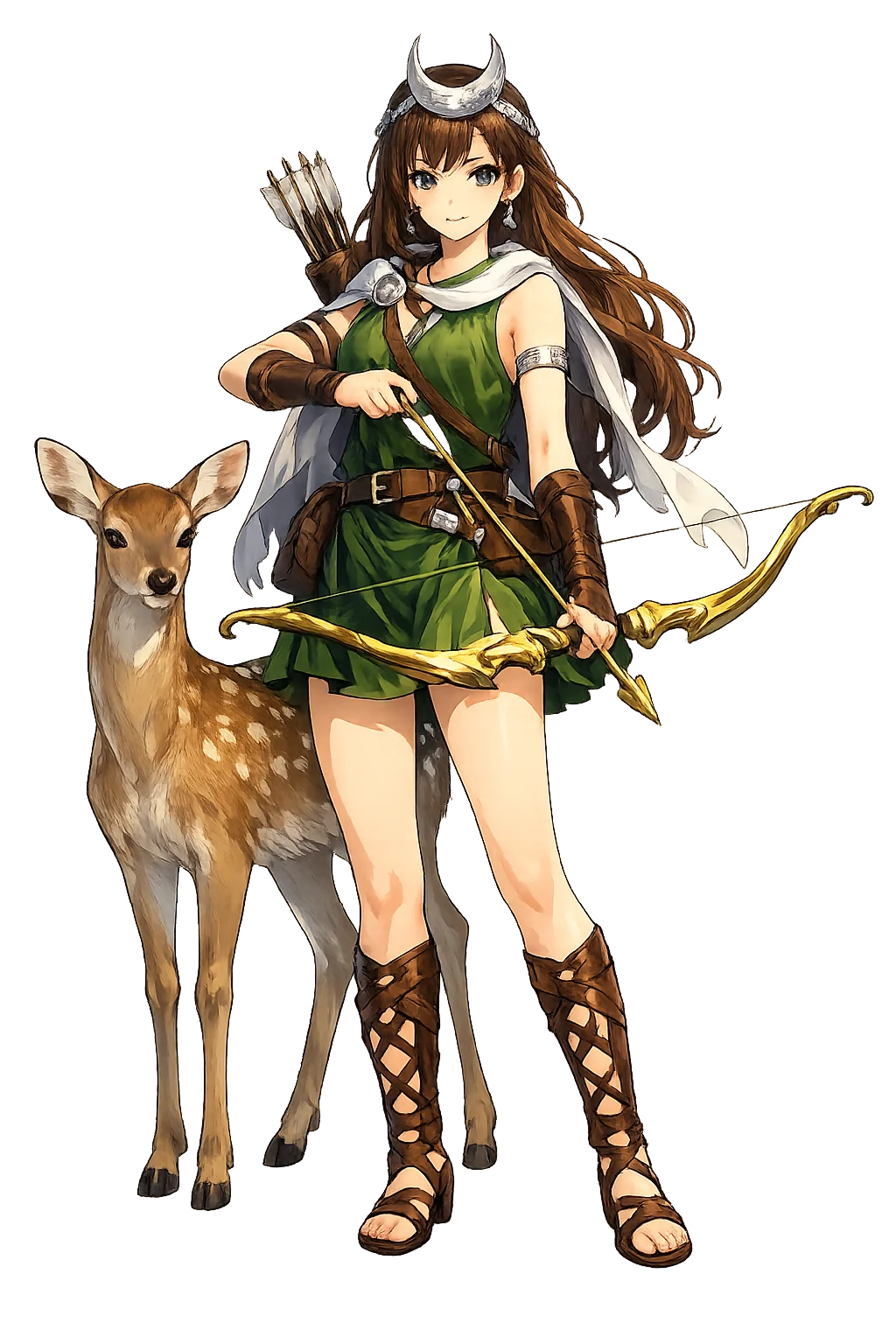
Diana is the Roman huntress par excellence: a short tunic, hunting boots, bow and quiver, hounds at heel, and a crescent moon crowning her hair. The most influential ancient image was the Diana of Versailles, a Roman marble adaptation of a lost Greek original that places one hand on a small deer. Republican and Imperial coins translate the type into a nimble figure running with a torch or spear. As Luna, she drives a two-horse chariot across the night sky; as Trivia, she stands at the crossroads holding two torches. Her attributes are never ambiguous: moon, bow, and deer announce her immediately.

06

Reception & Transformation

The name after its own age — transmission, translation, survival

Afterlives

After antiquity Diana was preserved less through ritual than through literature and art, where she was gradually fused with the Greek Artemis she had long absorbed. Ovid's hunts and Virgil's Aeneid kept her in the Latin curriculum, and medieval encyclopedists passed on her triple identity as moon-goddess, huntress, and chaste patroness of childbirth. Renaissance painters — Titian, Rubens, Poussin — made the bathing Diana a canonical scene of voyeurism and divine wrath. In England she became a poetic emblem of the Virgin Queen, and later a Romantic figure of solitary wilderness. The Nemi sanctuary itself passed into anthropology via Frazer's Golden Bough, so that Diana, ironically, became one of the best-known case studies in the modern study of religion.

Identifications Across Traditions

Her fusion with Artemis was total and early, but Diāna kept Italian features Artemis never had: the slave-priest of Nemi, the Aventine's federal politics, and her patronage of the plebeians, whose traditional asylum her temple provided. In the Middle Ages she became the witch-goddess: canon law condemned women who claimed to ride at night 'with Diana,' and Charles Leland's Aradia (1899) rebuilt her as the messiah of witchcraft — the root of modern Wicca's Diāna. Through her granddaughter Artemis she also drifts lunar, and Roman poets pair Phoebē the moon with Phoebus the sun; but the equation remains poetic, never cultic, and no ancient author confuses the two genealogies.

Modern Legacy

She lends her name to the moon in a hundred poems and to Diana's Mirror at Nemi, where Caligula's pleasure barges — raised in 1929–32, burned in 1944 — gave underwater archaeology its founding drama. Frazer's Golden Bough, the book that created comparative religion as a public genre, begins and ends in her grove, and Frazer's epilogue made Nemi the most famous small wood in the world. Her bow passed to every huntress of later literature, from Camilla to Atalanta retold, and the goddess of the wild remains the emblem of every conservation that is also a hunt — the argument, still unresolved, about whether what is preserved must also be owned.

07

The Meditation

What Diāna means — beyond the dictionary

Diāna is the wild that insists on a temple. Her priest wins office by violence in her most peaceful grove; her deer are protected by being hunted only by her. She asks the oldest question of stewardship: whether anything can be preserved without being owned — and answers with a lake that reflects the moon without holding it.

Her question to every managed wilderness is the lake's own: can you look without touching? The Actaeon myth is not about a peeping hunter but about the gaze that consumes what it sees — and the grove at Nemi, where the priest-king guarded the tree with a sword, admits the paradox outright: some things are protected only by being made dangerous to approach. The wild she keeps is the wild that keeps itself.

08

Frequently Asked Questions

Common questions about Diāna, Moon, Hunt, Wilderness, and Unicode restoration

01How do you pronounce Diāna?

In reconstructed pronunciation, Diāna is /diˈaː.na/ — approximately dee-AH-nah, with the long ā on the stressed second syllable.

02What does Diāna mean?

Diāna means 'The bright one, goddess' (from the root *dyēu-, to shine) in the roman tradition.

03What are the symbols of Diāna?

Diāna is associated with The bow (The hunt and the sudden death of women — her arrows strike gently, says Horace (Carm. 3.22), who asks her to spare the poet's beloved), The crescent (The waxing moon she steers as Luna — and as Jana, the Old Latin feminine of Janus, the moon that opens the month), The deer (Her sacred animal; the wild that cannot be owned, and the quarry Actaeon's hounds could not distinguish from their master), The oak of Nemi (The grove whose bough — the Golden Bough — only a runaway slave might break, and only to begin his priesthood by murder), The shachihoko-less roofline (Her Aventine temple, built in the Greek manner on Servius Tullius' foundations — the one Roman sanctuary the Latins entered as Rome's equals).

04Why restore Diāna in Unicode?

Plain ASCII diana strips the stress, length, and script that make the name specific. Unicode restoration returns the name to its original written dignity.

05What is the most important myth about Diāna?

“Actaeon” — the The Bath story that anchors the mythology of Diāna, told in full on the lore page.

09

Scholarly Sources

The philological foundations of this restoration

Every claim on this page is grounded in established scholarship. The orthographic restorations follow disciplinary convention. The etymological chain follows the best available reference works. This is not invention — it is resurrection through scholarship.

◈

Lexicography & Philology

  • Lewis & Short
  • Varro
  • Horace
◎

Primary Texts

  • Ovid, Metamorphoses 3.138–252; Fasti 3.263–272; Metamorphoses 15.497–546
  • Virgil, Aeneid 7.761–782; 7.803–817; 11.532–724
  • Strabo, Geography 5.3.12
  • Cicero, De Natura Deorum 2.68–69; Macrobius, Saturnalia 1.9
◉

Archaeology & Art History

  • Material evidence — iconography, inscriptions, and temple archaeology — for Diāna and related cults.
✦

Religious Studies

  • Dionysius of Halicarnassus, Antiquitates Romanae 4.25–26; Livy 1.45.2
  • Frazer, James George, The Golden Bough (1890)
Return

The Surface Awaits

You have traced the name from its earliest attestation to its Unicode restoration. Now return to the myth. The story is where the name lives.

Back to Lore
Diāna mascot