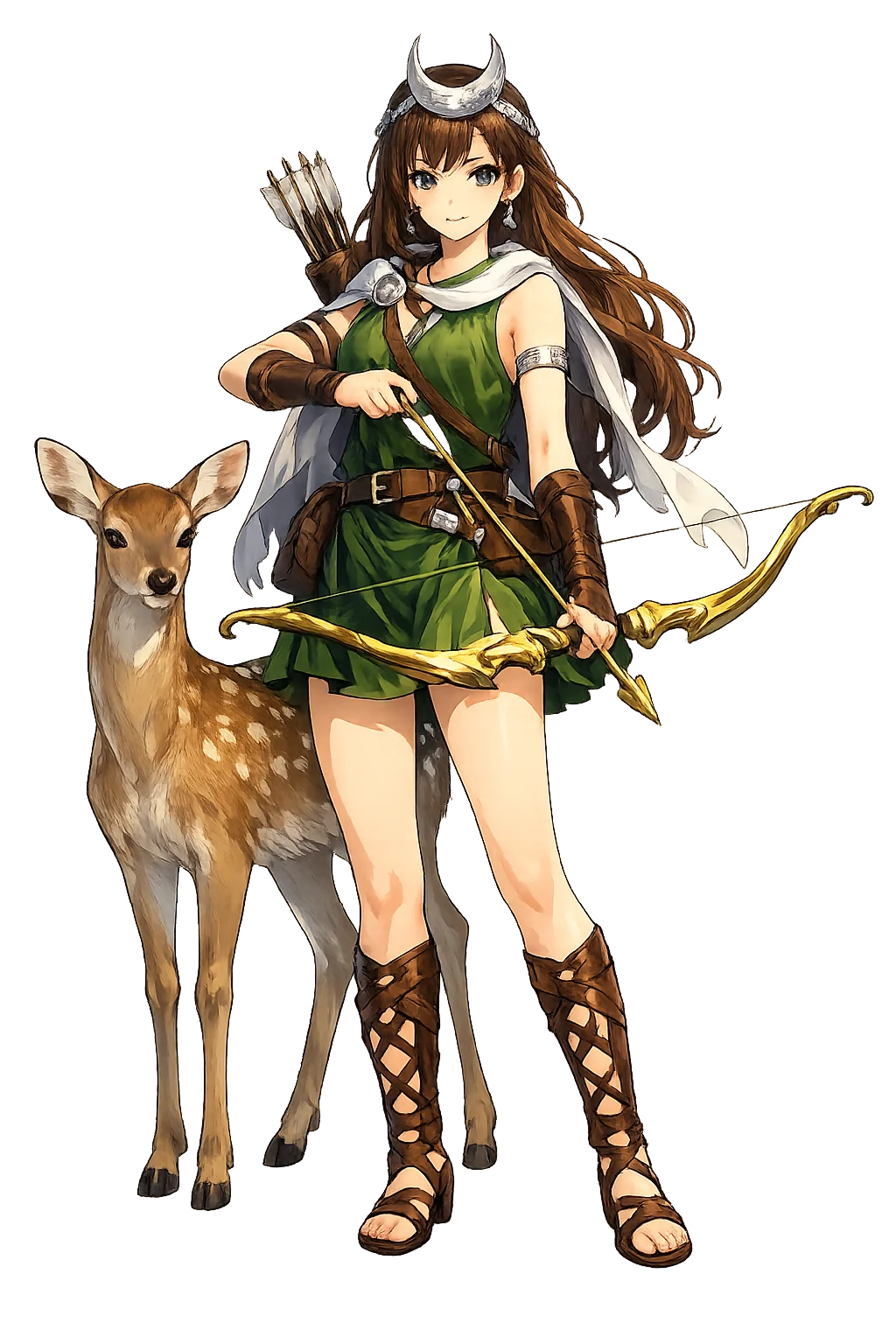
Stories of Diāna
Roman myth largely retells Artemis' stories under Diāna's name — but her cult institutions are Italy's own, older than the stories, and stranger: a grove ruled by an armed fugitive, a federal temple built as an act of constitutional politics, and a goddess whose most famous myth is a warning about looking.
It is Ovid who gives the Roman telling its shape (Metamorphoses 3.138–252), and he gives it a moral that is pure Diāna: it is about seeing, not lust. Actaeon, out hunting at noon with his hounds and his horses, wanders off — whether by fate or by error, the poet hedges — into a valley where a natural arch of rock drips with spring water, and there the goddess is bathing, her nymphs crowding to shield her. Too late: he has seen. She catches up a handful of the spring and sprinkles him — 'now you may tell that you saw me, if you can' — and the antlers begin, the neck lengthens, the hands become feet, and the hunter becomes the stag. Worse follows: his own pack, which knows only the shape of prey, does not know its master's voice, and the hounds tear him down while he cries his own name. The myth is the goddess's charter: the wild is not a picture. To look at it as an object is already to have entered the hunt — on the wrong side.
Strabo, a Greek geographer who knew Italy well, records the strangest priesthood in the Roman world (5.3.12): beside a lake in the Alban hills sacred to Diāna — Lake Nemi, which the Romans called Diana's Mirror — there stood a tree from which it was forbidden to break a bough, and the sanctuary's priest was always a runaway slave, armed with a sword, who had won his office by plucking the bough and killing his predecessor in single combat, and who held it thereafter against the next challenger, sword drawn. Ovid addresses the custom in the Fasti (3.263–272): when the priest who slew the slayer keeps watch in the lonely grove. The rite was already archaic in the Augustan age; two thousand years later it opened Frazer's Golden Bough, the book that made comparative religion a public science. The grove encodes a hard theology of the wild: possession of the sacred is never secure — it must be defended by the same violence by which it was taken, forever, at the edge of a lake that only reflects.
Roman tradition gave Nemi a founding ghost. Virgil tells it in half a dozen lines (Aeneid 7.761–782): Virbius, the most beautiful of men, son of Hippolytus and Aricia, was raised in the goddess's grove, where horses are banned — for Hippolytus was the Greek hunter dragged to death by his own horses, and the chaste son of Theseus could not be trusted near them. Ovid gives the whole story (Metamorphoses 15.497–546): Hippolytus, dragged to pieces and brought back from the dead by Aesculapius's art at Diāna's pleading, was hidden by the goddess in her Italian grove and given a new name — Virbius, vir bis, 'twice a man.' The myth is the Roman answer to the Greek tragedy: where the Greek story kills the hunter who rejected love, the Italian sanctuary shelters and rebirths him. Nemi's grove is a hospital for the twice-living — the place where even the tragic refuse of Greek myth is given a second body and a new name, under Roman protection.
Her greatest temple was a constitution. Dionysius of Halicarnassus (Antiquitates Romanae 4.25–26) describes the temple of Diāna that Servius Tullius built on the Aventine as the common sanctuary of the Latin peoples — a federal shrine where the cities of Latium met the Romans as equals, deliberately built in the Greek manner. Livy (1.45.2) fixes the foundation in Servius' reign. The dedication produced one of those characteristic Roman origin-stories about priority: at the joint festival, a Sabine declared his own ox the finest animal present and its entrails his by right; the cunning Roman priest sacrificed the beast first and carried off the liver, and the arbitration of the dispute confirmed that precedence belongs to whoever acts, not whoever talks. The sanctuary doubled as an asylum, sheltering fugitive slaves and debtors — fittingly, since its priest at Nemi was himself a fugitive. Diāna's Aventine was the one altar in Italy where Rome's future subjects practiced being partners, and the goddess of the wild presided over the city's oldest experiment in federalism.
Virgil's last Italian heroine belongs to Diāna. Metabus, king of the Volscians and hated by his own people, fled with his infant daughter when his city burned; blockaded at the flooded river Amasenus, he lashed the baby to his spear, called on the goddess of the woods, and hurled her across the torrent — and she was caught, or the river-goddess caught her. Swearing her to virginity and to the hunt, he raised her in the wilderness, and she became the warrior-maiden of the Italian war in the Aeneid: fleet of foot, racing the wind itself, her spear-work compared to an Amazon's (7.803–817). She falls to the hidden spear of Arruns, and Diāna answers: her nymph Opis, posted on a hill for exactly this, plants an arrow in Arruns and speaks the poem's bitterest epitaph — her spoils will never be enjoyed (11.532–724). Camilla is the goddess's price and her boast: the wild breeds loyalty, and even the losing side of history gets a divine witness.
Moon, Wild, and the King of the Wood
Diāna is Rome's own goddess before she is Artemis imported: mistress of the wildwood, the moon, and women in labour, whose strangest institution — the priest-king of Nemi who wins his office by murder — haunted anthropology for a century.
Of the three ways — her title at the crossroads, where moon, hunt, and underworld meet.
The lake called Diana's Mirror, sacred grove of the rex Nemorensis — the priest who slew the slayer (Strabo 5.3.12).
Her federal temple, founded by Servius Tullius as the common sanctuary of the Latin League (Livy 1.45.2; Dion. Hal. 4.25–26).
The hunter who saw her bathing and was run down by his own pack — the wild's answer to the gaze (Ovid, Met. 3.138–252).
From the original script to the living URL
DIANA
The name in its original Roman form. Diāna (DIANA) is attested in the source tradition — “'The bright one, goddess' (from the root *dyēu-, to shine)”. Its macron-length vowels carry the full phonetic and orthographic weight of the source tradition.
diana
Reduced to plain diana, the name loses everything that made it specific: macron-length vowels. What remains is an ASCII string that machines can parse but that no longer speaks with its original voice.
Diāna
The Unicode restoration recovers what ASCII flattened. Diāna restores macron-length vowels, returning the name to its original written dignity. The domain encodes to Punycode, but the browser displays the truth.
Diāna.com → xn--dina-rsa.com
The non-ASCII characters in Diāna are encoded while the ASCII remains visible. To the DNS, it is Punycode. To humanity, it is Diāna.
Owned, ideal, and ASCII forms of Diāna
Diāna
Restores DIANA. The live temple domain — diāna.com.
diana
Flattens DIANA. The plain ASCII fallback — what DNS and legacy systems see.
How Diāna was spoken
How Diāna travels from ancient script to the modern URL
The lore you have read is the living myth. Extended Lore opens the scholarly vault beneath it: the cult and its material remains, a history of the image, the name after antiquity, a meditation on what the name still means, and the full scholarly apparatus — etymology, orthography, sources.
Enter Extended Lore