PuniCodex

Extended Lore

धातृ Dhātṛ

Etymology · Orthography · Cult · Iconography · Reception · Sources

Tier 1 Dhātṛ.com
Dhātṛ — Creation, Ordinance, Support
01

Quick Facts

Essential information about Dhātṛ, Creation, Ordinance, Support

Original Scriptधातृ
Unicode RestorationDhātṛ
Reconstructed Pronunciation/d̪ʱɑːˈt̪r̩/
PantheonSanskrit
DomainCreation, Ordinance, Support
Meaning'The Ordainer, the Establisher' (from dhā, to place), an Āditya
ClassificationTier 1
Primary DomainDhātṛ.com
Sacred SymbolsThe measuring line, The lotus seat, The syllable dhā
02

Etymology & Word Family

From original script to Unicode restoration

Original Script धातृ Dhātṛ — "'The Ordainer, the Establisher' (from dhā, to place), an Āditya"
Unicode Restoration Dhātṛ Restored stress, length, and script
Modern ASCII dhatr Plain-ASCII fallback

The name Dhātṛ carries the orthographic signature of the sanskrit tradition: धातृ. Unicode restoration recovers what ASCII flattens.

03

Unicode Character Breakdown

Character-by-character philological analysis

CharacterUnicodeNameBlockPhonetic Role
DU+0044Latin Capital Letter DBasic LatinSame letter
hU+0068Latin Small Letter HBasic LatinSame letter
āU+0101Latin Small Letter A with MacronLatin Extended-AMacron marks the long vowel
tU+0074Latin Small Letter TBasic LatinSame letter
ṛU+1E5BLatin Small Letter R with Dot BelowUnknownScript-specific diacritic

The Tier 1 classification reflects how much of the original phonology this restoration preserves — stress and vowel length for Greek names, distinctive letters and diacritics for every other tradition.

04

Cult & Worship

How the sacred was kept — rites, sanctuaries, remains

The Cult

Dhātṛ's cult is the rarest thing in the Veda: a worship that never left the rite. He has no temples, no images, and no attested priesthood; his sanctuary is the domestic ceremony, and his votaries are the householders who speak his name at life's thresholds. The Atharvaveda's domestic hymns and the Brāhmaṇas invoke him with his twin Vidhātṛ at marriage and at birth — the Establisher and the Disposer called in to found the child's fortune and fix its lot — and the birth-rites (garbhādhāna, jātakarman) in which the pair are addressed have been transmitted continuously, in Vedic families, to the present day. What material trace he has is textual: the Ṛgveda manuscripts, among the oldest continuously copied books on earth. One later displacement is visible: his root-word dhātu became the organizing term of two learned disciplines, grammar and medicine — the god's cultus faded as his grammar was enthroned. He is served now, if at all, by grammarians parsing verbal roots and physicians listing tissue-elements, neither knowing they keep a god's vigil.

In the Earth

An aniconic god leaves no temples: Dhātṛ's material trace is the textual tradition — the Ṛgveda manuscripts (among the world's oldest continuously transmitted texts, UNESCO Memory of the World) and the ritual manuals that prescribe his invocation. The birth-rites (garbhādhāna and jātakarman) where he and Vidhātṛ are called to establish the child's fortune are performed, archaeologically invisible but ethnographically continuous, to this day.

05

Iconography

How Dhātṛ was imaged across the ages

The Image

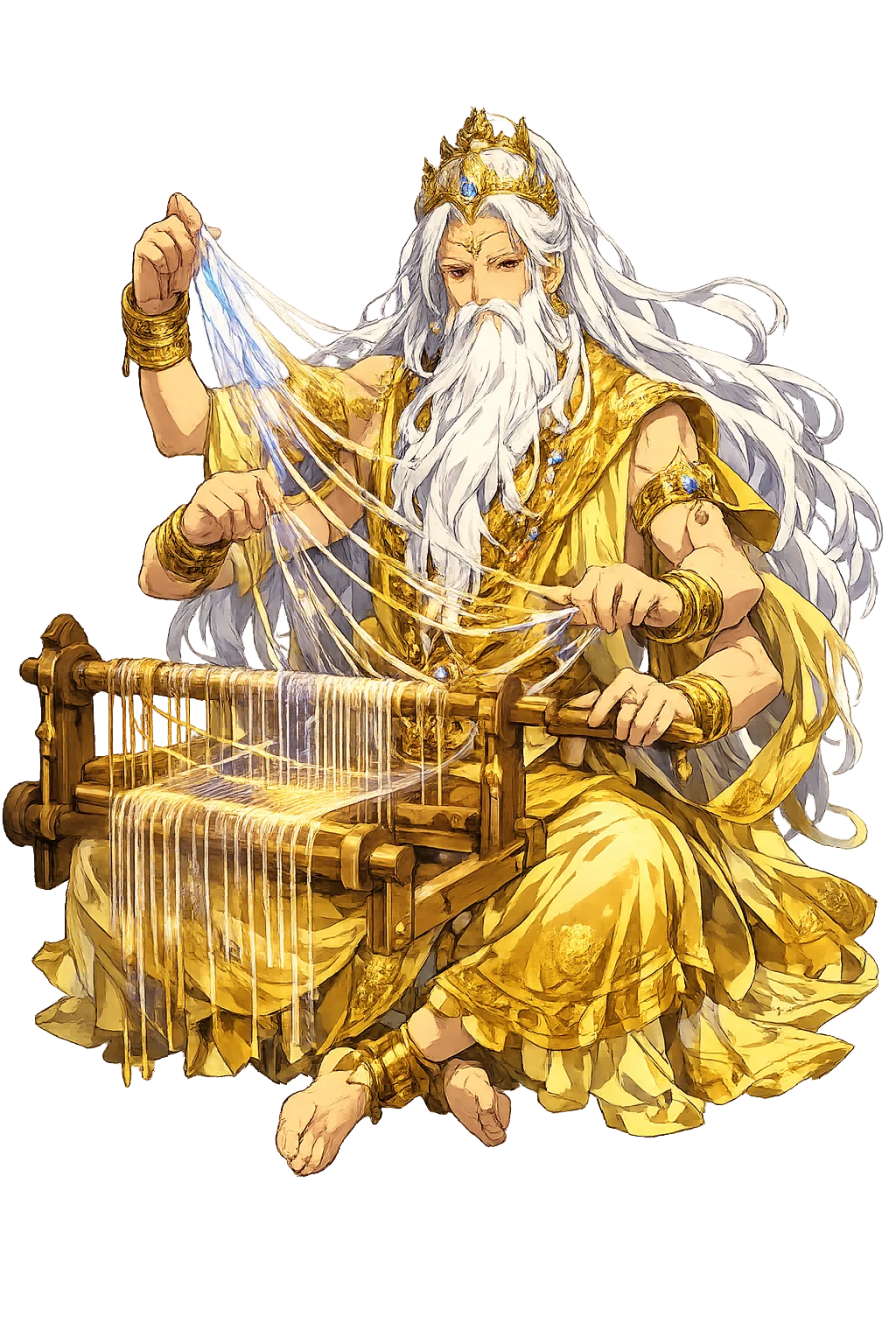
Dhātṛ has no face — and that is the most precise thing about him. No sculptural or painted image of the Vedic Establisher is known, and later iconography, when it must show him, dresses a Brahmā in his function: lotus seat, measuring cord, the white beard of the creator-god into whom he was absorbed. The texts themselves supply the attributes — the measuring line by which the formless receives form, the lotus, and above all the syllable dhā, the root made emblem. His truest portrait is a metaphor: the forehead. Later literature made Dhātṛ-Vidhātṛ the two scribes who write the newborn's destiny on its brow — lalāṭa-likhita, 'written on the forehead' — an image so vivid it outgrew its gods and became the proverbial shorthand for fate across the Indian languages. Where other gods accumulated bodies, he accumulated grammar; his iconography is a root-word declined through a civilization, and his only surviving likeness is the life-line a palmist reads.

06

Reception & Transformation

The name after its own age — transmission, translation, survival

Afterlives

Dhātṛ's afterlife is a promotion into parts of speech. The Ṛgveda's Establisher passed first into the office: by the epics, dhātā is an epithet of Brahmā and of fate itself, cried out in battle as one cries to providence. Then his root went to work. Pāṇini's grammar organized Sanskrit as a list of dhātus, verbal roots, and the Āyurvedic compendia organized the body as seven dhātus, tissue-elements — two learned civilizations sharing one word for 'the set-down units,' as if reality itself were his handiwork. The twin invocation Dhātṛ-Vidhātṛ migrated from Vedic Sanskrit into the vernacular birth-rites and proverbs — jo likhā so hoga, what is written will happen — where it still anchors everyday fatalism. European comparative philology recovered his deepest ancestry: Pokorny's *dheh₁-, Greek títhēmi, English 'do' — the Establisher's verb among the family's oldest furniture. What he never received is what most gods got: a sect. His reception ran along the scholar's path — root, commentary, dictionary — and his immortality is that Indian children are still, at birth, asked to be well-established, in words he would recognize as his own.

Identifications Across Traditions

Comparative philology hears his cognates across the Indo-European family: the root *dheh₁- gives Greek títhēmi ("I set") and English "do" — the Establisher's verb is one of the family's deepest. Within India he merges with Brahmā and, in the Smarta synthesis, with the abstract Brahman: the person dissolves into the principle. The Avestan dātā ("the Law-giver") is his Iranian counterpart in office if not in name.

Modern Legacy

His root-word dhātu became a foundational term of two civilizations of learning: Pāṇini's grammar organizes Sanskrit as a list of dhātus (verbal roots), and Āyurveda organizes the body as seven dhātus (tissue-elements). "Dhātṛ" survives as a name for fate in the vernaculars; the formula "dhātā-vidhātā" still opens Hindu birth-rite invocations. The idea that grammar and medicine share one word for "the set-down units" is his unnoticed monument.

07

The Meditation

What Dhātṛ means — beyond the dictionary

Dhātṛ is the god of foundations — the moment a thing is set where it will stand. Language, law, the body, the year: all are "establishments" in his grammar. He asks the builder's question beneath every ambition: not what will you make, but where, truly, have you set it down?

His is the least visible and most load-bearing idea in the Veda: that the world holds because things have been set where they belong — the sun in its path, the word in its form, the root in its dhātu. Grammar and medicine, the two great Indian sciences, both took his root-word for their elements, as if to say: reality is well-placed, and knowledge is learning the placements. Every foundation poured, every standard ratified, every definition fixed is a small act of Dhātṛ — the setting-down on which everything else stands.

It is fitting that the Establisher left no image: the act of setting-down is invisible in everything that stands. Languages keep their roots, bodies keep their elements, years keep their months — all establishments, all his. The Ṛgveda's wager is that order is not an accident but an act, performed once and renewed with every thing that is set, placed, founded, or named truly. Every well-laid stone is his unnoticed hymn.

And when the birth-rite is said today and the parents ask for the child to be well-established, the old god is still invoked — unnamed by most who say the words, present in the grammar of the blessing itself. The Establisher's last hiding place is the language, which is where he always lived.

08

Frequently Asked Questions

Common questions about Dhātṛ, Creation, Ordinance, Support, and Unicode restoration

01How do you pronounce Dhātṛ?

In reconstructed pronunciation, Dhātṛ is /d̪ʱɑːˈt̪r̩/ — approximately dhah-TRUH; the ṛ is a rolled vocalic r.

02What does Dhātṛ mean?

Dhātṛ means 'The Ordainer, the Establisher' (from dhā, to place), an Āditya in the sanskrit tradition.

03What are the symbols of Dhātṛ?

Dhātṛ is associated with The measuring line (The demarcation by which the formless receives form), The lotus seat (Later iconography's gift to the establishing powers), The syllable dhā (The root as emblem — setting, placing, founding).

04Why restore Dhātṛ in Unicode?

Plain ASCII dhatr strips the stress, length, and script that make the name specific. Unicode restoration returns the name to its original written dignity.

05What is the most important myth about Dhātṛ?

“Ṛgveda 10.190” — the The Ordinance story that anchors the mythology of Dhātṛ, told in full on the lore page.

09

Scholarly Sources

The philological foundations of this restoration

Every claim on this page is grounded in established scholarship. The orthographic restorations follow disciplinary convention. The etymological chain follows the best available reference works. This is not invention — it is resurrection through scholarship.

◈

Lexicography & Philology

  • Monier-Williams
  • Macdonell
◎

Primary Texts

  • Rigveda
  • Ṛgveda 10.190
  • Atharvaveda and Brāhmaṇas
◉

Archaeology & Art History

  • Material evidence — iconography, inscriptions, and temple archaeology — for Dhātṛ and related cults.
✦

Religious Studies

  • Monier-Williams, Sanskrit-English Dictionary, s.v. dhātṛ
  • Macdonell, Vedic Mythology
  • Pokorny, Indogermanisches etymologisches Wörterbuch, *dheh₁-
Return

The Surface Awaits

You have traced the name from its earliest attestation to its Unicode restoration. Now return to the myth. The story is where the name lives.

Back to Lore
Dhātṛ mascot