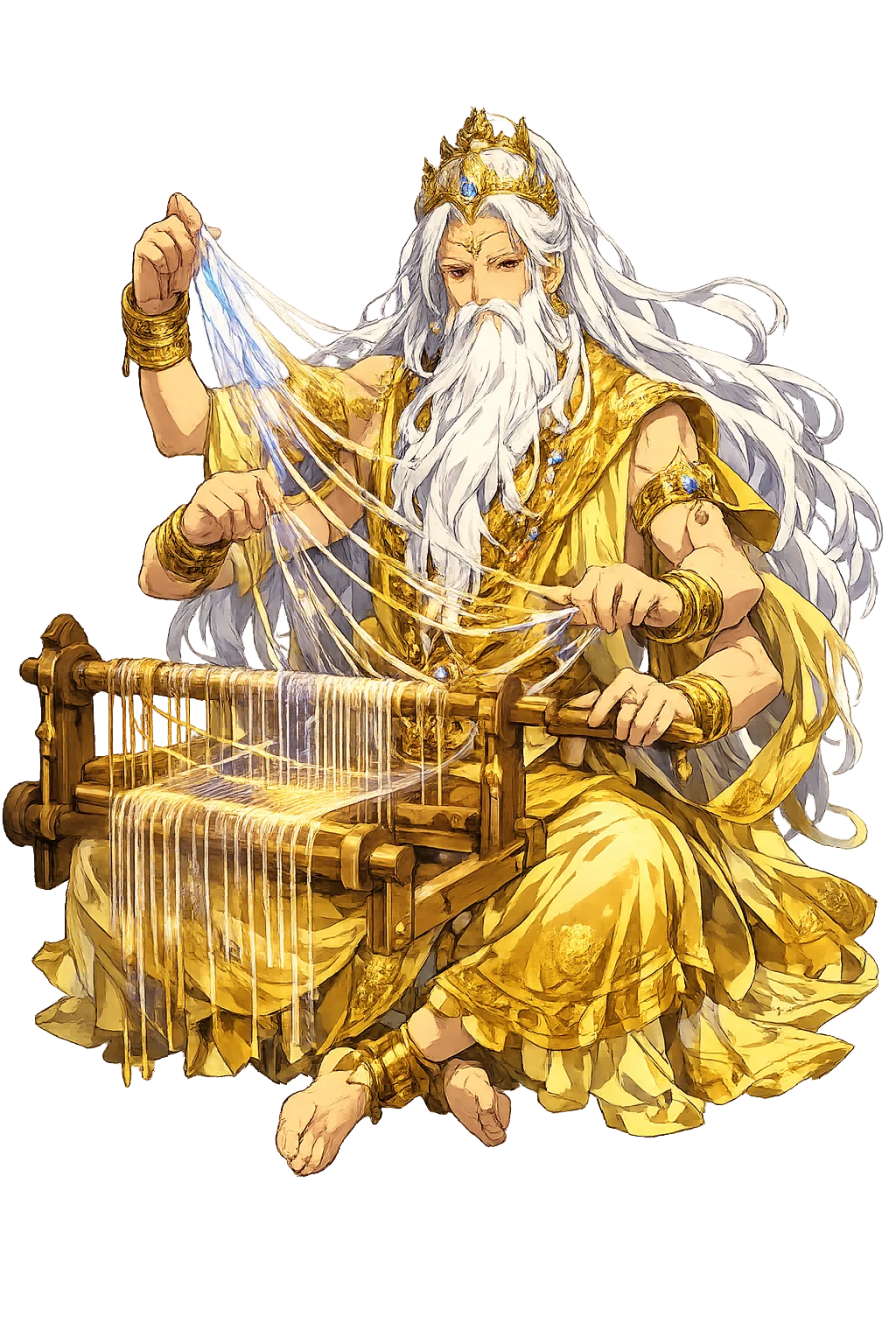
Stories of Dhātṛ
Dhātṛ's mythology is the Ṛgveda's creation poetry itself: he appears wherever the text needs not a story but the act — the setting of each thing in its station.
The hymn of the ordering is Ṛgveda 10.190, among the oldest creation texts on earth. From tapas — ardor, heat — was born order (ṛta) and truth (satya); from them, night; from night, the ocean; from the ocean, the year, apportioning its days and nights. And then the poem names its maker: 'Dhātṛ, as he had made the sun and moon, established heaven and earth, the mid-air and the light' (RV 10.190.1–3). There is no battle here, no dismembered giant, no world-egg — only a sequence of set-downs, each thing placed where it belongs, the world's making told in the grammar of a verb: dhā, to set. Creation in the Ṛgveda's most abstract hymn is not an event but a placement. The wonder the hymn asks for is quiet and enormous: that anything is where it is — the moon in its month, the air between the worlds — is an act, and the act has a name.
The Vedic ritualists soon found that establishing needs disposing. In the Atharvaveda's domestic hymns and throughout the Brāhmaṇas, Dhātṛ appears with his twin Vidhātṛ — the Establisher and the Disposer: one fixes a thing's place, the other fixes its lot. Together they are invoked at the thresholds of a life, in the marriage rite where a new household is set down and the birth rites where the child's fortune must be founded. Later tradition, keeping the pair, made them the joint signatories of destiny: Dhātṛ-Vidhātṛ become the formula in the epics and Purāṇas for 'as the powers ordained.' The pairing is subtle and complete — a thing is not only where it is but what it is for — and it survives in vernacular birth invocations still spoken today, where parents ask that the child be well-established. The two gods are one insight wearing two faces: no foundation without an allotment, no world without its law.
In the long history of Hindu godhood, Dhātṛ is the office that outlived its officer. The epics already use dhātā as an epithet of Brahmā and Prajāpati — the creator as the founder; by the Purāṇic age the name and the person have merged, and 'Dhātṛ' in the Mahābhārata usually means the creator-god or, more abstractly, fate itself: heroes cry to dhātā-vidhātā as one cries to providence. It is the quietest succession in religious history. No hymn mourns Dhātṛ; no myth kills him; his grammar is simply inherited — his root-word, his office, his twin — by a god with a face, a city, and a cult. Read closely, the epics preserve the Vedic view intact: when a hero blames 'what was established,' he is still quoting the Ṛgveda's Establisher, three thousand years downstream. The god did not die. He was promoted into a noun.
From the twin gods Dhātṛ-Vidhātṛ grew the most Indian of all images: the forehead-writing. Later literature holds that at a child's birth the Establisher and the Disposer inscribe its destiny upon the brow — lalāṭa-likhita, 'written on the forehead' — and no effort erases what they have written. The proverb runs through the epics and the story literature, through a thousand folktales, poems, and films: jo likhā so hoga, what is written will happen. The image turns cosmology into biography: the Establisher who set the moon in its orbit also set this life its course, and the drama of existence is the slow discovery of where the lines were drawn. Yet the tradition pairs the fatalism with the ardor that preceded it: the same root dhā gives dhāman, ordinance, and dhárman — law, the thing that holds. Destiny is written, the image says, but on the forehead — which is to say, at last, visible to the one who lives it.
Ordinance, Creation, and the Set-Down World
Dhātṛ is the Vedic verb of creation made personal: "the Establisher," the one who sets the sun in the sky and the child in the womb. Where Brahmā would later be a personality, Dhātṛ is still a function radiant with worship — creation as the act of setting-down.
Ṛgveda 10.190: he established heaven and earth, the waters and the light.
Paired with the "Disposer" — the Establisher founds, the Disposer assigns each thing its law.
His root-word: the elements of grammar and of medicine — the set-down units of reality.
He "establishes the embryo" — creation biological as well as cosmic.
From the original script to the living URL
धातृ
The name in its original Sanskrit form. Dhātṛ (धातृ) is attested in the source tradition — “'The Ordainer, the Establisher' (from dhā, to place), an Āditya”. Its macron-length vowels carry the full phonetic and orthographic weight of the source tradition.
dhatr
Reduced to plain dhatr, the name loses everything that made it specific: macron-length vowels. What remains is an ASCII string that machines can parse but that no longer speaks with its original voice.
Dhātṛ
The Unicode restoration recovers what ASCII flattened. Dhātṛ restores macron-length vowels, returning the name to its original written dignity. The domain encodes to Punycode, but the browser displays the truth.
Dhātṛ.com → xn--dht-2oa5868a.com
The non-ASCII characters in Dhātṛ are encoded while the ASCII remains visible. To the DNS, it is Punycode. To humanity, it is Dhātṛ.
Owned, ideal, and ASCII forms of Dhātṛ
Dhātṛ
Restores धातृ. The live temple domain — dhātṛ.com.
dhatr
Flattens धातृ. The plain ASCII fallback — what DNS and legacy systems see.
How Dhātṛ was spoken
How Dhātṛ travels from ancient script to the modern URL
The lore you have read is the living myth. Extended Lore opens the scholarly vault beneath it: the cult and its material remains, a history of the image, the name after antiquity, a meditation on what the name still means, and the full scholarly apparatus — etymology, orthography, sources.
Enter Extended Lore