
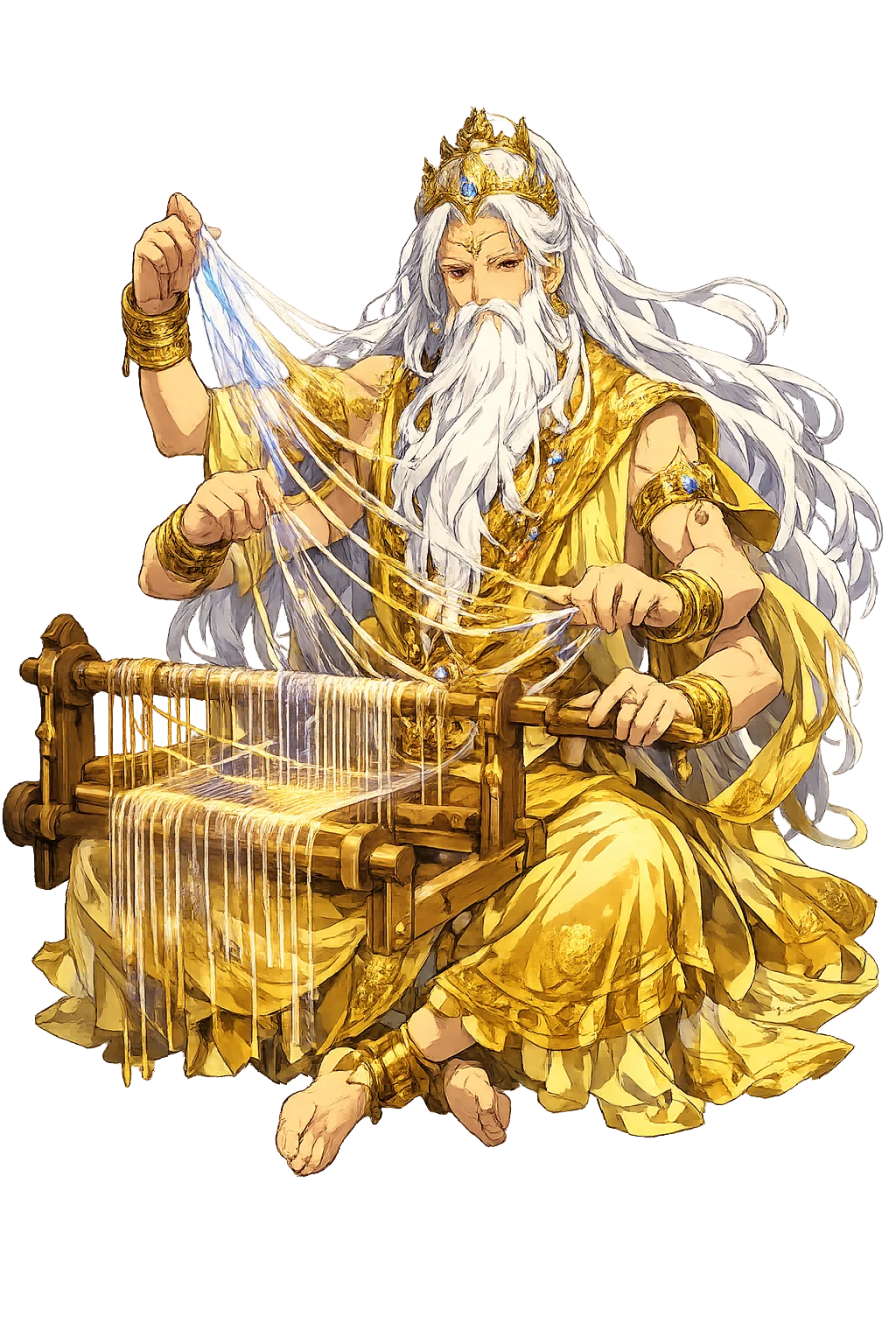
The appointments Dhātṛ made — and who is keeping them
Take Dhātṛ's stories in sequence. They are not episodes; they are appointments — and the modern trades are keeping them.
At a Glance
- Temple: Dhātṛ
- Pantheon: Sanskrit
- Domain of influence: Creation, Ordinance, Support
- Pattern seats: 3
- Sectors touched: Society & Spirit · Home & Lifestyle
- Strongest seat: Education, Research & Knowledge
- Series: The Resonance Files, No. 126 of 546
The Cycle, Read Forward
Education, Research & Knowledge — through Ṛgveda 10.190
The hymn of the ordering is Ṛgveda 10. 190, among the oldest creation texts on earth.
The atlas states the seat in one line: Dhātu: the root-elements of grammar; the structure of learning itself. The story above is the long version of the same sentence. That is the cycle working: story becomes duty, duty becomes trade.
Philosophy, Ethics & Standards — through Dhātṛ and Vidhātṛ
The Vedic ritualists soon found that establishing needs disposing. In the Atharvaveda's domestic hymns and throughout the Brāhmaṇas, Dhātṛ appears with his twin Vidhātṛ — the Establisher and the Disposer: one fixes a thing's place, the other fixes its lot.
The atlas states the seat in one line: Cosmic order as an act of establishment; the grammar of foundations. The story above is the long version of the same sentence. Industries do not invent their archetypes; they inherit them and call them best practice.
Architecture & Spatial Design — through Becoming Brahmā
In the long history of Hindu godhood, Dhātṛ is the office that outlived its officer. The epics already use dhātā as an epithet of Brahmā and Prajāpati — the creator as the founder; by the Purāṇic age the name and the person have merged, and 'Dhātṛ' in the Mahābhārata usually means the creator-god or, more abstractly, fate itself: heroes cry to dhātā-vidhātā as one cries to providence.
The atlas states the seat in one line: The establisher; foundations as sacred act. The story above is the long version of the same sentence. That is the cycle working: story becomes duty, duty becomes trade.
The Theme That Runs the Cycle
Dhātṛ's mythology is the Ṛgveda's creation poetry itself: he appears wherever the text needs not a story but the act — the setting of each thing in its station.
The Method, Stated Plainly
None of this is numerology. A seat exists only where the match can be argued from the deity’s documented domains and deeds — weighted, published, and falsifiable. The derivation, the weights, and the challenge process are public on the methodology page. If a seat in this file reads wrong, the atlas itself tells you how to prove it — and the correction becomes part of the record.
For the Ones Who Work There
If you work in education, research & knowledge, philosophy, ethics & standards, or any trade this temple holds a seat in, this is the honest version of what a placement means: your industry beside the story it has been re-telling all along — on the temple floor itself, before an audience that came specifically to read it. The patron tier and the advertising terms describe the mechanics; the resonance above describes the fit.
The File Continues
One of 546 Resonance Files — the series where the pantheon goes to work. Read the founding dispatch for the name, the Restoration File for the spelling, or the whole archive end to end.
Continue the series — previous: Dēmētēr (read it) · next: Diāna (read it).
The Resonance Files are argued from the same canonical record as the pattern atlas itself: the lexicon, the lore catalog, and the cited sources. Every seat can be challenged at the methodology page — and the challenge is the point.