
The Cult
No temple of Dharma stands alone, yet every temple is his: he is worshipped as Yudhiṣṭhira’s father and as the law itself at the Dharmaśāstra recitations. The Kurukshetra pilgrim circuit treats the epic’s battlefield as his sanctum.
Extended Lore
Etymology · Orthography · Cult · Iconography · Reception · Sources
Essential information about Dharma, Law, Duty, Righteousness
From original script to Unicode restoration
The name Dharma reaches the modern world through scholarly transliteration of the sanskrit tradition. Because the conventional spelling uses only Latin letters, its Unicode and ASCII forms coincide — the tradition it carries is in the name itself, not in diacritics.
Character-by-character philological analysis
| Character | Unicode | Name | Block | Phonetic Role |
|---|---|---|---|---|
| D | U+0044 | Latin Capital Letter D | Basic Latin | Same, capitalized |
| h | U+0068 | Latin Small Letter H | Basic Latin | Same |
| a | U+0061 | Latin Small Letter A | Basic Latin | Same |
| r | U+0072 | Latin Small Letter R | Basic Latin | Same |
| m | U+006D | Latin Small Letter M | Basic Latin | Same |
| a | U+0061 | Latin Small Letter A | Basic Latin | Same |
This restoration reflects fidelity to the attested tradition, not recovered diacritics: every character of Dharma already survives in ASCII. What the restoration preserves is the canonical spelling itself — the form scholarship standardised.
How the sacred was kept — rites, sanctuaries, remains
No temple of Dharma stands alone, yet every temple is his: he is worshipped as Yudhiṣṭhira’s father and as the law itself at the Dharmaśāstra recitations. The Kurukshetra pilgrim circuit treats the epic’s battlefield as his sanctum.
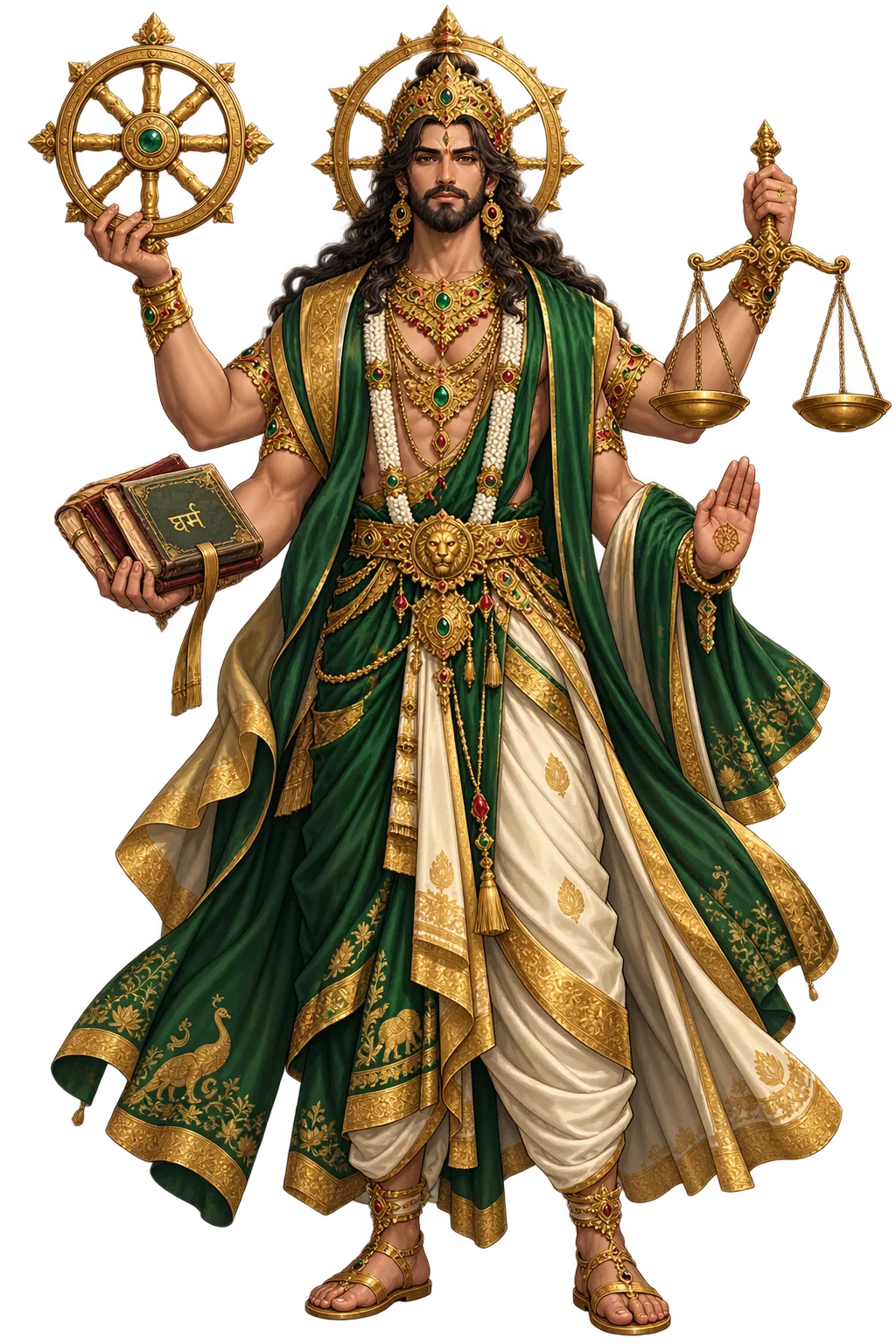
Dharma’s monuments are juridical: the edict-pillars of Aśoka, whose dhamma inscriptions are the oldest deciphered moral legislation on earth. His wheel crowns the Indian flag; his bull — the dharmavṛṣabha — kneels on the seal of the Republic.
How Dharma was imaged across the ages
Rarely imaged; when personified, a grave king with the plough or the wheel, often with Yudhiṣṭhira beside him. His true icon is the bull’s four legs, the wheel’s eight spokes, the scales of the king’s court — the law’s geometry rather than its face.
The name after its own age — transmission, translation, survival
Comparative law and religion use dharma as the test-case of an untranslatable that must be translated anyway; sociology of religion treats it as the most successful fusion of cosmic, social, and personal order ever devised. ‘Dharma’ entered English dictionaries as a loan-word — the surest sign a civilization’s key term refused to be carried.
Dharma and the Buddha’s Dhamma share a word and a mission: the Buddha claimed the title Dharmarāja, king of the law, and made dharma’s wheel — the dharmacakra — his teaching’s emblem. The Zoroastrian daēnā and the Roman Fas are the comparison-points scholars cite; in India itself dharma absorbed every local law-code, from the Vedic ṛta to the medieval digests.
The word is untranslatable and indispensable — every rendering (‘law’, ‘duty’, ‘religion’, ‘righteousness’) is a fraction. The four feet of dharma’s bull are India’s theory of history; the Bhagavadgītā’s ‘better one’s own dharma, though defective’ is among the most quoted ethical sentences on earth. India’s modern name for itself, ‘Hindu Dharma’, keeps the word at the nation’s centre.
What Dharma means — beyond the dictionary
Dharma: the name of the thing that holds, restored in letters that hold nothing but carry everything. It needs no mark over its vowels — the word’s burden is its own diacritic, the weight of the worlds it has held for four thousand years.
Common questions about Dharma, Law, Duty, Righteousness, and Unicode restoration
In reconstructed pronunciation, Dharma is /ˈdɑːrmə/ — approximately “DAHR-muh”.
Dharma means That which holds or sustains — law, duty, and righteousness; the moral and religious order that upholds the world (from √dhṛ, 'to hold, sustain'). in the sanskrit tradition.
Dharma is associated with The Load-Bearer (The cosmos rests on dharma; the four feet of the bull of dharma mark the four ages of time.), Duty by Caste and Stage (Svadharma — one’s own duty by birth and life-stage: the Bhagavadgītā’s central teaching.), The Cosmic Ages (The four yugas are the four feet of the bull: four in the Kṛta age, one stumbling foot in ours.), The Tester of Men (In the epics Dharma appears in disguise — a beggar, a dog, a crane — to test righteousness where it counts.).
Dharma is written entirely in ASCII letters, so its restoration is about canonical fidelity rather than recovered diacritics: the temple fixes the name in its scholarly standard spelling, attested in the source tradition, instead of leaving it to drift.
“The Father of Yudhiṣṭhira” — the Mahābhārata story that anchors the mythology of Dharma, told in full on the lore page.
The philological foundations of this restoration
Every claim on this page is grounded in established scholarship. The orthographic restorations follow disciplinary convention. The etymological chain follows the best available reference works. This is not invention — it is resurrection through scholarship.
You have traced the name from its earliest attestation to its Unicode restoration. Now return to the myth. The story is where the name lives.
Back to Lore