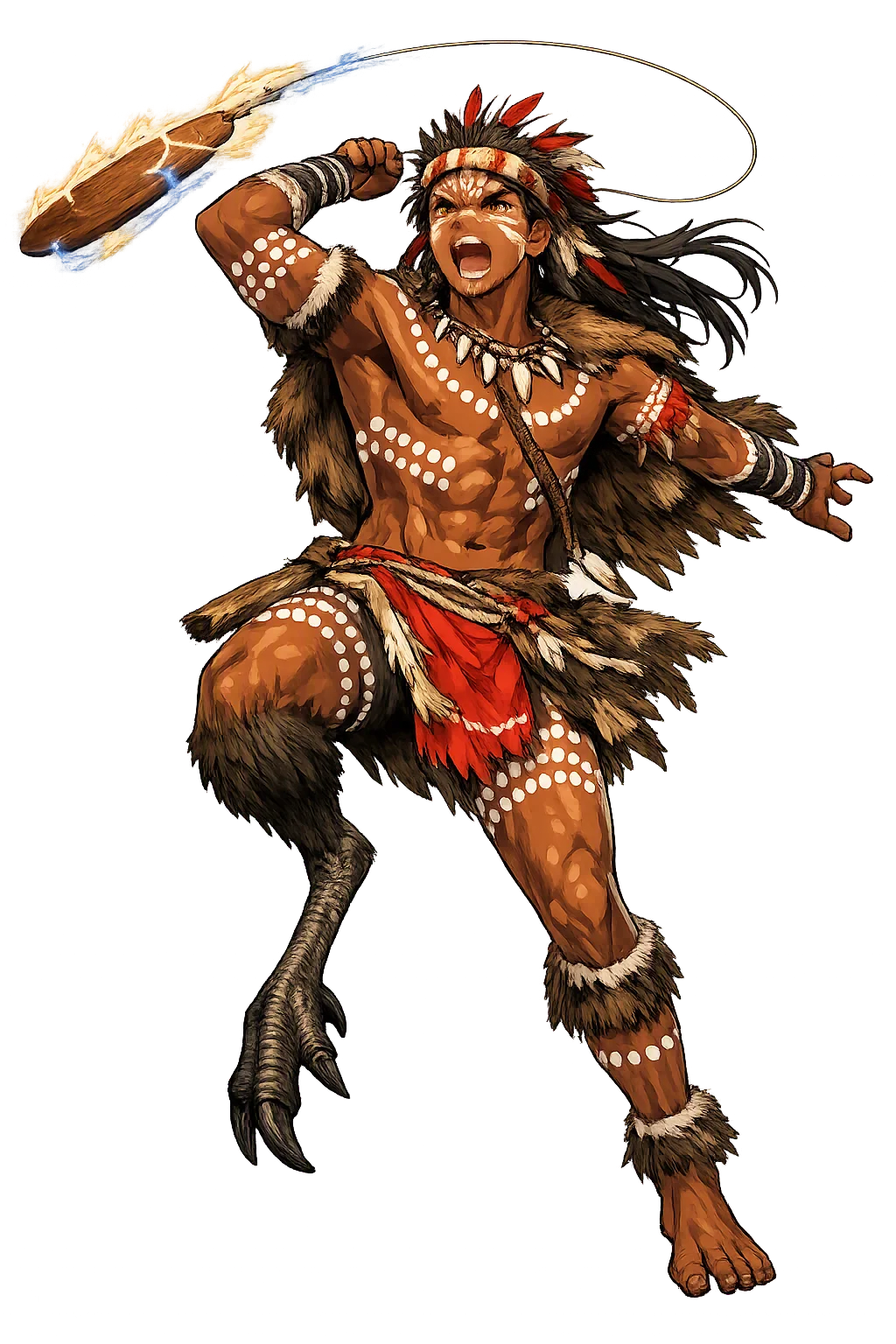
Stories of Daramulum
Daramulum's mythology is preserved in the ceremonial life and oral traditions of the Dharug, Eora, Euahlayi, and neighbouring nations of New South Wales. He is not a remote deity but an active guardian of social order: he descends for initiations, his voice sounds in the bullroarer, and he lives in the sky as a permanent sign of the Law.
In the traditions recorded around Sydney and the Blue Mountains, Daramulum is the son of Baiame — maker, sky father, the great being who shaped country, animals, and Law before withdrawing to his camp in the heavens. He serves as his father's principal agent on earth: he descends to the bora ground when boys are made men, he watches that initiates keep the secrets, and he punishes those who mock the ceremonies. K. Langloh Parker, writing from Euahlayi country in The Euahlayi Tribe (1905), describes him as a being of fearsome power, while A. W. Howitt's surveys of south-eastern Australia (The Native Tribes of South-East Australia, 1904) record the same sky-hero under variant spellings in the rites of many nations. His most striking feature is his body: several accounts make him one-legged, or emu-footed — a form that marks him as other-than-human and ties him to the great bird of the plains. The tradition does not explain the missing limb so much as let it speak: the enforcer of the Law moves like the emu, guardian bird and sky-sign at once.
The bora — from the Kamilaroi word for the initiation ground — is the hinge of a boy's life in south-eastern Australia, and Daramulum is its patron and its terror. When the season comes, the novices are taken from the camp to a cleared ring of earth, often ringed with stones and marked by carved trees; the women and the uninitiated remain behind a screen of branches and are told that the great spirit himself has come down. From the bush beyond the ground comes a deep roaring: men are swinging bullroarers — flat boards whirled on a cord — and the sound is Daramulum's voice, or Baiame's voice speaking through his son. Parker records that the novices were warned he would kill them if they revealed the secrets, and A. P. Elkin's Aboriginal Men of High Degree shows how the same sound-structure guarded the deepest teachings of the doctors. The bullroarer's roar does the theological work of a sermon: it tells the boys that the Law is older, larger, and more dangerous than any man, and that they are now answerable to it.
Aboriginal astronomy of the south-east reads the dark dust-lanes of the Milky Way, not its stars, as its principal constellations, and chief among them is the Emu. The head is the Coalsack beside the Southern Cross; the long neck and body run through Centaurus and Scorpius; the legs reach toward Sagittarius. Robert Fuller and colleagues have documented, in the Journal of Astronomical History and Heritage (2014), how the sky-emu serves as a seasonal clock: when she stands tall in the evening sky it is time to gather her eggs on earth, and when she sits — legs folded, low on the winter horizon — ceremony and story-time begin. In several south-eastern traditions the celestial emu is read as Daramulum's body or his sign, and his recorded one-legged, emu-footed form strengthens the identification — though the ethnographic sources preserve this link only partially, and the honest reader must hold it lightly. What is certain is that both figures do the same work: the emu in the sky is a map on which hunting, law, and season are written together, and Daramulum is that map's keeper.
When his work below is done, Daramulum withdraws to the sky, where Baiame keeps camp in the Milky Way — the river, road, and camping-ground of the ancestral powers. Initiates at the bora were taught that the dead journey toward this sky-country, and that the spirits of great doctors might rise to join the company there; Howitt recorded the belief across a dozen south-eastern tribes, and the rock engravings of Baiame Cave near Singleton, New South Wales, fix the same sky-father imagery in stone. Daramulum's place in that camp is the place of the enforcer: he is the one who comes down when the Law is transgressed and goes back up when order is restored. The cosmology gives a small human community a vast civil service — the sky is not heaven in the Christian sense but government: camps, paths, sentries, and a son of the highest authority permanently on call. The Milky Way turns overhead like a patrol route, and Daramulum is its most diligent officer.
Initiation, Law, and the Emu in the Sky
Daramulum is the one-legged son of Baiame, sky father and creator of the Aboriginal nations of south-eastern Australia. He presides over the bora, the initiation ground where boys become men and the Law is handed down, and he lives on in the sky — his emu-shaped body traced in the dark dust-lanes of the Milky Way as a seasonal clock for ceremony and hunt.
Son of Baiame and a power of the upper world; his camp is said to lie in the sky, especially among the stars of the Milky Way.
Guardian of the bora ring and the initiation ceremonies through which Law, identity, and adult responsibility are transmitted.
His one-legged form is identified with the dark emu traced in the Milky Way, a seasonal clock and sacred map.
The principal male descendant of the creator-sky father, acting as his agent in teaching, judging, and protecting the Law.
From the original script to the living URL
Daramulum
The name survives in scholarly transliteration. Daramulum is the standard Aboriginal romanisation, documented in academic sources — “The one-legged”. Because the spelling uses only Latin letters, the form is the same in both ASCII and Unicode.
No indigenous writing system is securely attested for individual aboriginal names. The form shown is a modern scholarly transliteration.
daramulum
The plain daramulum form is identical to the Unicode restoration. Because this name is already written in Latin letters, no diacritics, stress, or script information were lost — only capitalization differs.
Daramulum
The Unicode restoration does not need to recover lost marks for Daramulum. Its value is canonical spelling and consistent cataloguing, not the reconstruction of erased orthography. The domain is readable as-is to both DNS and humanity.
Daramulum.com
This restoration is written entirely in ASCII letters — no Punycode encoding stands between Daramulum and the DNS. The domain reads identically to machines and to human eyes.
Owned, ideal, and ASCII forms of Daramulum
Daramulum
The full Unicode restoration. daramulum.com is not in the PuniCodex collection — it is watched for release; if it drops, this temple upgrades to an owned flagship.
How Daramulum was spoken
How Daramulum is preserved in writing
No indigenous writing system is securely attested for individual aboriginal names. The form shown is a modern scholarly transliteration.
Contribute scholarly provenance →The lore you have read is the living myth. Extended Lore opens the scholarly vault beneath it: the cult and its material remains, a history of the image, the name after antiquity, a meditation on what the name still means, and the full scholarly apparatus — etymology, orthography, sources.
Enter Extended Lore