PuniCodex

Extended Lore

Daramulum

Etymology · Phonology · Orthography · Cultural Legacy · Primary Sources

Tier 2 Daramulum
Daramulum — Sky Hero, Son of Baiame
01

Quick Facts

Essential information about Daramulum, Sky Hero, Son of Baiame

Scholarly TransliterationDaramulum
Unicode RestorationDaramulum
Reconstructed Pronunciation/ˈdærəmʊləm/
PantheonAboriginal
DomainSky Hero, Son of Baiame
MeaningThe one-legged
ClassificationTier 2
Primary DomainDaramulum
Sacred SymbolsBoomerang, Emu, Bora ring, Centre of the Milky Way
02

Etymology & Word Family

From original script to Unicode restoration

Scholarly Transliteration Daramulum Daramulum — "The one-legged"
Unicode Restoration Daramulum Restored stress, length, and script
Modern ASCII daramulum Plain-ASCII fallback

The name is Tier 2 in the PuniCodex system: the ASCII string 'daramulum' already encodes the same phonemic material. The restoration capitalizes the initial letter to mark a proper name, but no stress mark, length mark, or distinctive letter is added.

03

Unicode Character Breakdown

Character-by-character philological analysis

CharacterUnicodeNameBlockPhonetic Role
DU+0044Latin Capital Letter DBasic LatinSame, capitalized
aU+0061Latin Small Letter ABasic LatinSame
rU+0072Latin Small Letter RBasic LatinSame
aU+0061Latin Small Letter ABasic LatinSame
mU+006DLatin Small Letter MBasic LatinSame
uU+0075Latin Small Letter UBasic LatinSame
lU+006CLatin Small Letter LBasic LatinSame
uU+0075Latin Small Letter UBasic LatinSame
mU+006DLatin Small Letter MBasic LatinSame

The Tier 2 classification reflects how much of the original phonology this restoration preserves — stress and vowel length for Greek names, distinctive letters and diacritics for every other tradition.

04

Cultural Significance

From ancient cult to modern Unicode

Ancient Domain

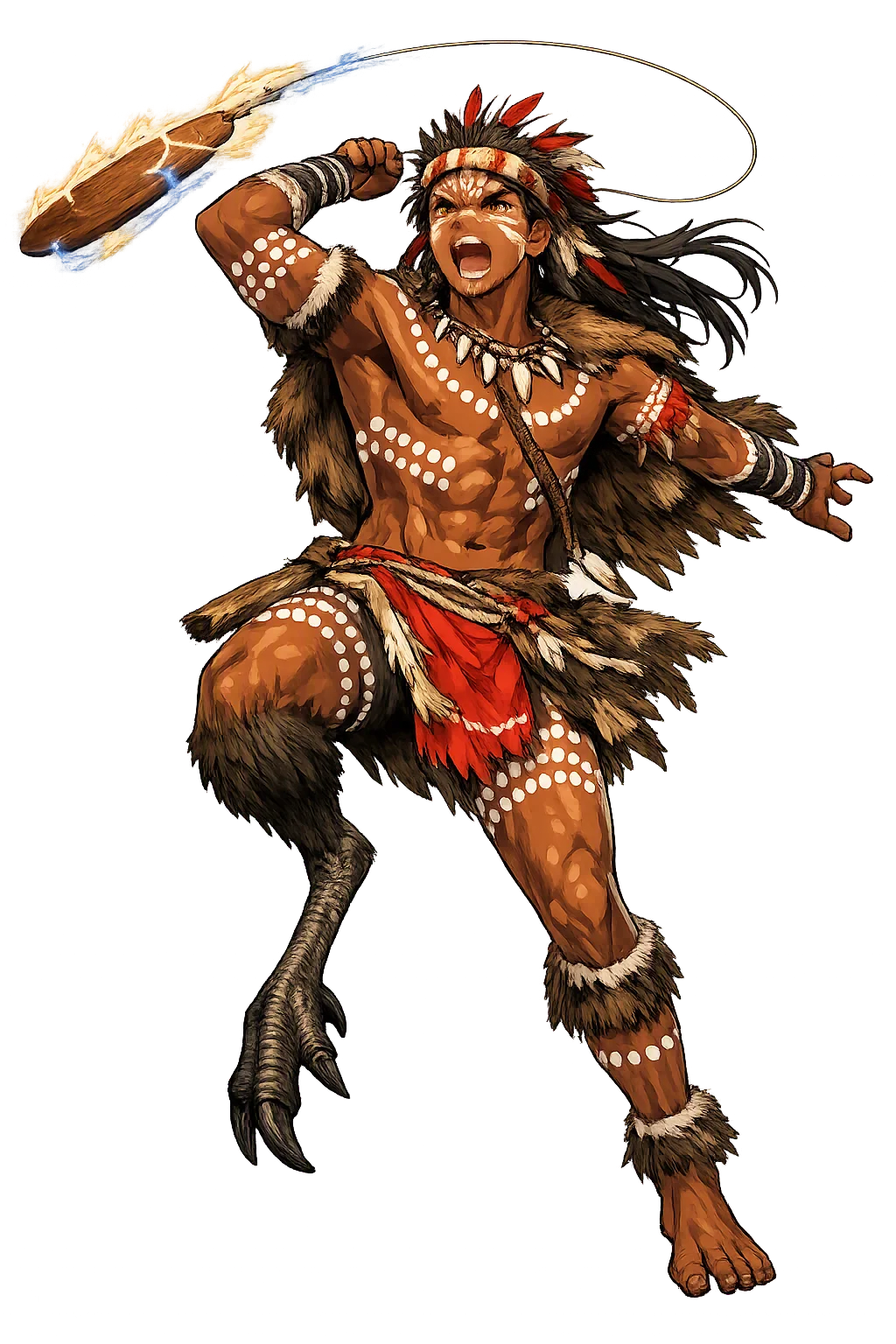
Daramulum is the one-legged son of Baiame, the great creator and sky father of several Aboriginal nations in southeastern Australia. He moves between earth and sky as an enforcer and teacher of the Law, presiding over the bora initiation ground where boys become men. His body is sometimes described as emu-like or one-legged, linking him to the dark silhouette of the emu that stretches across the Milky Way — the 'Emu in the Sky' that Aboriginal astronomers have used for millennia to mark seasons and ceremonies.

Unicode Restoration as Cultural Act

Restoring Daramulum in a domain name is more than orthographic accuracy. It is a statement that the internet should recognize the full range of human writing — not only the ASCII keyboard.

05

Frequently Asked Questions

Common questions about Daramulum, Sky Hero, Son of Baiame, and Unicode restoration

01How do you pronounce Daramulum?

In reconstructed pronunciation, Daramulum is /ˈdærəmʊləm/ — approximately 'DARR-uh-MOO-lum' — four even syllables, stress on the first, with the soft 'oo' of 'book' in the third and fourth syllables..

02What does Daramulum mean?

Daramulum means The one-legged in the aboriginal tradition.

03What are the symbols of Daramulum?

Daramulum is associated with Boomerang (Emblem of initiation, return, and the lawful exchange between earth and sky; also a weapon associated with Daramulum's authority.), Emu (His one-legged or emu-footed form; the dark emu in the Milky Way is read as his celestial body.), Bora ring (The sacred ground where initiation is performed and where Daramulum's presence is invoked.), Centre of the Milky Way (The camp or turning-place of Daramulum and Baiame in the sky; a focus of southeastern Aboriginal astronomy.).

04Why restore Daramulum in Unicode?

Plain ASCII daramulum strips the stress, length, and script that make the name specific. Unicode restoration returns the name to its original written dignity.

05What is the most important myth about Daramulum?

Daramulum is the son of Baiame, the creator and sky father. Accounts collected in the Sydney region describe him as a being of strange form — sometimes one-legged, sometimes with an emu's foot — who serves as his father's messenger and enforcer. His unusual body is not a deformity but a sign of his other-than-human nature and his connection to the emu, a bird that stands on one leg and that appears in the sky as a dark constellation.

06

Scholarly Sources

The philological foundations of this restoration

Every claim on this page is grounded in established scholarship. The orthographic restorations follow disciplinary convention. The etymological chain follows the best available reference works. This is not invention — it is resurrection through scholarship.

Lexicography & Philology

  • AIATSIS
  • Parker

Primary Texts

  • Primary sources in the aboriginal tradition for Daramulum.

Archaeology & Art History

  • Material evidence — iconography, inscriptions, and temple archaeology — for Daramulum and related cults.

Religious Studies

  • Parker, K. Langloh, The Euahlayi Tribe: A Study of Aboriginal Life in Australia, Archibald Constable, 1905
  • Berndt, Ronald M. and Catherine H. Berndt, The World of the First Australians: Aboriginal Traditional Life: Past and Present, Lansdowne Press, 1964; revised 1992
  • Elkin, A. P., The Australian Aborigines: How to Understand Them, Angus & Robertson, 1938; subsequent editions
  • Australian Institute of Aboriginal and Torres Strait Islander Studies (AIATSIS), Aboriginal Australia map and language resources
  • Fuller, Robert S. et al., 'The Emu Sky Knowledge of the Aboriginal Australians,' Journal of Astronomical History and Heritage, 2014
Return

The Surface Awaits

You have traced the name from its earliest attestation to its Unicode restoration. Now return to the myth. The story is where the name lives.

Back to Lore
Daramulum mascot