
The Cult
The modern Celtic revival keeps her cult — the seasonal gatherings and the mother-goddess invocations. The medieval tradition venerated her line at the sídhe-mounds; the fairy-legend itself is her oldest surviving liturgy.
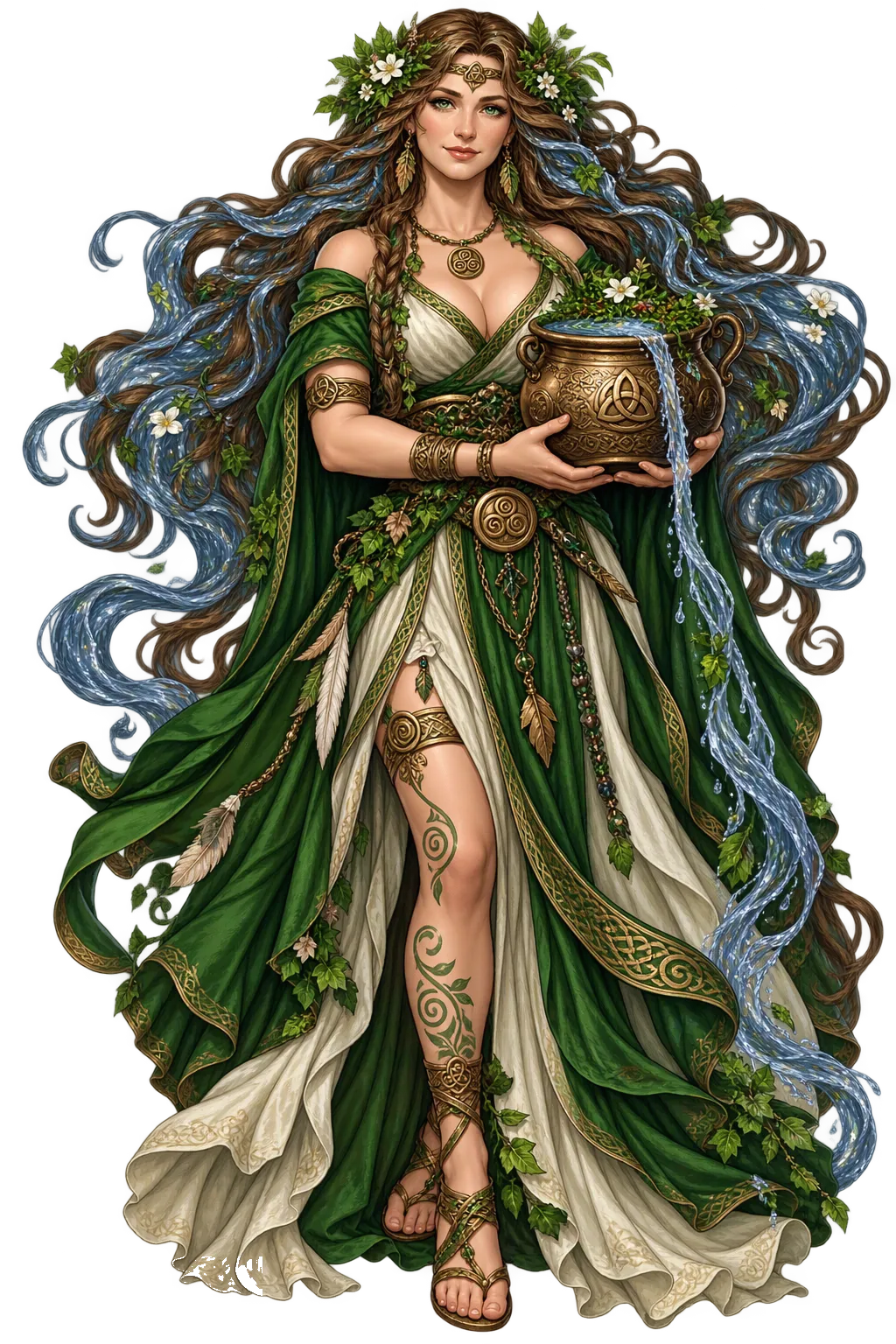
Essential information about Danu, Mother Goddess, Rivers
From original script to Unicode restoration
The name Danu reaches the modern world through scholarly transliteration of the celtic tradition. Because the conventional spelling uses only Latin letters, its Unicode and ASCII forms coincide — the tradition it carries is in the name itself, not in diacritics.
Character-by-character philological analysis
| Character | Unicode | Name | Block | Phonetic Role |
|---|---|---|---|---|
| D | U+0044 | Latin Capital Letter D | Basic Latin | Same, capitalized |
| a | U+0061 | Latin Small Letter A | Basic Latin | Same |
| n | U+006E | Latin Small Letter N | Basic Latin | Same |
| u | U+0075 | Latin Small Letter U | Basic Latin | Same |
This restoration reflects fidelity to the attested tradition, not recovered diacritics: every character of Danu already survives in ASCII. What the restoration preserves is the canonical spelling itself — the form scholarship standardised.
How the sacred was kept — rites, sanctuaries, remains
The modern Celtic revival keeps her cult — the seasonal gatherings and the mother-goddess invocations. The medieval tradition venerated her line at the sídhe-mounds; the fairy-legend itself is her oldest surviving liturgy.
Danu leaves no image — the medieval manuscripts give her no body. But the sídhe-hills of Ireland (Teamhair, Brú na Bóinne) are her race’s palaces, and the river-names across Europe are her signature.
How Danu was imaged across the ages
The river in flood, or the mother with the four treasures; in modern Druidic art, the flowing woman whose hair is the river-system. Her icon is the eponym itself — the race’s name, read backwards into the goddess.
The name after its own age — transmission, translation, survival
Comparative mythology’s river-mother paradigm runs from the Vedic Danu to the Celtic one — the same *dānu across the Indo-European world. Celtic studies treat her as the supreme example of the eponymous goddess: the mother known only through her children’s fame.
Danu is the Celtic branch of the Indo-European river-mother — kin to the Vedic Danu, mother of the demon Vṛtra in the Rigveda’s oldest combat, across the very language-family the names share. The Tuatha Dé Danann were euhemerized by the medieval Irish scholars into a people of sorcerers; the modern Celtic revival restored them to goddess-worship, with Danu as the primordial name.
Her name survives in the Tuatha Dé Danann’s — the divine race of every Irish legend of consequence — and in the river-network of Europe, the Danube most of all. The modern Druidic and Celtic-revival movements take Danu as the mother-goddess of their pantheon; and the sídhe-tradition she eponymizes is the ancestor of the world’s entire fairy-canon.
What Danu means — beyond the dictionary
Danu: the river-mother whose name flows through six European languages before it reaches this page. Restored plainly, it is the same word the Danube still spells with two syllables — the flowing one, the mother of a divine race, the water beneath the whole map.
Common questions about Danu, Mother Goddess, Rivers, and Unicode restoration
In reconstructed pronunciation, Danu is /ˈdɑːnuː/ — approximately “DAH-noo”.
Danu means Knowledge, wisdom in the celtic tradition.
Danu is associated with Mother of the Dé Danann (The divine race bears her name — the Tuatha Dé Danann, the peoples of the goddess Danu.), The River-Mother (Her name is the Indo-European *dānu — the same root as the Danube, the Don, the Dnieper.), The Northern Islands (Her race came from four northern cities — Falias, Murias, Gorias, Finias — bearing their four treasures.), Knowledge and Wisdom (Her gifts are the wisdom of the race — the cauldron, the spear, the stone, the sword of knowledge.).
Danu is written entirely in ASCII letters, so its restoration is about canonical fidelity rather than recovered diacritics: the temple fixes the name in its scholarly standard spelling, attested in the source tradition, instead of leaving it to drift.
“The Peoples of Danu Arrive” — the Lebor Gabála story that anchors the mythology of Danu, told in full on the lore page.
The philological foundations of this restoration
Every claim on this page is grounded in established scholarship. The orthographic restorations follow disciplinary convention. The etymological chain follows the best available reference works. This is not invention — it is resurrection through scholarship.
You have traced the name from its earliest attestation to its Unicode restoration. Now return to the myth. The story is where the name lives.
Back to Lore