The Living Myth
Mother Goddess, Rivers · Knowledge, Wisdom, Mother of the Tuatha Dé Danann · Knowledge, wisdom
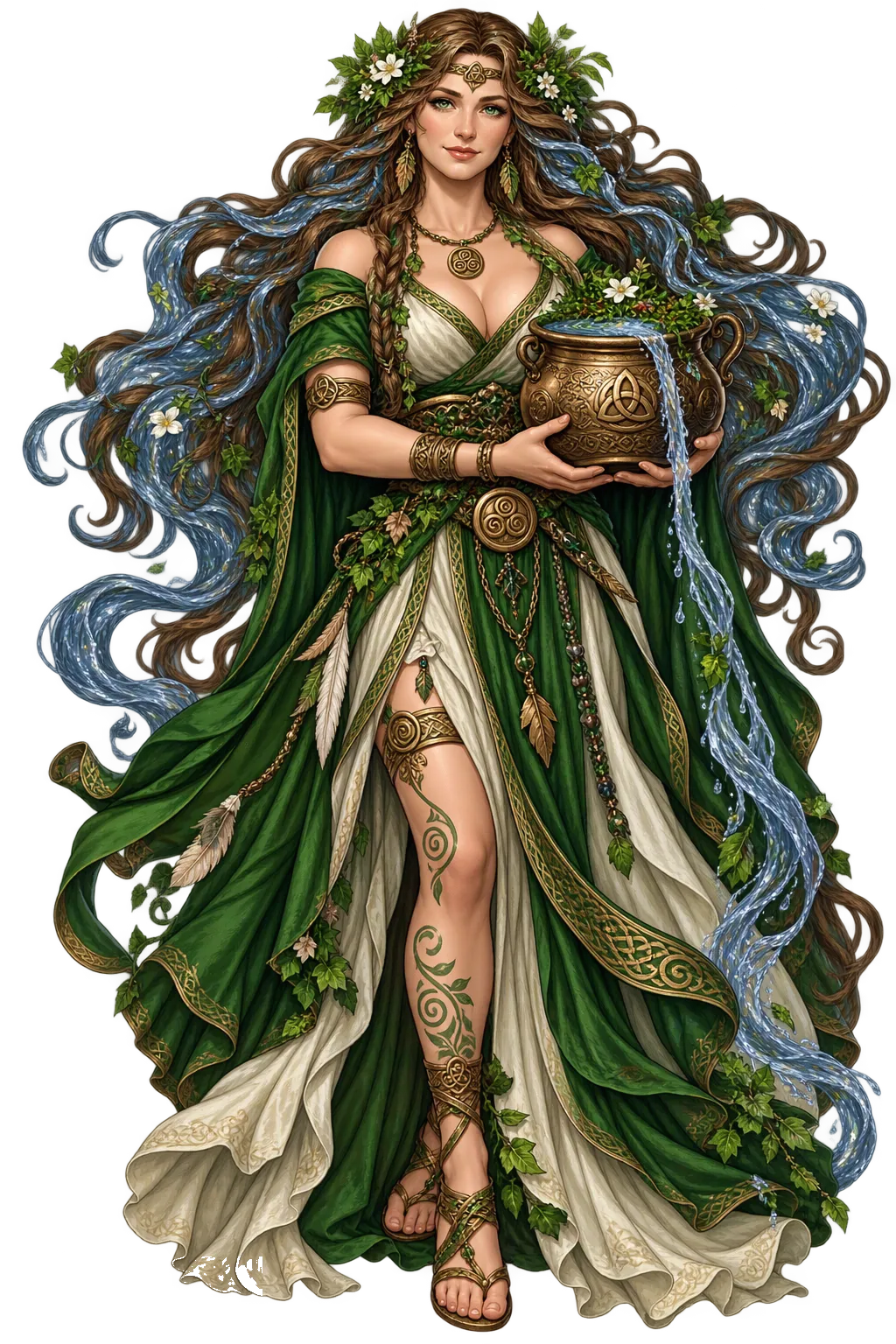
Stories of Danu
Danu’s mythology is peculiar: she is everywhere in the name and nowhere in the stories. The Tuatha Dé Danann — her peoples — fill the Mythological Cycle’s battles and sorceries, but their mother never takes the stage. Her biography is her children’s: the coming from the northern islands, the four treasures, the battles of Mag Tuired, and the fading into the sídhe, the hollow hills where the divine race retired when the sons of Míl took Ireland.
The Book of Invasions tells it as history: the Tuatha Dé Danann came from the northern islands in dark clouds, burned their ships behind them on the Irish shore, and contended for the island against the Fir Bolg and the Fomoiri. From each of the four cities they brought a treasure — the stone of Fál, the spear of Lugh, the sword of Nuadu, the cauldron of the Dagda — the four regalia of the divine race, each a gift of Danu’s line.
The race’s great war-cycle pits them against the Fomoiri, the sea-demons of chaos: Nuadu’s silver arm, Lugh’s many skills, the Dagda’s bottomless cauldron, and the Morrígan’s prophecy carry the day. Danu’s name stands over the whole cycle — the mother’s eponym on every battle-line, though she herself never draws a sword in the telling.
When the sons of Míl defeated the Dé Danann, the race did not die but withdrew — into the sídhe, the hollow hills of Ireland, where they keep their beauty and their treasure and their grievance, and from where they still interfere, bless, and curse. Danu’s peoples became the fairies of Irish tradition; their mother’s name contracted into the fairy-mounds’ oldest title.
The philology is the mythology here: *dānu, ‘the flowing one’, names rivers from the Danube to the Don to the Dnieper — the Indo-European river-mother’s name scattered across the map like water-systems. Irish Danu is the westernmost daughter of the family; her son the Dagda’s name has been read as ‘the good god’, the river’s generous flood made divine.
The River-Mother of the Divine Race
Danu is Ireland’s primordial mother-goddess: the eponym of the Tuatha Dé Danann, the ‘peoples of Danu’, the divine race who came from the northern islands to take Ireland in the island’s deepest legends. She herself barely appears in the texts — her children take every scene — but the race’s name keeps hers, and the river-name she shares with the Danube and the Don marks her as the Celtic river-mother, the flowing one beneath the whole family.
The divine race bears her name — the Tuatha Dé Danann, the peoples of the goddess Danu.
Her name is the Indo-European *dānu — the same root as the Danube, the Don, the Dnieper.
Her race came from four northern cities — Falias, Murias, Gorias, Finias — bearing their four treasures.
Her gifts are the wisdom of the race — the cauldron, the spear, the stone, the sword of knowledge.
From the original script to the living URL
Danu
The name survives in scholarly transliteration. Danu is the standard Celtic romanisation, documented in academic sources — “Knowledge, wisdom”. Because the spelling uses only Latin letters, the form is the same in both ASCII and Unicode.
No indigenous writing system is securely attested for individual celtic names. The form shown is a modern scholarly transliteration.
danu
The plain danu form is identical to the Unicode restoration. Because this name is already written in Latin letters, no diacritics, stress, or script information were lost — only capitalization differs.
Danu
The Unicode restoration does not need to recover lost marks for Danu. Its value is canonical spelling and consistent cataloguing, not the reconstruction of erased orthography. The domain is readable as-is to both DNS and humanity.
Danu.com
This restoration is written entirely in ASCII letters — no Punycode encoding stands between Danu and the DNS. The domain reads identically to machines and to human eyes.
The attested spelling family of Danu
Danu
The full Unicode restoration. danu.com is not in the PuniCodex collection — it is watched for release; if it drops, this temple upgrades to an owned flagship. Attested by Lebor Gabála, MacKillop.
How Danu was spoken
How Danu is preserved in writing
No indigenous writing system is securely attested for individual celtic names. The form shown is a modern scholarly transliteration.
Contribute scholarly provenance →The lore you have read is the living myth. Extended Lore opens the scholarly vault beneath it: the cult and its material remains, a history of the image, the name after antiquity, a meditation on what the name still means, and the full scholarly apparatus — etymology, orthography, sources.
Enter Extended Lore