
How Dagda got its accent back
The ASCII form dagda is missing something. Dagda restores the marks the source language used to distinguish this name from a thousand others — and those marks change how the name is read, pronounced, and understood. This post explains, with the full scholarly record behind it, what each restored mark preserves: the Celtic transcription evidence, the reconstructed sound, the myths the name carries, and the classification logic that separates Tier 1 restorations from Tier 2. By the end, the marks in Dagda will look less like ornaments and more like what they are — recovered evidence, pinned back in its proper place.
At a Glance
- Restored name: Dagda
- ASCII form: dagda
- Meaning: "The Good God (from Old Irish Dagde)"
- Domain of influence: Abundance, Strength, Magic
- Pantheon: Celtic
- Classification: Tier 2
Overview
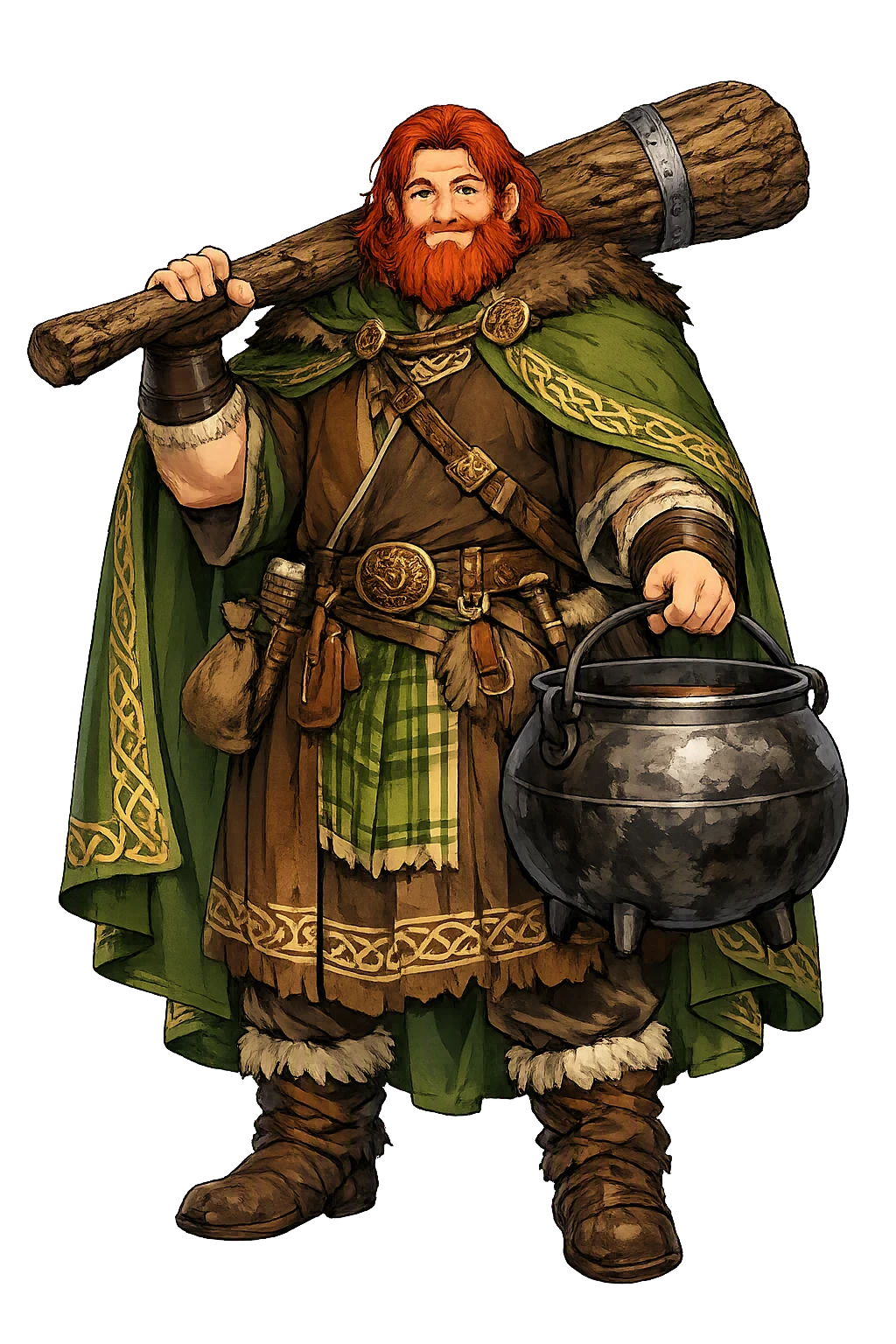
Dagda (dagda) — Abundance, Wisdom, Fatherhood · the Good God — is the great father-figure of the Túatha Dé Danann, the divine race of medieval Irish tradition: their king for eighty years, master of every art, and owner of the three wonders that define him — the club whose one end kills nine men at a blow while the other restores the slain, the cauldron from Murias that no company ever left unsatisfied, and the harp that leapt from the enemy's wall to his hand and played the three strains of weeping, laughter, and sleep.
Old Irish writes the name with the article, in Dagda — 'the Dagda' — and the tradition already explained it in the ninth century: Cormac's Glossary glosses him dago-dēwo-s, 'good god', where the 'good' is the craftsman's good, not the confessor's — he is good at things, all of them. His full style is Eochu Ollathir, 'Eochaid All-Father', and his dossier in Cath Maige Tuired is the largest of any Irish god: builder of Bres' forts, swallower of the Fomorians' porridge pit, lover of the Mórrígan at the ford of the Unius, and master of the harp on the wall.
PuniCodex restores the name as Dagda — identical to the ASCII input, because normalized Old Irish writes no diacritic in this name. The mechanical rule therefore places it in Tier 2: nothing distinctive is lost in transit, a statement about orthography and never about the god. No domain is claimed: the plain-ASCII dagda.com is registered to a third party outside the collection and is watched for release.
The Name
The theonym is attested in Old and Middle Irish as Dagda (later Daghdha), normally with the article — in Dagda, 'the Dagda' — a form that suggests the name functioned as a title before it functioned as a personal name. The medieval explanation is already in place by c. 900: Sanas Cormaic, the glossary of Cormac mac Cuilennáin, resolves the name as dago-dēwo-s, 'good god', and the modern etymological dictionaries — Vendryes' LEIA and the Dictionary of the Irish Language — still print essentially that compound: Proto-Celtic dagos, 'good', plus dēwos, 'god'.
The nuance the gloss hides matters. The 'good' of the Good God is not moral; the Irish tradition is explicit that he is good at things — every art, every craft, every stratagem — a god of competence rather than of virtue. His full ceremonial style Eochu Ollathir, 'Eochaid All-Father', and the epithet Ruad Rofhessa, 'the Red One of Great Knowledge', carry the two halves of his dossier: fatherhood and knowing.
The ASCII form dagda loses nothing, because the normalized Old Irish spelling is already plain Latin letters; the restoration is therefore a matter of canonical reference, not rescued diacritics, and the name is classified Tier 2 by the project's mechanical rule.
The letter-by-letter transformation runs:
- d → D — Same, capitalized
- a → a — Same
- g → g — Same
- d → d — Same
- a → a — Same
The project holds no domain for this name: dagda.com is registered to a third party outside the PuniCodex collection and is watched for release. The temple lives at its canonical lexicon address.
The Original Script
The name is preserved in medieval Irish manuscripts in the Latin alphabet as Dagda (with the article, in Dagda) — Old Irish / Middle Irish in Insular script, attested Old Irish, c. 7th–10th c. CE, in the glossaries and in the great codices that preserve Cath Maige Tuired and Lebor Gabála Érenn. The earlier monumental alphabet, ogham, predates the manuscript tradition, but no attestation of this theonym has ever been read on an ogham stone; the manuscript form is the primary witness.
The scholarly rendering proceeds step by step:
- Old Irish was written in the Latin alphabet using Insular minuscule from the early medieval period; the spelling Dagda requires no diacritic.
- The medieval glossaries already resolve the name: Sanas Cormaic gives dago-dēwo-s, 'good god', a compound the modern etymological dictionaries accept.
- Intervocalic g and d are lenited in pronunciation — [ɣ] and [ð] — but the orthography writes plain g and d; nothing distinctive is lost in ASCII.
- The Unicode restoration Dagda is therefore identical to the ASCII form apart from the capital; the temple form is a canonical reference, not a rescued spelling.
One caution attaches to the record: the 'good' of the Good God is competence, not morality — the glossaries' own tradition, and the one this edition follows.
Pronunciation
The reconstructed pronunciation of the name is /ˈdaɣ.ða/ — Old Irish Reconstruction.
Phoneme by phoneme:
- Da- — Broad dental stop [d] and short open [a], stressed on the first syllable as in all Old Irish
- -gda — Lenited [ɣ], the voiced velar fricative of Spanish lago; lenited [ð], the voiced dental fricative of English this; short final [a]
For the modern speaker, the closest approximation is: 'DAH-ghah' — the g melted into a gargle, the d into a soft 'th'; the modern Irish an Dagda keeps essentially this shape.
Kindred and historical forms of the name:
- Old Irish — in Dagda, 'the Dagda', with the article; full style Eochu Ollathir
- Cormac's Glossary — dago-dēwo-s, the medieval etymology
- Modern Irish — an Dagda, the unbroken living form
- Epithets — Ruad Rofhessa, 'the Red One of Great Knowledge'; the poets' 'Good God'
Dagda is Tier 2 because the restoration preserves nothing ASCII loses: the letters of the manuscript form are the letters of the keyboard. The capital alone marks the temple form.
Mythology
The Dagda's mythology is the fullest of any figure in the Túatha Dé Danann, and Cath Maige Tuired — the Second Battle of Mag Tuired — supplies its spine.
The Cauldron and the Kingship (Lebor Gabála; the Four Treasures)
The Túatha Dé Danann came to Ireland from four northern cities — Falias, Gorias, Finias, Murias — each with its treasure; from Murias came the Dagda's cauldron, of which the poem of the four jewels says no company ever went from it unthankful. The Lebor Gabála Érenn then gives him the divine race's longest reign: Eochu Ollathir, that is the Dagda, eighty years in the kingship, and records his death at the Brug from the wound Cethlenn, Balor's wife, dealt him at Mag Tuired.
The Builder of Bres' Forts (Cath Maige Tuired)
Under the tyranny of the half-Fomorian Bres, the greatest of the Túatha Dé Danann were put to serf-work: Ogma carried the firewood, and the Dagda built the raths. The satirist Cridenbél taxed him the three best bits of every meal until his health failed; Óengus's counsel — the pick of the cattle as wages, three gold coins hidden in the satirist's porridge — turned the trap, and Cridenbél died with the proof of his own greed in his belly.
The Porridge Pit and the Ford (Cath Maige Tuired)
Sent to the Fomorian camp before the battle, the Dagda was set a killing joke: a pit of porridge — eighty measures of new milk and the same of meal and fat, with goats, sheep, and swine boiled in — which he must finish or die. He finished it, scraped the pit with his ladle, and walked away with his belly dragging while the Fomorians laughed. That Samain night he met the Mórrígan washing at the ford of the Unius; they lay together, and she pledged herself to the Túatha Dé Danann's cause, promising the hearts of the Fomorian host and the blood of their king Indech. The place was afterward called the Bed of the Couple.
The Harp on the Wall (Cath Maige Tuired)
After the battle the Fomorians had carried off his harper Uaithne, and the harp — Daur Da Bláo, the Oak of Two Greens; Coir Cethar Chuir, the Four-Angled Music — hung on the wall of Bres' hall. Lugh, the Dagda, and Ogma pursued; the Dagda summoned the harp, and it sprang from the wall to his hand, killing nine men in its path. He played the three strains — the weeping-strain until their women wept, the laughing-strain until their youths laughed, the sleeping-strain until the host slept — and the three walked out through sleeping enemies.
The Day and the Night (Tochmarc Étaíne; De Gabáil in t-Sída)
Óengus is the Dagda's son by Bóand, wife of Elcmar of the Brug: to hide the affair the Dagda held the sun fast for nine months, so that the boy was conceived and born within a single day — whence mac ind Óc, 'the son of the young'. Years later, when the Dagda divided the síd-mounds among the Túatha Dé Danann, Óengus was away fostered with Mídir and received nothing; granted Brú na Bóinne for 'a day and a night', he kept it forever, on the plea that the whole world is spent in days and nights.
Symbols & Iconography
The Dagda's attributes are three working tools and one notorious meal — the largest and most functional regalia in the Irish corpus:
- The great club — So heavy it had to be dragged on a wheel; one end kills nine men at a blow, the other restores the slain to life — death and life hung on opposite ends of one tool
- The cauldron of Murias — The fourth treasure of the Túatha Dé Danann, from which no company ever went away unthankful — plenty as a standing fact
- The harp (Daur Da Bláo, Coir Cethar Chuir) — The Oak of Two Greens, the Four-Angled Music: it killed nine men coming to his hand, then played the goltraí, gentraí, and suantraí — weeping, laughter, and sleep
- The porridge pit — Eighty measures of milk and meal, the whole herd boiled in, poured into a hole in the ground: the Fomorians' mock-feast, swallowed whole
- Brú na Bóinne — The Brug on the Boyne, his Otherworld house, won from him by Óengus for 'a day and a night'
Archaeology & Evidence
The Dagda is a textual god: no ogham stone names him, no votive inscription invokes him, and Irish paganism generally left literature rather than dedications. His manuscript witnesses, however, are exact: Cath Maige Tuired survives uniquely in the sixteenth-century British Library MS Harley 5280, the basis of Gray's edition, while Lebor Gabála Érenn is preserved in the twelfth-century Book of Leinster and its sister codices.
His mythic address is one of the most famous pieces of architecture in Europe: Brú na Bóinne, the Bend of the Boyne, where the passage tomb of Newgrange (c. 3200 BCE) has stood for five thousand years on the site the tales call the Dagda's Brug and Óengus's síd. The nearest material kin of his iconography is Gaulish: the altar from Sarrebourg showing Sucellos with his mallet and pot beside Nantosuelta is the standard comparison for the good god with the club and the vessel — comparative evidence, never identification.
Realm & Domain
Dagda is catalogued under the domain 'Abundance, Wisdom, Fatherhood' — three words that map exactly onto his three treasures and his one great role.
Abundance
The cauldron from Murias is the type-case of Celtic plenty: the medieval poem of the four treasures says of it that no company ever went away from it unthankful. The porridge-pit episode is the same power viewed from the enemy's side — a capacity for provision so large the Fomorians mistook it for a joke.
Wisdom
He is Ruad Rofhessa, 'the Red One of Great Knowledge'; Cath Maige Tuired shows the knowing in action — the truce won at the porridge pit, the intelligence gained at the ford, the harp recovered by cunning rather than force.
Fatherhood
Eochu Ollathir, the All-Father: father of Óengus, Mídir, Bodb Derg, and Brigit, and the standing provider of the whole Túatha Dé Danann — the god whose table, by definition, never runs out.
The Good God of All Arts
The glossaries' etymology is itself a domain-statement: good at everything — king, builder, harper, warrior, lover, host.
Across Cultures
The Dagda's clearest cross-border witness is not Welsh but Gaulish. The Welsh corpus knows no counterpart of him — the Brythonic silence is total, and no scholar has repaired it convincingly; the comparison the handbooks prefer runs to the Gaulish Sucellos, 'the Good Striker', shown on altars with a long-shafted mallet in one hand and a pot in the other, often beside his consort Nantosuelta. Sjoestedt and Mac Cana both set Sucellos beside the Dagda — the good god with the enormous club and the vessel of plenty — as two regional faces of one Celtic figure-type: the all-providing father whose single tool serves both ends of life.
Within the Irish tradition his closest structural kin are the pantheon's other masters: Nuadu, the king whose silver arm he out-reigned; Lugh, the samildánach ('equally skilled in all arts') whose mastery mirrors his own; and the Mórrígan, whose Samain tryst made her his war-counsel. The Christian scribes who preserved him euhemerized him as an ancient king mighty in magic and druidry; the glossaries kept the name's meaning anyway — Sanas Cormaic was printing 'good god' by c. 900.
Cultural Legacy
The Dagda rode the Celtic revival better than almost any Irish god. Lady Gregory's Gods and Fighting Men (1904) carried Cath Maige Tuired into English — porridge pit, ford, and harp complete — and made him the genial giant of a generation's reading, the counterweight to the revival's more ethereal Sidhe. Twentieth-century scholarship gave him his modern standing: Mac Cana's Celtic Mythology made him the type-case of the Celtic all-skilled father, and the Sucellos comparison fixed him in the pan-Celtic frame.
Modern Druidry and Celtic pagan practice honor him as god of plenty, craft, and fatherhood; and Brú na Bóinne — Newgrange, the most visited prehistoric monument in Ireland — keeps his mythic address, the Brug of the Dagda that his son won for a day and a night. In Irish itself the name never went anywhere: an Dagda has meant the same large, shrewd, inexhaustible father of the gods for twelve hundred years of the written language.
The Scholarly Record
The account of the Dagda given in this edition rests on the witnesses and reference works listed below. Cath Maige Tuired supplies the narrative spine; Lebor Gabála the kingship and death; the glossaries and etymological dictionaries secure the name; the Gaulish material is cited for comparison only.
- Gray, Elizabeth A., ed. and trans., Cath Maige Tuired: The Second Battle of Mag Tuired, Irish Texts Society 52 (Naas: Irish Texts Society, 1982).
- Macalister, R. A. S., ed. and trans., Lebor Gabála Érenn, 5 vols. (Dublin: Irish Texts Society, 1938–56).
- Bergin, Osborn, and R. I. Best, ed. and trans., 'Tochmarc Étaíne', Ériu 12 (1938), 137–196.
- Hull, Vernam, ed. and trans., 'De Gabáil in t-Sída', Zeitschrift für celtische Philologie 19 (1933).
- Meyer, Kuno, ed., 'Sanas Cormaic: An Old-Irish Glossary', Anecdota from Irish Manuscripts 4 (Halle: Niemeyer; Dublin: Hodges, Figgis, 1912), s.v. Dagda.
- Vendryes, Joseph (gen. ed.), Lexique étymologique de l'irlandais ancien (Dublin: Dublin Institute for Advanced Studies, 1959–96), s.v. dagdae, dag.
- Dictionary of the Irish Language (Dublin: Royal Irish Academy, 1913–76; electronic ed. eDIL 2019), s.v. dagdae.
- Mac Cana, Proinsias, Celtic Mythology (London: Hamlyn, 1970).
- Sjoestedt, Marie-Louise, Gods and Heroes of the Celts, trans. Myles Dillon (London: Methuen, 1949).
- Stokes, Whitley, ed. and trans., 'The Second Battle of Moytura', Revue Celtique 12 (1891), 52–130, 306–308.
- Koch, John T., ed., Celtic Culture: A Historical Encyclopedia, 5 vols. (Santa Barbara: ABC-CLIO, 2006), s.v. Dagda.
- Gregory, Lady Augusta, Gods and Fighting Men (London: John Murray, 1904).
- McManus, Damian, A Guide to Ogam, Maynooth Monographs 4 (Maynooth: An Sagart, 1991).
A Meditation
The Dagda is the god of competence, and his name says so: the 'good' of the Good God is the goodness of the craftsman, not the confessor — he is good at things, all the things, and the tradition loves him for it without ever making him solemn. He is the only great god in the Irish corpus whom the myths allow to be ridiculous: belly dragging, porridge-smeared, out-argued by his own son, set to digging forts by a usurper. And every one of those scenes ends the same way — the job finished, the pit scraped clean, the truce won, the satirist buried by his own greed.
His three treasures are really one treasure in three keys. The club settles accounts at both ends of life; the cauldron makes sure the table never runs out; the harp keeps feeling itself in order — grief, joy, and rest, each in its strain. Provision, power, and harmony: the whole duty of a father, enlarged to divine scale. The Dagda asks the question every household answers daily — not whether you are good, but whether you are good for something, and whether there is enough.
The Unicode Restoration
Dagda is classified as Tier 2: the restoration needs no distinctive letters or diacritics its ASCII form would lose. The ASCII fallback dagda still resolves everywhere, but it is the restored form that carries the name's full information. That is the whole thesis of this temple: the marks are the message.
Why This Restoration Matters
The marks in Dagda were never lost; they were only waiting for a carrier that could hold them. Now that the carrier exists, the burden flips: every use of dagda is a choice to leave evidence on the table. The PuniCodex temple keeps the restored form in circulation — as a domain, a dataset entry, and a scholarly argument — so that the choice to use it stays easy. Accent by accent, macron by macron, that is how the original names come back: not with a single grand gesture, but with a spelling that finally works everywhere.
Explore Further
This post is one doorway into the temple. The home page carries the full character breakdown and the ambient canvas; the lore page tells the myths in long form; the Scholarly Edition preserves the sources, pronunciation data, and revision history; and the patron wall supports the restoration directly. For the wider map, browse the Lexicon, explore the Pantheon, or return to the PuniCodex blog.
Related Names
Sources
The full scholarly apparatus — every citation, revision, and review — lives in the Scholarly Edition. Key references for this post:
- Gray, Elizabeth A., ed. and trans., Cath Maige Tuired: The Second Battle of Mag Tuired, Irish Texts Society 52 (Naas: Irish Texts Society, 1982).
- Meyer, Kuno, ed., 'Sanas Cormaic: An Old-Irish Glossary', Anecdota from Irish Manuscripts 4 (Halle: Niemeyer; Dublin: Hodges, Figgis, 1912), s.v. Dagda.
- Vendryes, Joseph (gen. ed.), Lexique étymologique de l'irlandais ancien (Dublin: Dublin Institute for Advanced Studies, 1959–96), s.v. dagdae.
- Dictionary of the Irish Language (Dublin: Royal Irish Academy, 1913–76; electronic ed. eDIL 2019), s.v. dagdae.
- Lexicon authorities for this entry: Vendryes.