PuniCodex

Extended Lore

𐤃𐤂𐤍 Dāgān

Etymology · Orthography · Cult · Iconography · Reception · Sources

Tier 1 Dāgān.com · dāgan.com
Dāgān — Grain, Fertility
01

Quick Facts

Essential information about Dāgān, Grain, Fertility

Original Script𐤃𐤂𐤍
Unicode RestorationDāgān
Reconstructed Pronunciation/daːˈɡaːn/
PantheonPhoenician
DomainGrain, Fertility
MeaningGrain
ClassificationTier 1
Primary DomainDāgān.com
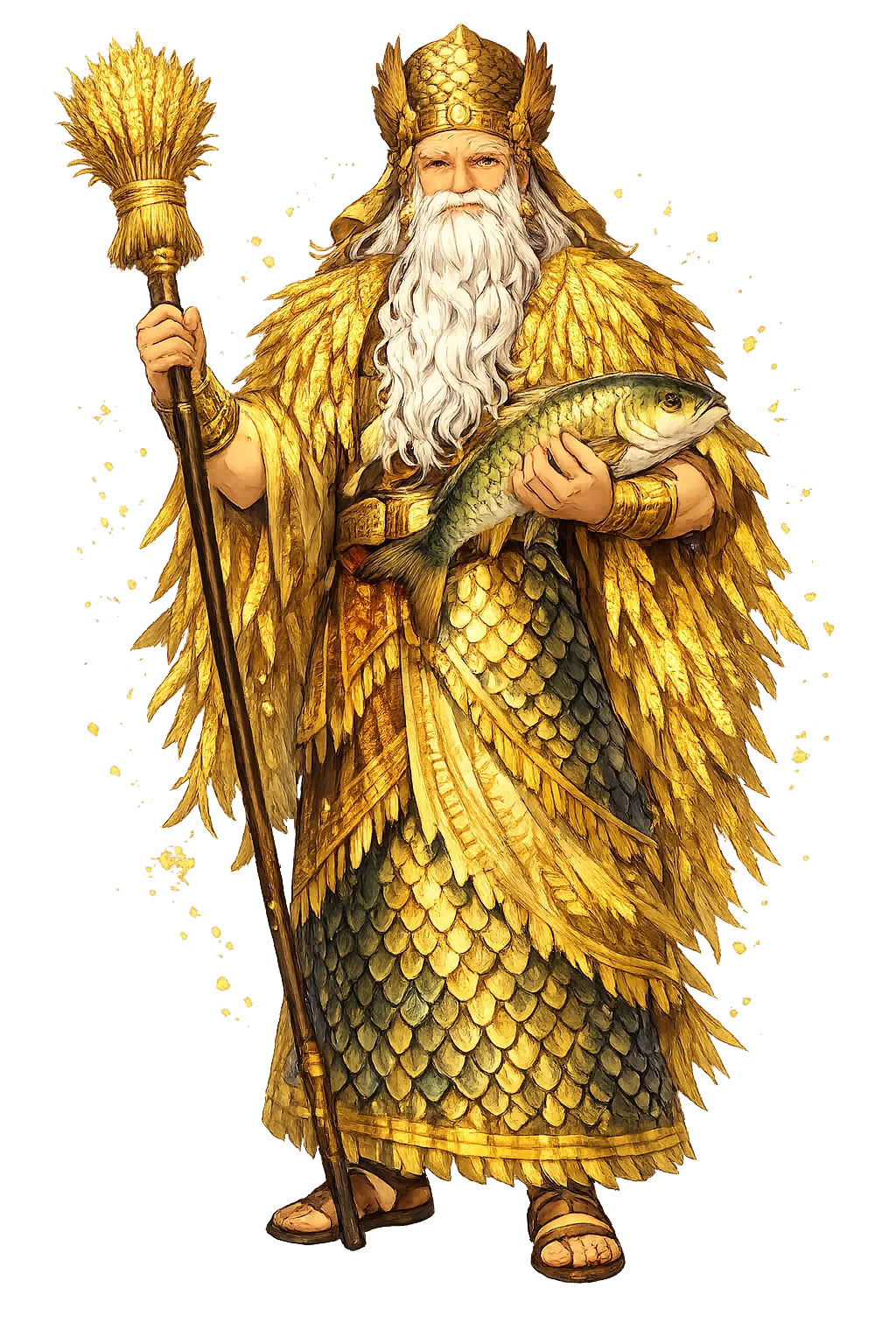
Sacred SymbolsSheaf of wheat or barley, Plowed field, Storehouse or granary, Bull or ram
02

Etymology & Word Family

From original script to Unicode restoration

Original Script 𐤃𐤂𐤍 Dāgān — "Grain"
Unicode Restoration Dāgān Restored stress, length, and script
Modern ASCII dagan Plain-ASCII fallback

The name Dāgān carries the orthographic signature of the phoenician tradition: 𐤃𐤂𐤍. Unicode restoration recovers what ASCII flattens.

03

Unicode Character Breakdown

Character-by-character philological analysis

CharacterUnicodeNameBlockPhonetic Role
DU+0044Latin Capital Letter DBasic LatinSame, capitalized
āU+0101Latin Small Letter A with MacronLatin Extended-AMacron: long /aː/
gU+0067Latin Small Letter GBasic LatinSame
āU+0101Latin Small Letter A with MacronLatin Extended-AMacron: long /aː/ (Dāgān)
nU+006ELatin Small Letter NBasic LatinSame

The Tier 1 classification reflects how much of the original phonology this restoration preserves — stress and vowel length for Greek names, distinctive letters and diacritics for every other tradition.

04

Cult & Worship

How the sacred was kept — rites, sanctuaries, remains

The Cult

Dāgan was one of the ancient Near East's most traveled gods. His earliest secure homes were inland: Tuttul on the middle Euphrates, where German excavations at Tell Bi'a uncovered a major temple precinct in the city identified with his cult center, and Mari, whose eighteenth-century BCE archives record kings seeking oracles from 'Dagan of Tuttul' on matters of rule and war; Ebla's archives already preserve royal dedications to him. At Ugarit the great temple beside the royal zone has long been attributed to him — Schaeffer's identification, never proven — and the palace rituals show the king anointing the temples of Baal and Dagan together. Southwest, the Philistines adopted him as a national patron: Scripture sets his temples at Gaza and Ashdod, the latter briefly captor of the ark. The through-line is grain — an agricultural god carried by traders, kings, and Sea Peoples alike, and installed wherever harvests decided survival.

In the Earth

At Ugarit (Ras Shamra), a large temple area by the royal zone has long been attributed to Dāgan — the identification goes back to Schaeffer's excavations, though the tablets name several temples and the attributions are not all secure. On the middle Euphrates, German excavations at Tell Bi'a (ancient Tuttul) uncovered a major temple precinct with connections to Dāgan's cult. The Mari tablets supply the textual layer: dedications and oracles spanning the eighteenth century BCE. In Philistia, the biblical temples at Gaza and Ashdod have never been securely located — the story of Samson's demolition is beyond archaeological reach — but Philistine material culture at sites such as Tel Miqne (Ekron) frames the milieu. The famous 'fish-god' Dagon is a medieval iconographic development without ancient Near Eastern support.

05

Iconography

How Dāgān was imaged across the ages

The Image

No image of Dāgan has ever been securely identified, and antiquity's only explicit descriptions come late and oddly. Philo of Byblos, preserved by Eusebius in the early fourth century, reports that the Phoenicians depicted Dagon with a fish's tail — a learned pun on the Semitic word for fish that probably says more about Philo's etymologizing than about cult statues. The Mishnah lists Dagon among forbidden cult-images, and the Talmud's discussion of his form — fishy and agricultural at once — shows later antiquity remembering a god of grain with a maritime accent. The reliable attribute is the harvest: sheaves, the threshing floor, the full storehouse. Early Assyriologists sometimes draped Mesopotamia's fish-cloaked apkallu figures in Dagan's name; the misidentification itself became part of his story, and later centuries turned the confusion into a sea monster.

06

Reception & Transformation

The name after its own age — transmission, translation, survival

Afterlives

Dāgan's afterlife runs through three resurrections. The first was biblical: as the Philistines' national god he entered Scripture twice — felled by Samson at Gaza, humiliated by the ark at Ashdod — and Jerome's Latin, followed by a thousand years of commentators, kept the riddle of his name alive. The second was Philo of Byblos, whose first-century Phoenician history, quoted by Eusebius, preserved a Levantine memory of Dagon behind the learned fish etymology. The third was modern and stratigraphic: in the 1930s E. A. Speiser's excavation at Tell Billa reached the temple quarter of the city identified with Tuttul, and the 1929 Ras Shamra tablets added the shock — Baal was 'son of Dagan'. The enemy's god of the Bible became the grain-father of Canaanite poetry. Twentieth-century scholarship redrew his map: the Mari scholarship of Jean-Robert Kupper, Johannes de Moor's work on Ugaritic ritual, Mark Smith's studies of divine translation across the Bronze Age. The name meanwhile did quieter work — Hebrew dāgān, 'grain', still feeds its speakers daily, a god dissolved into a noun so common his presence became invisible.

Identifications Across Traditions

Dāgan's cult spread from Mesopotamia to the Levantine coast and was adopted by the Philistines after their settlement in Canaan — a grain god inherited, or seized, as a national patron. The Hebrew noun dāgān, 'grain,' shares his root, though which came first — the god from the word or the word from the god — is undecidable. Some ancient interpreters, hearing the echo of dāḡ, 'fish,' invented a fish-god: the medieval and early modern image of a half-man, half-fish Dagon is that pun's long afterlife, with no support in the older Northwest Semitic evidence. In Ugarit the syncretism runs the other way: Dāgan is the father of Baal, marrying agricultural fertility to the storm in a single divine household — the Levant's quietest and most consequential theological merger.

Modern Legacy

Dāgan survives in the Bible as the Philistine god toppled by Samson and humbled by the ark, and his name echoes in the Hebrew word for grain. In modern fantasy and role-playing games, 'Dagon' often appears as a tentacled or fish-like sea monster — a distortion of the ancient grain god produced by the medieval iconographic confusion. For scholars of religion he is a key case study in how an agricultural deity becomes a national patron and then a symbol of the enemy's false confidence. And the word itself never stopped feeding people: every speaker of Hebrew who says dāgān for grain is keeping the god's name in daily use, four thousand years after his first altar.

07

The Meditation

What Dāgān means — beyond the dictionary

Dāgan is the god of the harvest, the silent partner in every loaf of bread. He asks us to notice that civilization rests on grass: wheat and barley tamed, sown, reaped, and ground. In a world of industrial food systems, Dāgan reminds us that fertility is not a commodity but a relationship between soil, seed, rain, and human labor. To remember him is to remember the sacredness of daily bread.

08

Frequently Asked Questions

Common questions about Dāgān, Grain, Fertility, and Unicode restoration

01How do you pronounce Dāgān?

In reconstructed pronunciation, Dāgān is /daːˈɡaːn/ — approximately DAH-ghan — both the first 'a' is long like 'father,' and the second 'a' is short; stress falls on the long first syllable.

02What does Dāgān mean?

Dāgān means Grain in the phoenician tradition.

03What are the symbols of Dāgān?

Dāgān is associated with Sheaf of wheat or barley (The grain that is Dāgan's gift and the basis of Levantine agriculture), Plowed field (The cultivated land made fertile by his blessing), Storehouse or granary (The surplus that allows cities, armies, and temples to endure), Bull or ram (A symbol of agricultural potency and royal sacrifice).

04Why restore Dāgān in Unicode?

Plain ASCII dagan strips the stress, length, and script that make the name specific. Unicode restoration returns the name to its original written dignity.

05What is the most important myth about Dāgān?

“The Blessing of the Storehouse” — the Ugaritic Cult story that anchors the mythology of Dāgān, told in full on the lore page.

09

Scholarly Sources

The philological foundations of this restoration

Every claim on this page is grounded in established scholarship. The orthographic restorations follow disciplinary convention. The etymological chain follows the best available reference works. This is not invention — it is resurrection through scholarship.

◈

Lexicography & Philology

  • Ugaritic texts
  • CIS
◎

Primary Texts

  • Baal Cycle, KTU 1.1–1.6 (Baal as bn dgn)
  • Hebrew Bible, Judges 16:23–30
  • Hebrew Bible, 1 Samuel 5:1–7
◉

Archaeology & Art History

  • Material evidence — iconography, inscriptions, and temple archaeology — for Dāgān and related cults.
✦

Religious Studies

  • Mari archives, oracles of Dāgan of Tuttul (ARM)
  • Michael D. Coogan, Stories from Ancient Canaan
  • Mark S. Smith, God in Translation: Deities in Cross-Cultural Discourse in the Biblical World
Return

The Surface Awaits

You have traced the name from its earliest attestation to its Unicode restoration. Now return to the myth. The story is where the name lives.

Back to Lore
Dāgān mascot