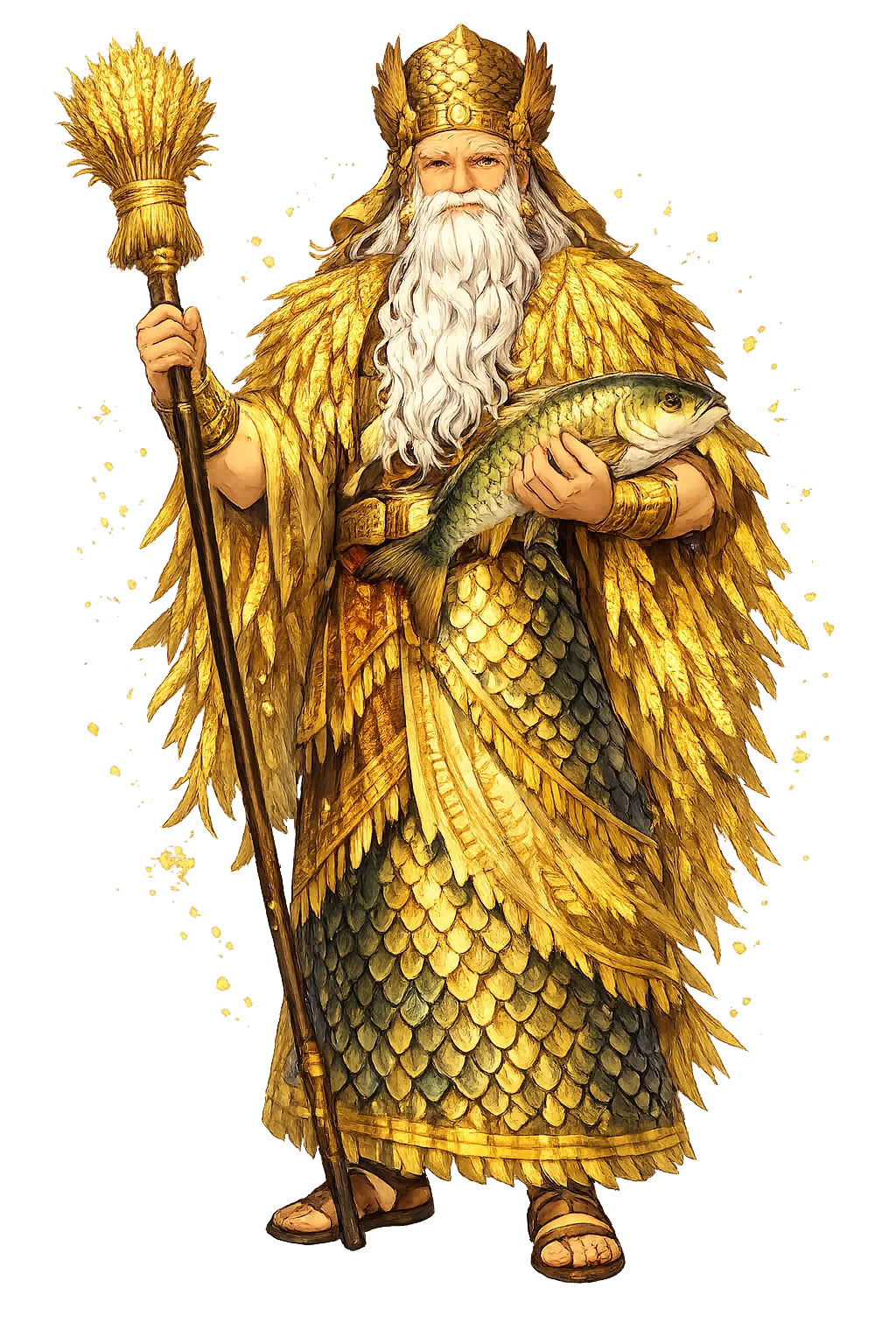
Stories of Dāgān
Dāgan is a father figure rather than a warrior. In the Ugaritic texts he receives offerings and grants blessings; in the Hebrew Bible he is a foreign god whose temples symbolize Philistine power — and fall. His myths are few, but his importance is immense: he is the god of the staple crop on which every Near Eastern society depended.
The Ugaritic tablets never tell a story about Dāgan; they do something more like accounting for him. Offering lists and ritual texts record his sacrifices at planting and harvest, and throughout the Baal Cycle (KTU 1.1–1.6) the storm god is styled bn dgn, 'son of Dāgan' — even when the plot sends messengers hurrying 'to the house of Dāgan' to announce Baal's victories (KTU 1.3 III). His temple stood among the great shrines of Ugarit, and his cult city Tuttul, on the middle Euphrates, gave him a second throne older than the city itself. The picture is of a god who sits at the center of the economy rather than at the center of the plot: the father of the storm because the storm is only the rain; the rain is only the grain; and the grain is his. Baal rides the clouds, but Dāgan owns the granary they fill — in a Bronze Age city, the more quietly tremendous office.
Judges 16:23–30 sets the scene in the temple of Dagon at Gaza, where the Philistine lords have gathered 'to offer a great sacrifice to Dagon their god and to rejoice,' saying 'our god has given Samson our enemy into our hand.' They call the blinded prisoner out to entertain them — 'about three thousand men and women' crowding the roof to watch. Samson prays for his strength back, embraces the two central pillars, and pulls the house down on the lords and all the people, dying with them. The narrative is the Bible's blackest comedy of divine irony: the victory feast becomes the funeral, the captive becomes the demolition, and the god's temple becomes his people's tomb. For the storytellers of Israel, Dagon's feast is what idolatry looks like from inside the rubble — power holding a banquet on a load-bearing floor.
In 1 Samuel 5 the Philistines carry the captured ark of the covenant into Dagon's temple at Ashdod and set it beside his image. The next morning the image lies face down before the ark; they set it back, and the next morning it lies again, this time with head and hands cut off on the threshold, 'only Dagon's trunk was left to him.' The temple priests thereafter 'do not tread on the threshold of Dagon in Ashdod to this day' — the biblical writer etiologizes a cult custom from the wreckage. Then tumors break out on the city, and the ark is rushed from Ashdod to Gath to Ekron, pursued by plague wherever Dagon's honor tried to hold it. The two shrines are a collision of economies: the grain-god's house of plenty against the God who owns the lightning, and the episode's verdict is delivered in carpentry — the idol ends in pieces at its own front door, in the place its priests were afraid to step.
Eighteen centuries before the Bible's stories, the archives of Mari on the Euphrates show Dāgan already enthroned. The correspondence of King Zimri-Lim records oracles of 'Dāgan of Tuttul' confirming his kingship and directing his wars; kings and nomad sheiks alike bring dedications to the god who rules both the settled strip and the steppe beyond it. His title at Mari is essentially territorial — Dāgan of this city, of that bank — a god whose jurisdiction is written in place-names, the oldest form of political theology in Mesopotamia. That a grain-god's oracle should crown a king is no surprise once the economics are seen: sovereignty is the right to eat, and the god of the harvest is the god of the realm. From Mari to Gaza, Dāgan's real biography is the slow migration of that single insight — whoever feeds the people is the father of the state.
Fertility, Agriculture, and Divine Fatherhood
Dāgan is the grain god of the ancient Levant, the divine power who fills the storehouses and makes the fields fertile. In Ugaritic myth he is the father of Baal and the patron of the agricultural cycle; in Philistine religion he is the national god whose temple Samson pulls down. His domain is not the storm on the mountain but the quiet miracle by which seed becomes bread.
His name and cult center on wheat, barley, and the harvest that sustains city and village alike.
In Ugaritic texts Dāgan is Baal's father, grounding the storm god's power in the agricultural cycle.
A major temple area at Ugarit has long been attributed to Dāgan, receiving royal offerings.
Worshipped by the Philistines as a national god; his temples at Gaza and Ashdod are broken by Israel's heroes.
From the original script to the living URL
𐤃𐤂𐤍
The name in its original Phoenician form. Dāgān (𐤃𐤂𐤍) is attested in the source tradition — “Grain”. Its macron-length vowels carry the full phonetic and orthographic weight of the source tradition.
dagan
Reduced to plain dagan, the name loses everything that made it specific: macron-length vowels. What remains is an ASCII string that machines can parse but that no longer speaks with its original voice.
Dāgān
The Unicode restoration recovers what ASCII flattened. Dāgān restores macron-length vowels, returning the name to its original written dignity. The domain encodes to Punycode, but the browser displays the truth.
Dāgān.com → xn--dgn-1oab.com
The non-ASCII characters in Dāgān are encoded while the ASCII remains visible. To the DNS, it is Punycode. To humanity, it is Dāgān.
Owned, ideal, and ASCII forms of Dāgān
Dāgān
Restores 𐤃𐤂𐤍. The live temple domain — dāgān.com.
dāgan
Restores 𐤃𐤂𐤍. A second live spelling — dāgan.com.
dagan
Flattens 𐤃𐤂𐤍. The plain ASCII fallback — what DNS and legacy systems see.
How Dāgān was spoken
How Dāgān travels from ancient script to the modern URL
Semitic dgn “grain"; Dāgan is a grain and fertility god worshipped across the Levant and Mesopotamia.
The lore you have read is the living myth. Extended Lore opens the scholarly vault beneath it: the cult and its material remains, a history of the image, the name after antiquity, a meditation on what the name still means, and the full scholarly apparatus — etymology, orthography, sources.
Enter Extended Lore