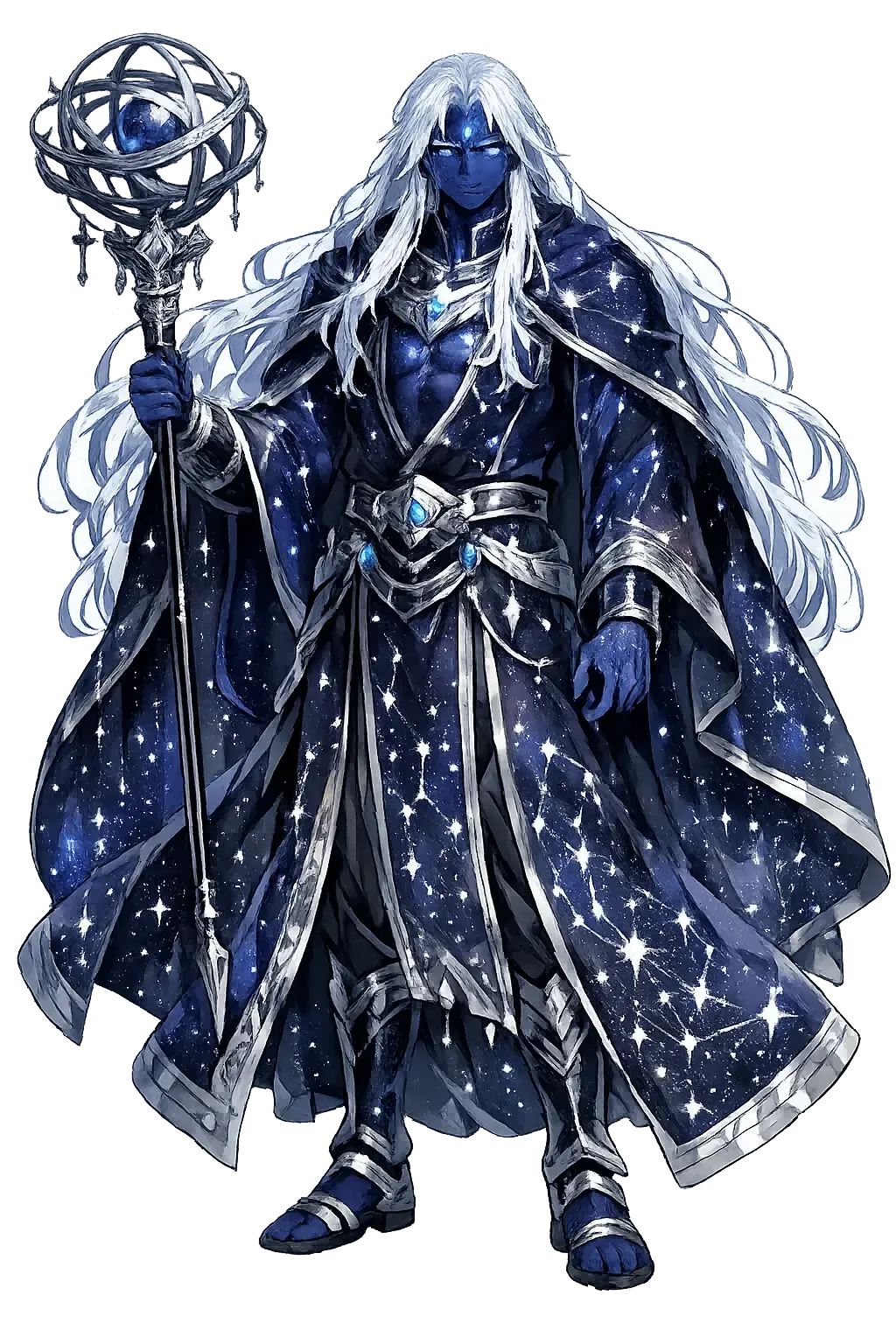
Stories of Koîos
Koîos has no independent mythic biography; he exists in Hesiod's genealogies and in the shadow of the Titanomachy. Yet his name — plausibly 'the questioner' — and his luminous daughters give him a quiet, intellectual importance: through Lētō he becomes grandfather of Apollo and Artemis.
Hesiod gives Koîos his entire childhood in a few lines: he is a son of Ouranos (Sky) and Gaia (Earth), born among the twelve Titans whom the wide-seeing son of Earth bore (Theogony 132–138). When Ouranos was overthrown, the Titans' turn came to hold the cosmos — and Koîos held the north. He married his sister Phoibe, 'the Bright One' (Theogony 404–406), and she bore him two daughters: dark-gowned Lētō and Asteria, 'the Starry One', ancestress of the island Delos and the goddess Hekate (Theogony 404–410). A genealogy this spare is itself the myth: a god of questioning weds a goddess of brightness, and their children are Night's gentlest and wildest lights — the mother of the Delian twins, and the ancestress through whom Hekate descends. The Titan of the north fathers the line that will carry the Olympian lights.
When Zeus led the younger gods against the old order, Koîos fought with his brothers, and the war shook the cosmos. Hesiod's Titanomachy (Theogony 617–735) thunders with the detail: the hundred-handed Hekatoncheires hurling mountains, the sea roaring, the sky itself groaning under the strain. Victory went to the Olympians, and the defeated Titans were hurled down into misty Tartaros, imprisoned behind bronze gates beneath the roots of earth and sea (Theogony 717–745). Koîos's individual fate is never narrated — Homer and Hesiod pass over him in silence, and later mythographers supply nothing reliable. The omission may itself be the message: in the war of generations, the thinker among the Titans was among the first things the new order consigned to obscurity, remembered only through the genealogies of his luminous daughters.
Later antiquity, unwilling to leave a Titan nameless, gave Koîos a cosmic office: Polus, the celestial pole. The equation belongs to late antique and Renaissance mythography rather than to any early Greek text — the scholiasts and Latin compilers were mapping the Titans onto the physical cosmos, and the still point of the northern sky needed a Titan to hold it. As Polus, Koîos becomes the invisible axis around which the whole sphere of the fixed stars revolves each night, the cardo mundi that never moves. The identification is interpretive, not canonical — but it is a genuinely illuminating error: it makes the questioning Titan the pivot of cosmic order, the fixed point against which all heavenly inquiry is measured. Medieval star-lore and Renaissance genealogies of the gods kept the equation alive, and it survives in every modern dictionary that glosses Koîos with 'the pole'.
Koîos's immortality is genealogical. Through his daughter Lētō — 'daughter of famed Koîos' (Hesiod, Theogony 918) — he is grandfather of Apollo and Artemis, the two brightest deities of the new dispensation. The line even touches Delphi: Aeschylus, in the prologue of the Eumenides (1–8), traces the oracle from Gaia through Themis to Koîos's own wife Phoibe, who hands it to Apollo as her gift. And Lētō's story binds the old generation to the new by force: hunted by Hera's jealousy over the whole earth, she found no resting place until the wandering island Delos — Asteria's daughter, some say — received her, and there Apollo and Artemis were born (Homeric Hymn to Apollo). The myth keeps a quiet score: the defeated generation's questioning and brightness were not destroyed but inherited — Koîos asks, and his grandchildren answer.
Intellect, the North, and the Celestial Axis
Koîos is one of the most obscure Titans: a god of questioning, intelligence, and the northern pillar of the sky. His name may be connected to the Greek word for inquiry, and later antiquity identified him with Polus, the celestial pole around which the heavens turn. He is the ancestor, through Leto, of Apollo and Artemis.
His name links him to inquiry, curiosity, and the unsettling power of asking.
Later identified with Polus, the invisible axis of the revolving sky.
Through Leto and Zeus he becomes grandfather of Apollo and Artemis.
As a Titan he belongs to the generation that held the cosmos before Zeus.
From the original script to the living URL
Κοῖος
The name in its original Greek form. Koîos (Κοῖος) is attested in the source tradition — “Questioning, inquiry”. Its diphthongs and acute accents carry the full phonetic and orthographic weight of the source tradition.
coeus
Reduced to plain coeus, the name loses everything that made it specific: diphthongs and acute accents. What remains is an ASCII string that machines can parse but that no longer speaks with its original voice.
Koîos
The Unicode restoration recovers what ASCII flattened. Koîos restores diphthongs and acute accents, returning the name to its original written dignity. The domain encodes to Punycode, but the browser displays the truth.
Koîos.com → xn--koos-1pa.com
The non-ASCII characters in Koîos are encoded while the ASCII remains visible. To the DNS, it is Punycode. To humanity, it is Koîos.
Owned, ideal, and ASCII forms of Koîos
Koîos
Restores Κοῖος. The live temple domain — koîos.com.
coeus
Flattens Κοῖος. The plain ASCII fallback — what DNS and legacy systems see.
How Koîos was spoken
How Koîos is preserved in writing
A bespoke provenance study for Koîos is being prepared by the PUNICODEX scholarly team.
Contribute scholarly provenance →The lore you have read is the living myth. Extended Lore opens the scholarly vault beneath it: the cult and its material remains, a history of the image, the name after antiquity, a meditation on what the name still means, and the full scholarly apparatus — etymology, orthography, sources.
Enter Extended Lore