
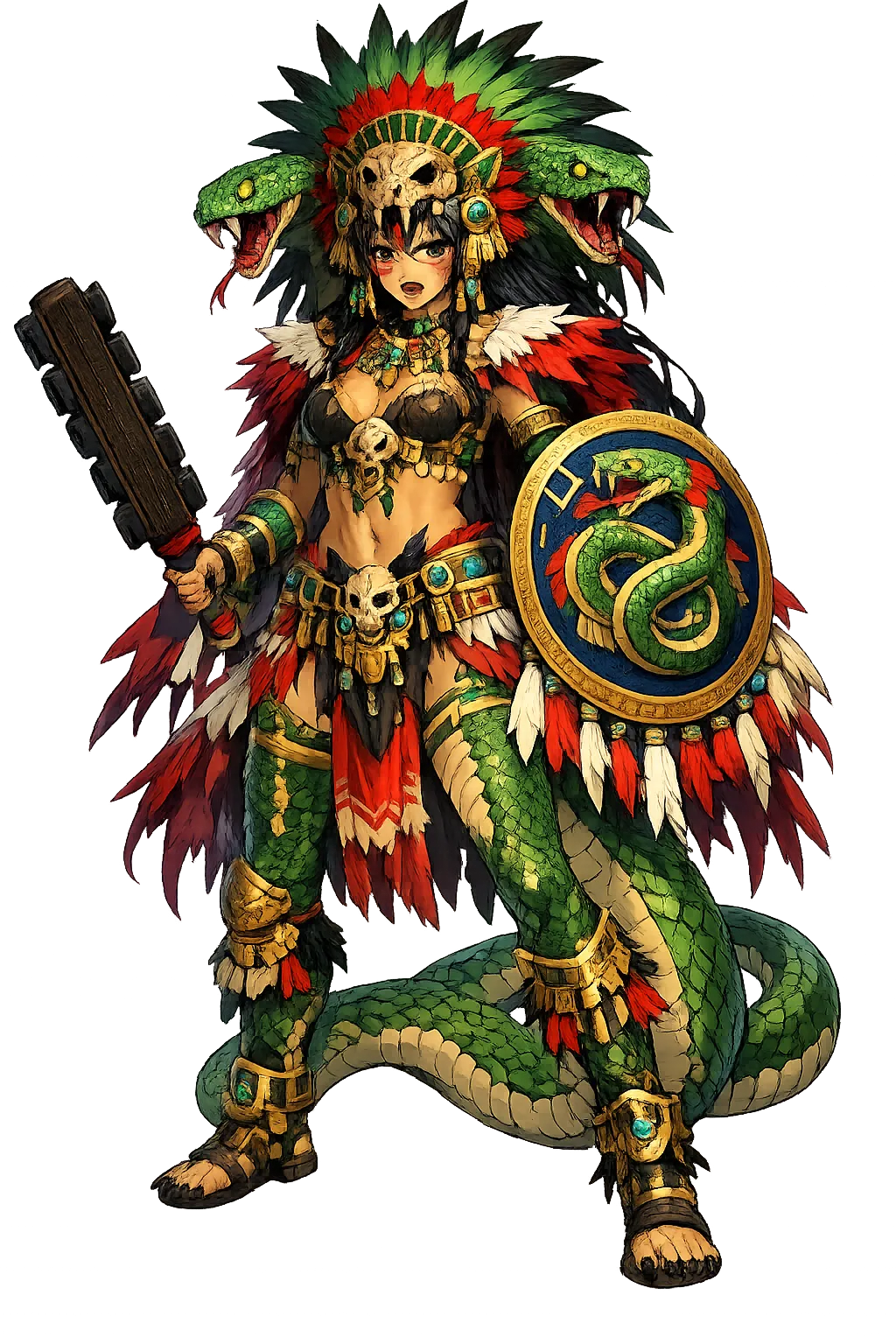
How Cihuacōātl was rebuilt, mark by mark
From the restoration bench — the working notes on Cihuacōātl, kept because the process is the proof.
What We Found
The attestation runs through the tradition's own sources: —. Meaning: "Snake Woman".
The figure behind the name: Cihuacōātl's mythology is preserved in the birth rituals recorded by Sahagún and in the widespread Mexican legend of the weeping woman.
What the Name Carried In
The Midwives’ Prayer. Sahagún’s informants describe how the midwife received the newborn as a captive taken in sacred battle: the child, they said, had been chosen in the land of the dead by the gods and delivered into the midwife’s hands. She addressed the infant as a warrior arriving from the sky, invoked the divine protectresses of the birthing chamber — among them Cihuacōātl — cut the umbilicus over an open vessel, and buried the afterbirth in the corner of the house as an offering.
The Cihuapipiltin and the Crossroads. Women who died in childbirth — above all in a first labor — were believed to become cihuāpīpiltin, “noble women,” spirits of enormous and ambivalent power. They wandered at night dressed in white, faces chalked, hair loose, weeping at crossroads and waterways for the children they had lost; they could seize or strike men who mocked them, appear as omens of war, and visit fathers in dreams.
A spelling that has to carry stories like these is not a label. It is equipment.
Where It Stood Before Us
Cihuacōātl is not represented by a single monumental sculpture comparable to Cōātlīcue, but her presence is documented in the birth rituals recorded by Sahagún, in ceramic figurines of women in childbirth, and in the large corpus of Nahuatl ritual speech preserved in colonial manuscripts. Cross-cultural parallels with Maya childbirth deities and with colonial-period ex-votos suggest a long history of female-divine assistance at birth in Mesoamerica. The bench inherits all of it — the web temple is the newest site, not the first.
What We Kept
The evidence, mark by mark — 2 features the keyboard form cihuacoatl cannot hold:
- o → ō — Macron on o. Kept.
- a → ā — Macron on a. Kept.
What We Rejected
cihuacoatl as the primary form. It survives as the convenience it is; it does not get to lead. The hierarchy is full restoration first, and this name can afford to stand at the top of it.
What We Set Down
Cihuacōātl — What survives here cannot be shown in ASCII: a feature of the original that the fallback alphabet flattens. That is the Tier-1 test, and this name passes it without argument.
For the voice: 'see-wah-KOH-ahtl' — the first vowel is short, the 'c' is a hard 'k,' and the final -tl is one crisp tongue-stop.
The temple stands at /cihuacoatl/ — the notes above are public in its Scholarly Edition, sources and all.
At a Glance
- Restored name: Cihuacōātl
- ASCII form: cihuacoatl
- Meaning: "Snake Woman"
- Domain of influence: Childbirth, Motherhood, Earth
- Pantheon: Nahuatl
- Classification: Tier 1
- Original script: —
- Series: The Restoration Files, No. 109 of 546
The File Continues
The temple's founding dispatch tells the name's story; its Resonance File reads the myths into the industries; the blog index holds the whole archive.
Continue the series — previous file: Cheírōn (read it here) · next file: Kírkē (read it here).
The Restoration Files are written from the same canonical record as the temples themselves: the lexicon, the lore catalog, the pattern atlas, and the cited scholarly sources. If a file ever disagrees with its temple, the temple is right — tell us, and the file will be corrected.